









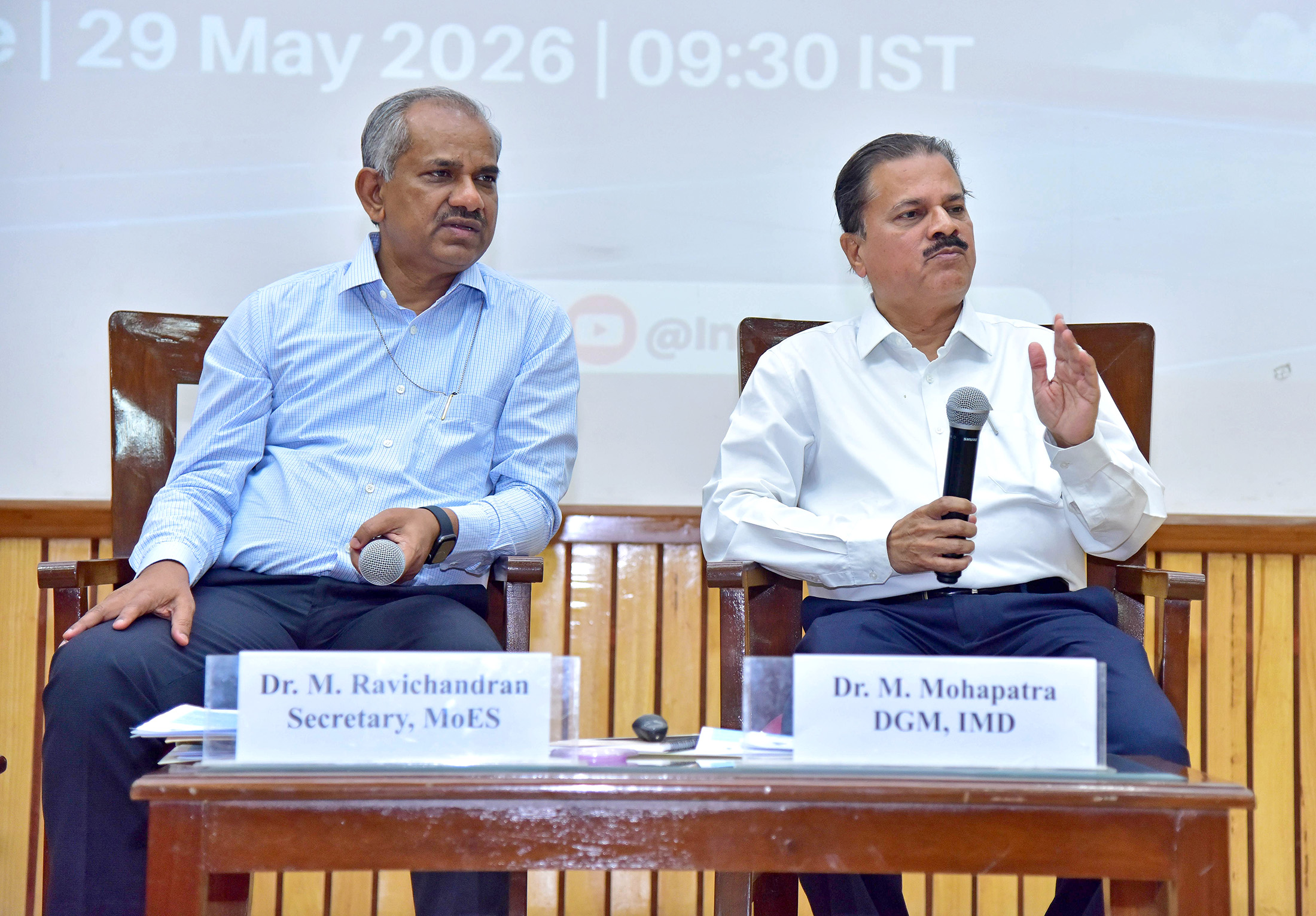
By Our Correspondent
NEW DELHI:Since 2021, the India Meteorological Department (IMD) has been using a new strategy for issuing operational long range forecasts on a monthly and seasonal scales for rainfall and temperatures across the country. For this, a newly developed Multi-Model Ensemble (MME) forecasting system is used. The MME system utilizes simulations from the coupled global climate models (CGCMs) sourced from various global climate prediction and research centers, including IMD’s Monsoon Mission Climate Forecasting System (MMCFS) model.
On 13th April, 2026, the IMD has issued the first-stage forecast for the 2026 southwest monsoon seasonal (June to September) rainfall, consisting of quantitative and probabilistic forecasts for the country as a whole, and the spatial distribution of probabilistic forecasts for the tercile categories (above normal, normal, and below normal) of the seasonal (June-September) rainfall. As a part of the second stage forecasts, the IMD has prepared the following forecasts:
-
-
- Updated quantitative and probabilistic forecasts for the monsoon seasonal(June-September) rainfall over the country as a whole during 2026 and spatial distribution of the probabilistic forecasts for the seasonal rainfall over the country.
- Probabilistic forecasts for the seasonal rainfall over the four homogenous regions of India (northwest India, central India, south Peninsula, and northeast India) and the monsoon core zone (MCZ) consisting of most of the rainfed agriculture areas of the country.
- Probabilistic forecast for the rainfall over the country as a whole and spatial distribution of the probabilistic forecasts for the rainfall over the country during June, 2026.
-
-
-
- Spatial distribution of the probabilistic forecasts of Temperatures (Maximum and Minimum) and Outlook for Heatwaves over the country for the month of June 2026.
-
-
- Sea Surface Temperature (SST) over the equatorial Pacific & Indian Oceans
Currently, neutral El Nino-Southern Oscillation (ENSO) conditions are transitioning towards El Nino conditions over the equatorial Pacific region. The latest MMCFS as well as other climate model forecasts indicate that the El Nino conditions are likely to develop during the southwest monsoon season.
At present, neutral Indian Ocean Dipole (IOD) conditions are observed over the Indian Ocean. The latest MMCFS forecast indicates that neutral IOD conditions are likely to continue during the monsoon season.
-
- Second Stage Forecasts for the 2026 Southwest Monsoon Rainfall
3a. Updated Forecast for the Rainfall over the Country as a whole during Monsoon Season, 2026
Quantitatively, the monsoon seasonal(June-September) rainfall for the country as a whole during 2026 is likely to be 90% of the Long Period Average (LPA) with a model error of ± 4%.The LPA of the seasonal rainfall over the country as a whole based on data of 1971-2020 is 87 cm.
The five category probability forecasts for the Seasonal (June to September) rainfall over the country as a whole during 2026 are given below. It suggests 84% probability for below normal or less rainfall for the country as a whole.
It indicates that below-normal seasonal rainfall is most likely over most parts of the country, except some areas over Northwest & Northeast India, eastern parts of peninsular India and adjoining areas of east-central India and isolated pockets of East India, where normal to above normal rainfall is likely.There is no signal by the model over the white shaded areas within the land region of the country.
Below-normal rainfall may lead to challenges for agriculture, water availability, hydropower generation, and ecosystem sustainability, along with increased risks of drought, heat stress, and pressure on drinking water resources. To minimize these impacts, strategies can include efficient water resource management, promotion of water conservation practices, contingency planning for agriculture, strengthening drought monitoring and use of early warning services of IMD, and enhancing preparedness measures in sectors that are particularly vulnerable to rainfall deficits.
3c.Forecast for the Monsoon Rainfall over the four Homogenous regions of the country and Monsoon Core Zone (MCZ) during Monsoon Season, 2026.
The average rainfall for the country as a whole during June, 2026 is most likely to be below normal (<92% of the Long Period Average (LPA)).The LPA of the rainfall over the country as a whole during June 2026 based on the data of 1971-2020 is165.4cm.
The spatial distribution of probabilistic forecasts for tercile categories (above normal, normal, and below normal) for rainfall during June, 2026 is displayed in Fig.3. Below normal monthly rainfall is very likely over most parts of the country, except over some parts of Northwest and Northeast India, and many parts of south Peninsula and isolated areas of central India where normal to above normal rainfall is likely. There is no signal indicated by the model over the white shaded areas within the land region of the country.
-
- Probabilistic Forecast for the Temperatures over the Country during June, 2026 Figures 4a and 4b display the forecasted probabilities of maximum and minimum temperatures, respectively, during June 2026.
In June 2026, above normal monthly maximum temperatures are likely over most parts of the country, except some parts of the Central, Northwest and East India, where normal to below normal maximum temperatures are very likely (Fig. 4a).
During June 2026, above-normal monthly minimum temperatures are likely across most parts of the country, except some parts of Northwest, Central and adjoining south Peninsular India where normal to below-normal minimum temperatures are very likely(Fig. 4b).
-
- Heat Wave outlook for the Month of June 2026
The anomaly (deviation from the normal) forecast for the number of heatwave days in the country for June 2026 is shown in Fig. 5. During June 2026, above normal heat wave days are expected over many parts of Uttar Pradesh, Haryana, Punjab, Bihar, Odisha, Chhattisgarh, Gujarat and Andhra Pradesh and isolated regions of Maharashtra, Telangana, Himachal Pradesh, and Tamil Nadu. However, below-normal heat wave days are likely over Rajasthan and Jharkhand.
The increased likelihood of heatwave conditions during the June 2026 may have considerable impacts on public health, water availability, power consumption, and essential services. Vulnerable groups, including the elderly, children, outdoor workers, and persons with pre-existing health conditions, are particularly at risk from prolonged exposure to extreme heat. Persistent high temperatures may also place additional stress on infrastructure and resource management systems.In view of the anticipated conditions, State Governments and district administrations are advised to undertake necessary preparedness measures, including ensuring the operational readiness of cooling shelters, availability of safe drinking water, and enhanced health surveillance and emergency response mechanisms.The India Meteorological Department
regularly issues weekly and extended-range forecasts, along with Early Warnings and Impact-Based Forecasts (IBF), indicating the probable intensity and spatial distribution of heatwave conditions to facilitate timely preparedness and response planning. The public is advised to stay informed about official forecasts and warnings, and to follow precautionary measures such as maintaining adequate hydration, minimising exposure during the peak afternoon hours, and taking special care of vulnerable individuals throughout the heatwave season.
-
- Extended Range Forecast and short to medium range forecasting services
IMD also regularly prepares and provides extended range forecasts (7–day averaged forecasts for the next four weeks) for rainfall, maximum temperatures, and minimum temperatures over the country. These forecasts are updated every week on Thursday. These forecasts are based on the Multi-model Ensemble Dynamical Extended Range Forecasting System, which is currently operational at IMD.