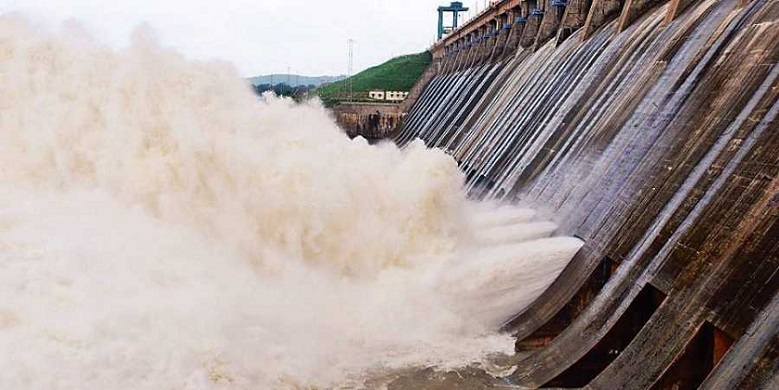
Have you noticed one thing?? After one rain, it has been decided to open the gates of Hirakud and release water. This means how weak the water storage capacity of Hirakud reservoir is ?
BHUBANESWAR:Have you noticed one thing?? After one rain, it has been decided to open the gates of Hirakud and release water. This means how weak the water storage capacity of Hirakud #hirakudreservoir is. Why are we fighting with other states for not releasing water? When there is water, there is no capacity to store it, there is no attempt to conserve it and use it for various purposes. If news of building a barrage comes out somewhere, various NGOs, environmentalists will come out and protest. What will be the progress of Odisha in this. Whatever irrigation system was built during the British era, Odisha has survived by adding this Hirakud dam and washing it dry. Hirakud has already been buried in it. We need to think about it.
Sambalpur: The largest Hirakud Dam.
And Odisha’s most important water infrastructure for irrigation, power generation, and flood control is facing a major challenge due to siltation.
According to the report, the reservoir’s water storage capacity has been significantly reduced as sediment is accumulating much faster than expected. According to the information, the storage capacity has been reduced by about 27 percent, raising concerns about its power generation and flood control capabilities.
Speaking to ETV Bharat, retired Chief Engineer of the Water Resources Department, Yashwant Parida explained, “Sedimentation is a natural process and a result of blocking the course of the Mahanadi and storing its water in reservoirs.”
This phenomenon is observed in all reservoirs. The process is no different in the Hirakud Dam. However, the rate of sedimentation has been higher than expected. Initially, it was estimated that 2.5 hectares of sediment would be deposited per 100 square kilometers annually. But by 2000, it was found that sedimentation had increased to 5 hectares per 100 square kilometers, which is twice the previous estimate. Although this will not cause any damage to the river embankment, the storage capacity will definitely be affected.
He pointed out that the water storage capacity of the Hirakud reservoir has decreased by about 27 percent.
The maximum water storage capacity of the Hirakud reservoir is 630 feet, and when the water level drops below 590 feet, it enters the dead storage zone. “The dead storage zone is the water below the minimum discharge level while the live storage is the water available for use between the minimum level and the full reservoir level. Currently, about 50 percent of the dead storage zone of the dam is filled with silt,” Parida explained, adding that this accumulation will not affect the quality of the water.
The desalination process is a difficult task.
The Hirakud Dam is spread over an area of 743 sq km, and removing sediment from such a large area is not only difficult, but considered almost impossible. Sediment storage is equally challenging. In addition, large tree trunks submerged in the reservoir have complicated the process of using dredging equipment. Official reports show that dredging was carried out between 2008 and 2010 at the mouth of the Administrative Canal because it was not receiving sufficient water supply. However, dredging the entire reservoir is not practical, another official was quoted as saying.
Mahanadi River Basin Authority Chief Engineer Sushil Kumar Behera also admitted that the water storage capacity has been reduced due to sedimentation. “The reservoir of the reservoir is spread over an area of about 83,400 sq km. The sedimentation is natural and evident. The age of the dam is about 68 years and two surveys have been conducted, one in 1957 and the other in 2000. In the second survey, it was found that the overall water capacity has reduced by 27 per cent and the usable water storage has reduced by 17 per cent,” he said.
Although sedimentation will not affect the structure of the dam, Behera notes that the reduction in water-holding capacity could affect irrigation, power generation, and industrial water supply.
The official said that necessary steps are pending to mitigate the problem. “An expert gave a demonstration on the sludge removal technique. The proposal is currently under review, and may be implemented soon,” the chief engineer noted.