








By Our Correspondent
BHUBANESWAR:A stone inscription dating back approximately 1,000 years has been recovered from Boribandha village near Kuladagarh in Bhanjanagar Block of Ganjam district. The inscribed stone slab was found in a neglected condition within the premises of the ancient Suvarnakesari Temple at Boribandha.
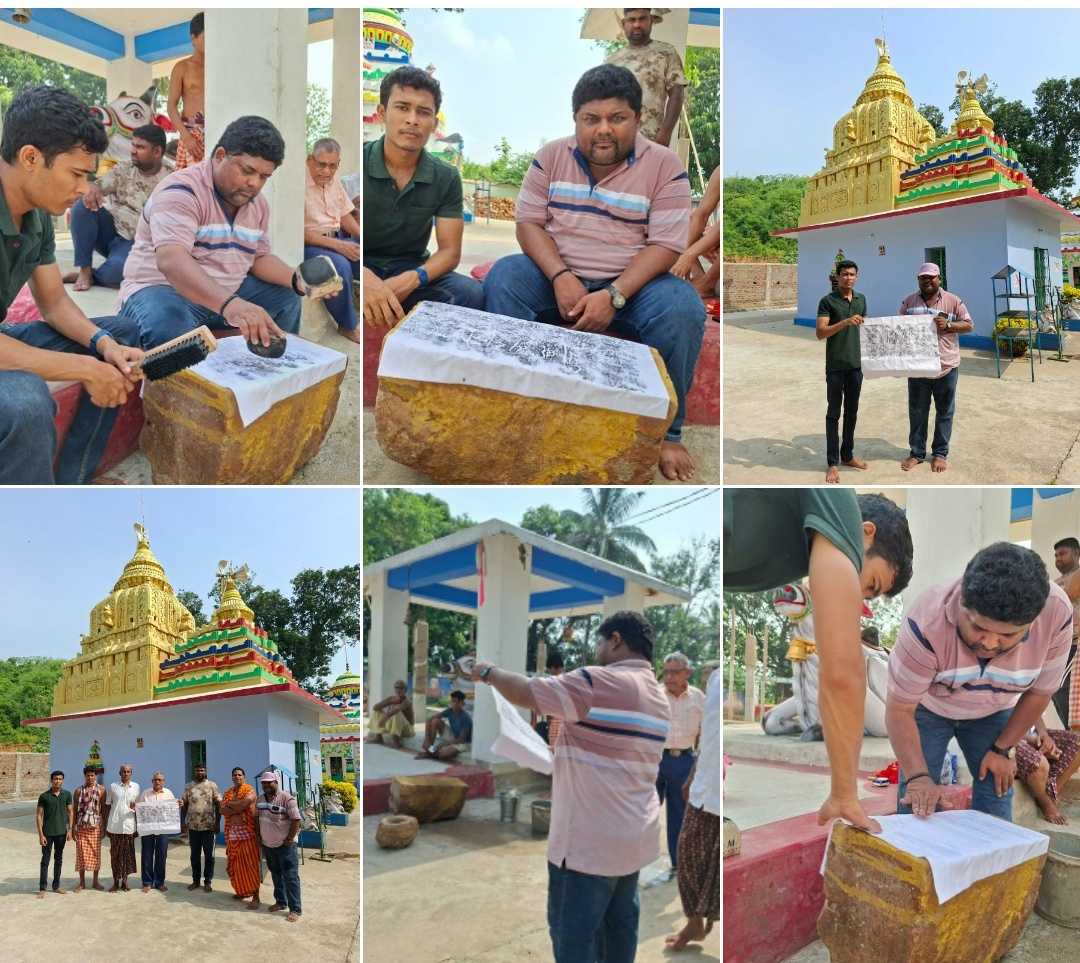
The inscription-bearing stone was first noticed by local heritage enthusiast Mr. Bimal Gauda, who informed Mr. Soumya Ranjan Panda, a member of Rediscover Lost Heritage Trust (RLHT). Following the information, members of the Trust visited the village and carefully extracted the inscription stone from a layer of cement plaster that had covered it. An estampage (ink impression) of the inscription was subsequently collected for study and documentation.
With the assistance of local villagers, the inscription stone has now been safely relocated and preserved inside the temple premises. Members of RLHT, including Mr. Suman Prakash Swain, Mr. Nrupati Nihar Siala, and Mr. Deepak Kumar Nayak, participated in the archaeological exploration. Researchers of the Trust have since completed a preliminary reading and study of the inscription.
Providing further details, RLHT founding member and heritage researcher Mr. Deepak Kumar Nayak stated that Boribandha village lies in close proximity to Kuladagada, the ancient capital of the Bhanja rulers. The Ghumusar region, historically known as Khinjalimandala, was ruled by the Bhanja dynasty from approximately the 9th/10th century CE until the 19th century. The dynasty is renowned for producing Odisha’s celebrated poet Kabisamrat Upendra Bhanja. Numerous copper-plate grants issued by the Khinjali Bhanja rulers have previously been discovered from Bhanjanagar and surrounding areas.
According to Mr. Nayak, the newly recovered inscription from the Suvarnakesari Temple, although brief, possesses considerable historical significance. The inscription is engraved in Sanskrit language using the Eastern Nagari script and consists of two lines. Based on palaeographic analysis, it is tentatively dated to the 10th century CE. The script exhibits several similarities with the writing found in the Pettasar Copper Plate Grant issued by the Bhanja king Netabhanja Kalyanakalasa during the 10th century.
The inscription has been read as follows:
Line 1: Śrī-Svasti-Ghasalīṇa
Line 2: Magadhaka(ra?)(pra?)(_)
Although the last three characters of the inscription have suffered damage and remain partially illegible, the deciphered portion suggests that an individual bearing the name ‘Magadhakara’ possibly associated with a locality named “Ghasalīṇa,” may have been a devotee of the deity worshipped at the temple. The exact identification of the place-name “Ghasalīṇa” remains uncertain and requires further investigation.
Mr. Nayak further noted that based on paleographical ground the script of the inscription itself serves as important evidence for the antiquity of the temple site and contributes valuable information to the early history of the region.
Trustees of the Suvarnakesari Mahadeva Temple, Mr. Niranjan Gauda and Mr. Yudhishthira Pradhan, have assured that the inscription will be preserved for future generations. They stated that during earlier renovation works, the stone had inadvertently been covered with cement plaster outside the temple due to a lack of awareness regarding its historical importance. Following its decipherment and identification as a significant archaeological relic, the temple authorities have resolved to safeguard all ancient remains associated with the shrine in the future.