




By Our Correspondent
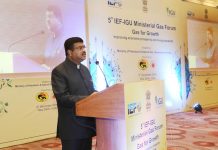
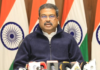
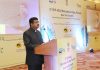
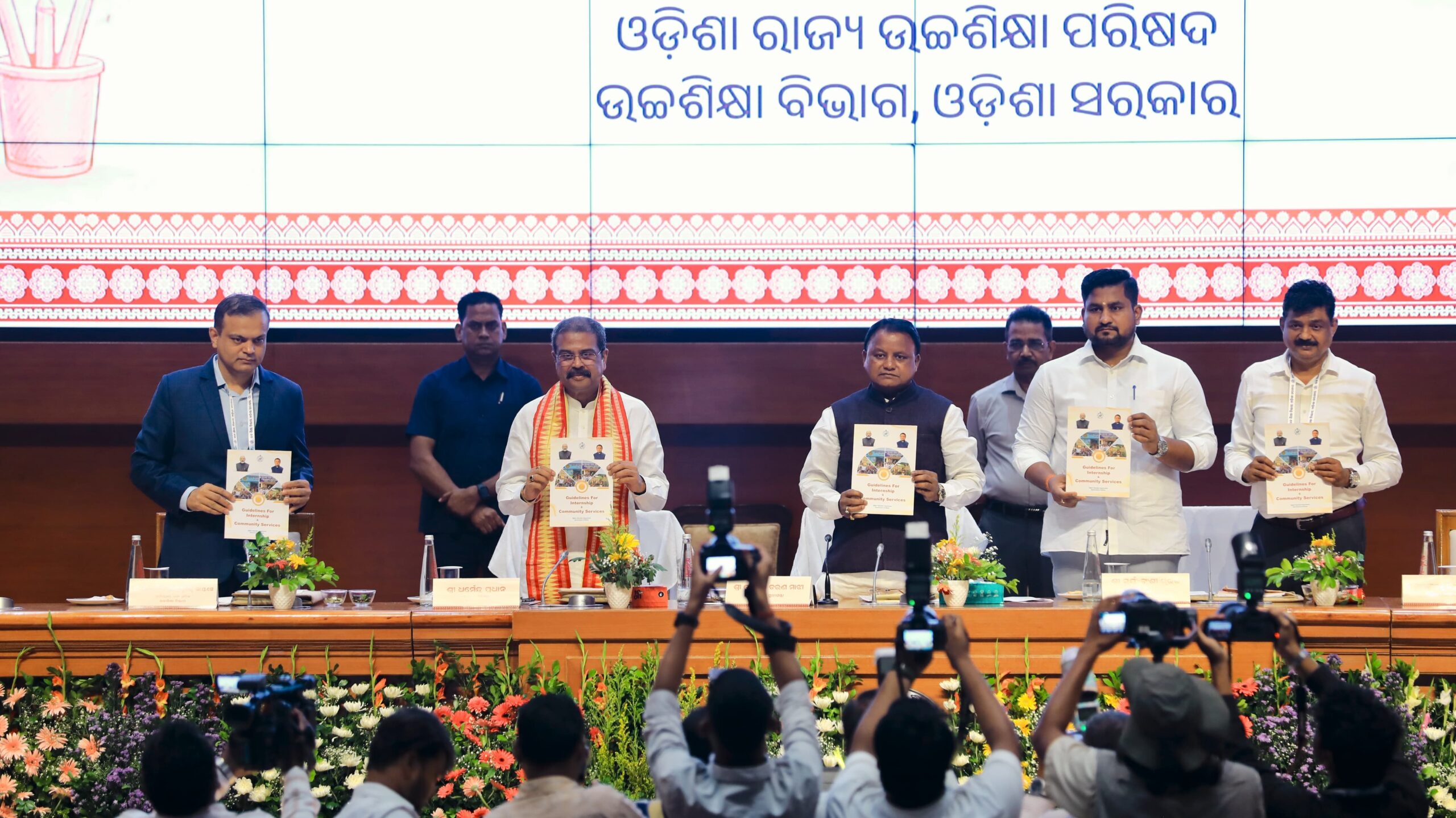
BHUBANESWAR:Educational institutions in Odisha should not be limited to traditional teaching only but should create a model for the entire country through autonomy, innovation and research. Based on the National Education Policy, universities should start such ‘best practices’ that will solve local problems and help in building ‘Developed Odisha’ and ‘Developed India’. Union Education Minister Shri Dharmendra Pradhan said this while participating in the inauguration ceremony of a two-day workshop ‘Pragya Prerna’ on the effectiveness and implementation of the National Education Policy-2020 in Bhubaneswar on Saturday.
The event, organized by the Higher Education Department of the Government of Odisha, was attended by Odisha Chief Minister Shri Mohan Charan Majhi, Higher Education Minister Shri Suryavanshi Suraj and Vice Chancellors of various universities, educationists and professors. In his speech on the occasion, Shri Pradhan described Odisha as a ‘Land of Knowledge’ and said that since time immemorial, Odisha has been showing the way to the whole world. The Kalinga War was not just a bloody struggle, but it was a message of victory and peace for humanity. Odisha was the birthplace of Indian culture that spread from Sri Lanka to South-East Asia. Odisha’s maritime trade, agriculture, temple art, literature, and culture – the root cause of all this was education at that time. Odisha was a region that loved education and was driven by education from the very beginning. Timeless works like the Mahabharata, Chandi Purana and the Ramayana are a shining proof of this.
Men of letters like Pathani Samanta, poet emperor Upendra Bhanja, Fakir Mohan Sahabi and Swabhav poet Gangadhar Meher are symbols of the intellectual excellence of the Odia nation and civilization. Guru Padmasambhava, the founder of the main branch of Buddhism ‘Vajrayana’, was born in Odisha and it was from this land that Vajrayana originated and spread to Tibet and Arunachal including the Himalayas. Therefore, our curriculum should be prepared based on Odisha’s own needs, 450 km of coastline and mineral resources. Universities should not only focus on ‘building’, but also on ‘building ideas’ or advanced thinking.
Shri Pradhan further said that it is very important to make the students aware of the glory of our land by including local history, village temples and the heroic stories of unknown heroes of Odisha in our education system. We should make efforts to emphasize the philosophy and scientific knowledge of great personalities like Sant Kavi Bhim Bhoi, Gopabandhu Das and Pathani Samanta in the curriculum and to make Pathani Samanta’s astrophysics and astronomy knowledge available at the national level. A new curriculum should be prepared based on the glorious facts of Odisha like the story of Koraput’s rice cultivation and the ancient ‘rock art’ of Sambalpur Bhim Sangam.
As India is preparing to lead the world as a ‘knowledge-based society’, about 47% of Odisha’s 4.5 crore population is between the ages of 24 and 29, which is the biggest asset and potential for the development of the state. If we consider the working age of the society (44-45 years), then about 70% of the people of Odisha are in this age bracket, which further increases our responsibility in the field of education. In order to emphasize skills rather than degrees, the National Education Policy has made provisions like ‘Academic Bank of Credit’ and ‘Apar ID’ to meet the needs of the 21st century.
To increase the enrolment rate in higher education in Odisha, we need to take the help of modern technology and digital media. Through channels like Swayam and Swayam Prabha and AI content available in Odia language, we can reach out to the students living in remote areas and bring them into the mainstream of education. Along with this, foreign language education and time-efficient courses should be developed with an emphasis on internationalization, so that the youth of Odisha can become empowered and competent to compete globally.
Under the leadership of Hon’ble Prime Minister Narendra Modi, the main goal of our education policy should be to free ourselves from the mentality of subordination by giving priority to our mother tongue Odia and to spread knowledge based on Indian languages, which will increase respect for our language and tradition. Taking inspiration from Shri Jagannath culture, we have to imbibe the principles of global responsibility and nationalism along with Odia pride in the education system.
In 2036, 100 years of the formation of a separate province on the basis of the Odisha language will be celebrated, and by 2047, India will celebrate the centenary of independence. To achieve the goals of ‘Developed Odisha’ and ‘Developed India’, educational institutions will have to work with determination from now on. Above all, it is our collective responsibility to create a creative culture by creating sports, arts, skill-based education and a service attitude on campus and to secure the future of one and a half crore youth of Odisha. Shri Pradhan said that today’s workshop will act as a guide towards achieving this goal.
On this occasion, the ‘Internship and Community Service Guidelines’ booklet was launched to enhance the practical knowledge of the students, and the ‘Shaktishri’ mobile app was also launched for the protection and empowerment of young girls and women.