




By Our Correspondent
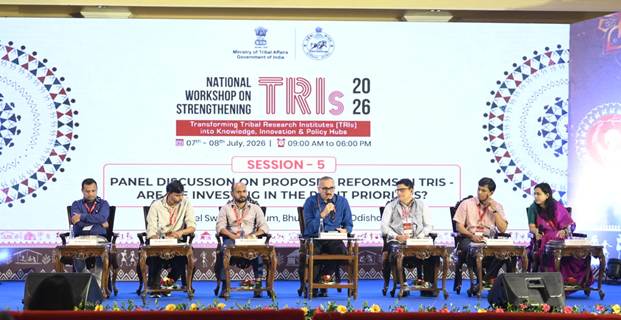
BHUBANESWAR:We, all the representatives of Tribal Research Institutes, and State Tribal Welfare Departments together with representatives of academia, research organizations, technology institutions, non-governmental organizations, international development agencies and private sector partners, assembled at Bhubaneshwar, Odisha, on 7–8 July 2026 for the National Workshop on Strengthening Tribal Research Institutes.
Recognizing the pivotal role of Tribal Research Institutes (TRIs) as principal knowledge and think-tank institutions of the States for tribal development, as essential contributors to the vision of Viksit Bharat, and custodians of tribal cultural heritage and
Having deliberated over two days on strategies to strengthen TRI research ecosystems, institutional capacities, and technology adoption through plenary sessions, expert discussions, and thematic working groups.
Do hereby adopt this Declaration and resolve as follows:
- Develop TRIs as Centres of Excellence to lead specialised research, thematic projects, and high-level knowledge dissemination, while reintroducing Nodal TRI systems to facilitate mentorship and capacity building by established TRIs for newer institutes.
- Mandate community-level need analysis to ensure TRI research and interventions are directly informed by ground-level requirements and establish a TRI Innovation Network to pilot and scale successful local solutions.
- Implement a Result and Ranking Framework for all TRIs via the NTRP portal to foster performance-based growth, accountability, and healthy inter-state competition.
- Develop a Research Dissemination and Utilisation Strategy to translate complex research findings into accessible dashboards, policy briefs, and learning resources for wider policy and public use.
- Finalize the Model TRI Framework 2030, defining essential functions, institutional features, and technology platforms, and encourage each State to benchmark its TRI against this framework with a time-bound institutional improvement plan.
- Formulate a National TRI Research Agenda (2027–2032) to identify and prioritize high-impact thematic areas for tribal research aligned with national development goals and policy requirements, while institutionalizing a Research Standards Framework to ensure high-quality outputs within an outcome-output framework through mandatory peer review, ethics, and data management standards
- Document and preserve tribal indigenous knowledge and art forms, including languages, traditions, music, musical instruments, tribal cuisine, and vanishing arts, through systematic documentation and the active involvement of tribal youth.
- Adopt measures to attract, retain, and continuously build the capacities of specialized researchers, domain experts, and technical professionals within TRIs to ensure institutional excellence.
- Strengthen entrepreneurship, skilling, and livelihoods by institutionalising partnerships with universities, academic institutions, NGOs, technology organisations, and industry to create durable mechanisms for joint initiatives and peer learning.
- Adopt a Shared-Service Model for advanced technology infrastructure, including AI, analytics platforms, and Innovation/Tech Hubs, to avoid duplication of costs and establish a robust central repository for tribal data.
We commit to carrying forward the spirit of this workshop in our respective institutions and jurisdictions, and to working in collaboration with fellow TRIs, academic and research institutions, and civil society organisations to realise the vision of Tribal Research Institutes as vibrant think tanks, cultural custodians and policy-oriented knowledge hubs for tribal development in India.
Adopted at Bhubaneshwar, Odisha, on this 8th day of July 2026.
[This Declaration reflects the collective deliberations of the plenary sessions, the four thematic breakout working groups, and the expert panel discussions held during the Workshop, for onward consideration and formal adoption by the Ministry of Tribal Affairs.]
TRIs are the voices of tribal communities, translating ground-level needs into national policy and ensuring the preservation of indigenous tribal knowledge.