









By Our Correspondent
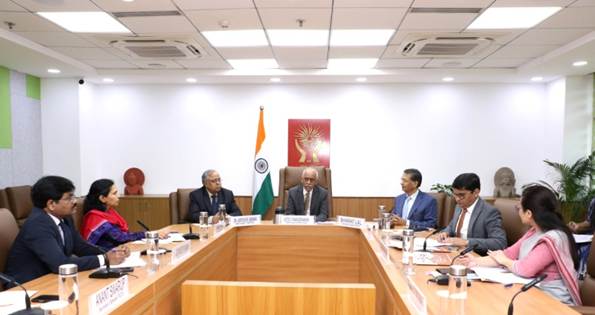
NEW DELHI: The National Human Rights Commission (NHRC), India organised a core group meeting on ‘Protecting Migrant Workers’ Rights: Shared Responsibility of Government and the Private Sector,’ in hybrid mode at its premises in New Delhi. Chairing the meeting, the Chairperson, NHRC, Justice V. Ramasubramanian said that compared to others, the migrant workers face greater challenges because most belong to the unorganised sector. Language barriers, mobility and lack of stable shelter prevent them from protecting their rights in an organised manner.
He also recalled the strong tradition of trade unions for workers’ rights. NHRC Member, Justice (Dr.) Bidyut Ranjan Sarangi, Secretary General, Shri Bharat Lal, DG (Invstg.), Smt. Anupama Nilekar Chandra, Registrar (Law), Shri Joginder Singh, Joint Secretaries, Shri Samir Kumar and Smt. Saidingpuii Chhakchhuak, senior functionaries of Government of India, eminent domain experts and representatives of various UN bodies were present in the meeting.
Justice Ramasubramanian referred to laws such as the 1979 legislation recognising migrant workers and the Industrial Disputes Act provisions granting protection after 240 days of continuous work, while noting loopholes like employers giving breaks before eligibility periods. He highlighted the role of the NHRC, India and its core group in advising governments. He said that while India has strong labour laws, including migrant worker protections since 1979, implementation remains a concern. He said that the problems being faced by migrant workers are widely known and the Commission expects that multi-stakeholder discussions result in suggesting practical solutions as recommendations to the Union and state governments for implementation.
Justice Ramasubramanian emphasised the need to shift from a compliance-based approach to a rights-based culture for migrant workers. He also stressed systemic reforms such as interstate coordination, portable social protection and stronger implementation of labour laws. He said that the immediate focus should be on the migrant workers engaged in construction, hotel, business and domestic work. He suggested that linguistic identity-based association members should be taken on board the coordination councils to improve the ecosystem for migrant labourers.
NHRC, India Member, Justice (Dr.) Bidyut Ranjan Sarangi said that migrant workers are neither given due regard nor wages. He said that non-payment of remuneration on time defeats their purpose of leaving their homes. They need to be provided sufficient wages, housing, health and educational facilities for their children to survive with dignity. He also said that a database on the family members accompanying them should also be created to ensure that they also get all the due benefits.
Before this, NHRC, India Secretary General, Shri Bharat Lal, referring to a report on migration, said that migrants worldwide are driving the economy at all levels. He noted that nearly 28.9% of India’s population consists of migrant workers moving between rural and urban areas, playing a vital role in every sector of the economy. Recalling the severe hardships faced during the COVID-19 crisis, he expressed concern over the exploitation of outsourced workers, many of whom reportedly do not receive even minimum wages, with contractors allegedly deducting large sums through payment apps. He stressed the need for greater social sensitivity toward migrants.
Emphasising the importance of targeted investments and welfare measures for workers, he said that these result in an increase in their efficiency. In this context, he cited a study by the Indian Institute of Management Ahmedabad on migrants. The welfare measures led to an increase in factory workers’ efficiency, which rose by 1.38 times and improved family welfare, education and future prospects for their children. He observed that perceived discrimination and injustice can sometimes lead to violence. Emphasising that ensuring fair wages and social security is a collective responsibility, supported by new labour codes and digital governance systems, he highlighted NHRC, India’s initiatives during COVID-19. While appreciating initiatives like One Nation One Ration Card, he emphasised the need to bridge the gap between laws and implementation. He also called for stronger interstate coordination, portable social protection, worker upskilling and a shift from compliance-based practices to a rights-based approach.
NHRC, India Joint Secretary, Shri Samir Kumar gave the overview of the three technical sessions, including ‘Legal and Institutional Framework: Gaps in Protection and Implementation’, ‘Role of Businesses in Protecting the Rights of Migrant Workers in India’ and ‘Identifying Practical Measures for Strengthening the Protection and Welfare of Migrant Workers in India: Multi-stakeholder Approach.’ He emphasised that migrant workers are very important to the economy, infrastructure, logistics, domestic work and daily life. In this context, he recalled how labour protests in NOIDA, Uttar Pradesh evolved. He also referred to migrant workers returning home during the recent state elections, which created labour shortages that affected cities and public systems.
Shri Vimal Bhattar, Deputy General Manager, Securities and Exchange Board of India (SEBI) explained how the Business Responsibility and Sustainability Report (BRSR), under ESG reporting, discloses a listed company’s environmental, social and governance (ESG) performance, capturing labour welfare data, including migrant and contract workers. However, he noted that most migrants fall outside regulation due to their presence in MSMEs and the unorganised sector. Smt. Anuja Bapat, Policy Division, Deputy Director General, Ministry of Micro, Small and Medium Enterprises emphasised that migrant workers should be seen within a broader family and ecosystem context and said that MSME schemes like PM Vishwakarma, PMEGP and Udyam Registration can reduce distress migration by creating local livelihoods.
Shri Deepangkar Guha, Director, Ministry of Labour and Employment said that the e-Shram portal is a strong foundation, but its real value depends on better integration and use of its data across government schemes for welfare of migrant workers. Shri K. C. Meena, Joint Director (CSR), Ministry of Corporate Affairs referred to compliance frameworks and reporting structures, highlighting that certain reporting obligations for listed companies are voluntary or evolving and statutory requirements vary.
Shri Tom Thomas, CEO, Praxis Institute for Participatory Practices emphasised the need for better data systems, especially linking and strengthening platforms like the e-Shram portal, to track migrant workers for social protection coverage. He also focused on improving data flow between databases so that even partial coverage could significantly improve policy targeting and welfare delivery.
Dr. Kishlay, Research Associate, Centre for Migration, Mobility and Diaspora Studies, Indian Council of World Affairs focused on construction workers and highlighted subcontracting issues, lack of documentation, exclusion from welfare schemes and the need for affordable housing and fair floor wages. Shri Sanjay Awasthi, Head of Office, International Organization for Migration (IOM) urged compliance with UN Guiding Principles on Business and Human Rights, ethical recruitment, zero recruitment fees, accountability across subcontracting chains and stronger grievance redress systems and data systems.
Ms. Nusrat, Business and Human Rights Specialist, Representative, United Nations Development Programme (UNDP India) called for clearer and more sector-specific articulation of corporate responsibility toward migrant workers, suggesting an updated National Guidelines on Responsible Business Conduct and stronger policy coherence on business and human rights. Shri Insaf Nizam, Specialist on Fundamental Principles and Rights of Migrants, International Labour Organization (ILO) emphasised a rights-based approach for all workers and not only migrants, stressing the need to address structural and institutional barriers and to uphold labour laws while improving governance and enforcement systems. Shri Namit Agarwal, Asia Policy Lead, World Benchmarking Alliance, highlighted the need to arbitrage the wage structure for the migrant workers.
Shri Pradeep Narayanan, Director, Partners in Change, noted India’s leadership in ESG disclosures and proposed linking ESG ratings to migrant worker welfare. Dr. Jatinder Singh, Deputy Secretary General, PHD Chamber of Commerce and Industry proposed integrating e-Shram with Aadhaar, EPF, ESIC and state schemes, QR-based migrant IDs and a national migrant labour dashboard. He also suggested multilingual grievance systems, contractor compliance declarations, pre-departure training and migrant-specific disclosures in the BRSR reporting. Shri S. Giridhaya Rajan, Founder Chair, International Institute of Migration and Development called for real-time migration data, sector-specific interventions and recognition of migrants as permanent contributors, not guests. He highlighted poor living conditions, wage theft, lack of overtime, language barriers in services, digital payments, interstate coordination and climate vulnerability. Shri Santosh Poonia, Director (Knowledge and Learning), Aajeevika Bureau raised the issue of migrant workers’ access to healthcare and the need to move away from a one-size-fits-all approach.
The other speakers included Shri Anant Swarup, Secretary General, FICCI; Shri Sunil Misra, Principal Advisor, Confederation of Indian Industry; Dr. Rajesh Kumar Dangeti, Chief General Manager, SEBI; Prof. Vasanthi Srinivas, IIMB; Dr. Vidya Tikoo, Senior Vice President, Aditya Birla Management Corporation Pvt. Ltd; Ms. Catherine Laws, Labour Migration Specialist, DWT-South Asia; Ms. Pichamon Yeophantong, Asia-Pacific Member, UN Working Group on Business and Human Rights; Shri Kailash Bhandari, Joint Director, Department of Public Enterprises; Shri S. Irudaya Rajan, Founder Chair, IIMAD; NHRC Special Monitor, Shri D. S. Dhapola; Special Rapporteur, Smt. Shomita Biswas, among others.
Some of the suggestions that emanated from the discussion are as follows:
- Need for a coordination council to address the issue of the migrant labourers;
- Focus on sector-wise associations and member networks organised around shared linguistic identities so that migrant workers can approach them more easily for support and communication;
- National migrant workers’ dashboard to track their movement district-wise;
- Linking and harmonising databases across government systems, not just e-Shram alone, to create an integrated migrant worker information ecosystem for real-time governance;
- Making value-chain/ supply-chain disclosure standards broader and more uniform so that migrant labour data becomes part of ESG/ BRSR-style reporting even beyond top-listed companies;
- Introducing sector-specific corporate responsibility guidelines, especially for high-migrant-intensity sectors like textiles, gig work and construction, rather than relying on generic business responsibility frameworks;
- Creating a formal national-level advisory or consultation mechanism for migrant workers themselves, ensuring they are directly represented in policy formulation;
- Improving institutional coordination between departments at an operational level, reducing delays caused by multi-layered bureaucratic approvals in addressing worker grievances;
- Updating migration data systems at district and real-time levels, since existing national data was described as outdated and insufficient for crisis response;
- Standardising certification processes for migrant workers in welfare schemes, especially in construction, hospitality and domestic work, so that they may access benefits like education support and insurance;
- Embedding migrant worker considerations into urban planning frameworks, not as an afterthought but as a core component of housing and infrastructure planning;
- Strengthening portability architecture beyond existing schemes, ensuring smoother cross-state access not only to rations but also to health, insurance and welfare entitlements;
- Developing clearer articulation of ‘corporate responsibility’ under business and human rights frameworks, especially to address informality and subcontracting ambiguity;
- Create ESG-linked incentives through rating systems so that companies that improve migrant worker welfare receive better ESG ratings, encouraging compliance through market mechanisms;
- Identify and regulate ‘invisible value chains,’ where no single company takes responsibility, by making sectoral ‘top companies’ jointly accountable for migrant worker conditions;
- Bring sectoral industry leaders into NHRC/ core group platforms to co-design practical, sector-specific migrant welfare solutions, not just policy discussions;
- Strengthen education on collective bargaining innovations, especially for workers outside traditional trade union structures;
- Integrate caste-specific vulnerability analysis into labour policy, including coordination with National Commissions for SC/ ST and historically migrant communities;
- Develop coordinated multi-commission policy responses involving human rights, caste and tribal commissions for historically mobile populations;
- Establish delivery-focused policy architecture, ensuring discussions translate into actionable mechanisms rather than remaining academic deliberations;
- Mandate contractor-level migrant welfare declarations, requiring suppliers to certify compliance on wages, safety, housing and recruitment conditions;
- Create actionable grievance systems with strict timelines, ensuring complaints are not only recorded but resolved within defined periods;
- Introduce structured pre-departure orientation programmes in high-migration districts, covering rights awareness, contracts, wages and legal protections;
- Include migrant-specific disclosure sections in ESG/ BRSR frameworks, covering registration status, wage audits, grievance resolution rates and housing/ safety compliance;
- Move towards “living wage” benchmarks instead of minimum wages, based on the actual urban cost of living rather than statutory floors;
- Develop migrant-sensitive urban planning frameworks, integrating long-term housing and service access for migrant populations;
- Promote digital wage payment systems linked to payroll records to reduce wage theft and improve transparency; and
- Strengthen interstate migration corridor coordination mechanisms, especially between high-outflow and high-inflow states.
The Commission will further deliberate on various suggestions to finalise its recommendations to the government.