




By Our Correspondent
BHUBANESWAR: The termination of the Bhubaneswar Metro Rail Project (announced April 4-5, 2026) has triggered immediate political criticism and some public disappointment, particularly in the Bhubaneswar-Cuttack region.
BJD (Naveen Patnaik-led) has been the most vocal, calling it a “betrayal” by the “double-engine government.” Patnaik and BJD leaders have repeatedly accused the BJP of scrapping a visionary project initiated under the previous regime, claiming it will set urban mobility back by a decade. Similar attacks came earlier in 2025 when tenders were first stalled, and they continue now. BJD has staged protests (e.g., in Cuttack) and framed it as anti-development politics.
Congress has also criticised the move, with spokespersons highlighting the Rs 273.51 crore already spent as a “waste” while questioning the government’s priorities.
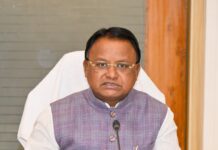
The Bhubaneswar Metro Rail Project (Phase-1) has been terminated by the Odisha government. On April 4, 2026, the Odisha Cabinet (chaired by Chief Minister Mohan Charan Majhi) approved the retrospective expenditure of Rs 273.51 crore incurred on the project until December 31, 2025, and formally terminated the agreement with the Delhi Metro Rail Corporation (DMRC), which was acting as the turnkey consultant.
An Inter-Ministerial Committee (IMC) review found that the project did not meet key requirements of the National Metro Rail Policy 2017. Traffic demand was below the required threshold, and projected ridership was too low, which would have led to substantial annual operating losses. The government is now shifting focus to a broader, more sustainable urban mobility framework instead of pursuing this standalone elevated metro in its current form.
The Bhubaneswar Metro Rail Corporation Ltd (BMRCL) — the state-owned company set up in August 2023 to implement the project — will be repurposed as the nodal agency for the Sustainable Urban Mobility Transition Plan for Odisha. It may also act as a Special Purpose Vehicle (SPV) for future mobility projects. The government will use technical assistance from the Asian Development Bank (ADB) to prepare a Comprehensive Mobility Plan (CMP) for the Bhubaneswar-Cuttack-Puri-Paradeep Economic Region, emphasising Transit-Oriented Development (TOD) and multi-modal integration.
What was originally planned
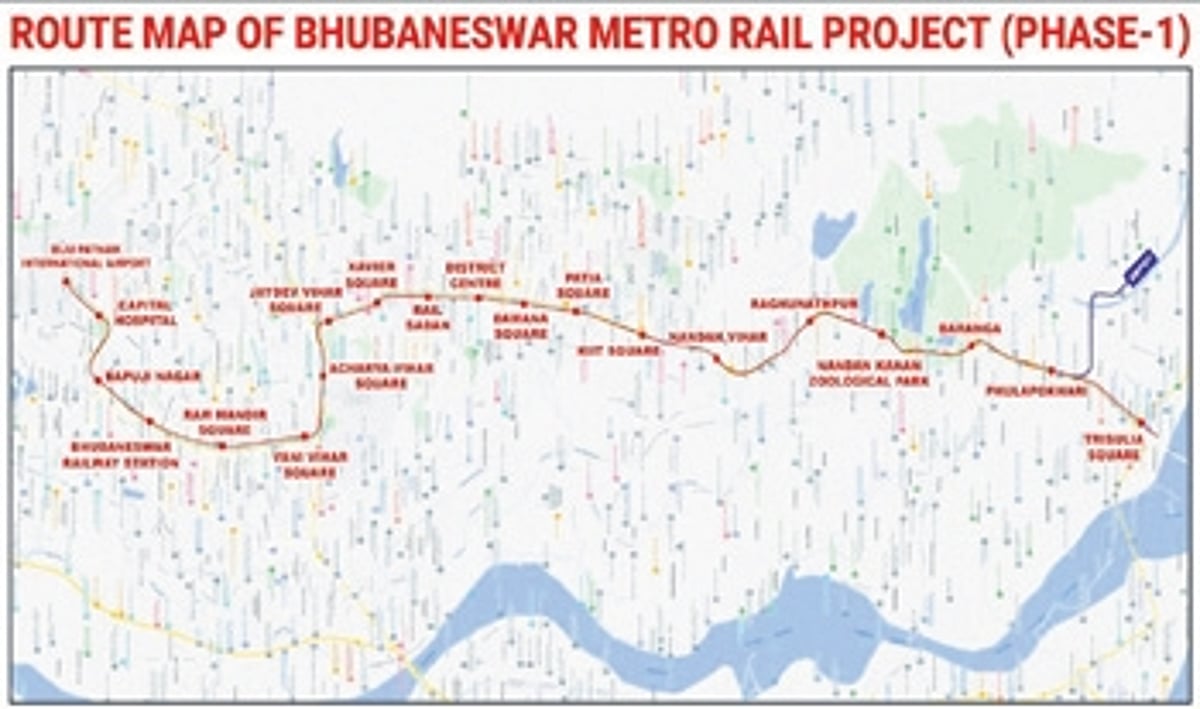
Route: 26 km fully elevated corridor from Biju Patnaik International Airport (BPI Airport) to Trisulia Square (near Cuttack).
Stations: 20 elevated stations.
Key stations (in sequence): BPI Airport → Capital Hospital → Bapuji Nagar → Bhubaneswar Railway Station → Ram Mandir Square → Vani Vihar → Acharya Vihar → Jaydev Vihar Square → Xavier Square → Rail Sadan → District Centre → Damana Square → Patia Square → KIIT Square → Nandan Vihar → Raghunathpur → Nandankanan Zoological Park → Barang → Phulapokhari → Trisulia Square.
Cost: Rs 6,255.94 crore (fully funded by the Government of Odisha).
The project was intended to ease traffic congestion in the capital region, connect major institutions, hospitals, commercial areas, and transport hubs, and position Bhubaneswar among cities with modern metro systems. No further construction or tenders are proceeding under the original plan. The government’s focus has shifted to a more comprehensive, integrated, and financially sustainable urban transport strategy for the region.