





By Our Correspondent
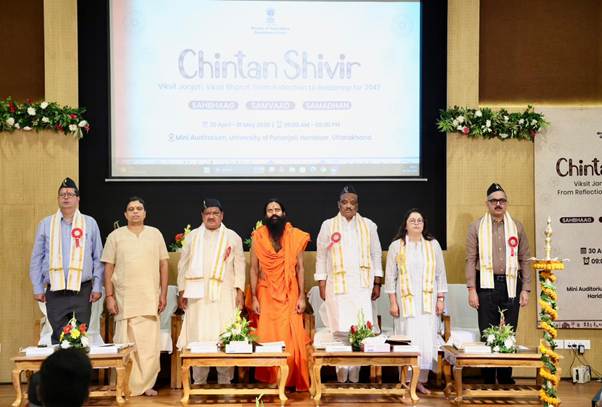
NEW DELHI/BHUBANESWAR:Union Minister for Tribal Affairs Shri Jual Oram has emphasised strengthening last-mile delivery of schemes and deepening convergence across government systems to ensure impactful outcomes for tribal communities, at the two-day Chintan Shivir 2026 organised by the Ministry of Tribal Affairs at the University of Patanjali, Haridwar.
Shri Oram underscored that effective governance requires a seamless blend of institutional experience and emerging domain expertise, noting that collaboration between senior and young officers can significantly enhance policy implementation. Reaffirming the Government’s commitment, he stated that empowering tribal communities remains a central priority, driven by innovation, coordination, and accountability.
Yoga Guru Baba Ramdev, addressing the inaugural session, stressed the importance of resilience, discipline, and purposeful effort in governance, emphasising that policies must translate into tangible benefits at the grassroots level and reach the last mile effectively.
Minister of State for Tribal Affairs Shri Durgadas Uikey highlighted the rich cultural legacy and civilisational contributions of tribal communities, underlining the need to integrate traditional knowledge systems into contemporary development frameworks.
Secretary, Ministry of Tribal Affairs, Smt. Ranjana Chopra emphasised a whole-of-government approach, calling for stronger horizontal and vertical convergence, and underscored the importance of grounding policies in the lived realities of tribal communities.
Chintan Shivir 2026: Day 2 Focuses on Sustainable Tribal Livelihoods and Holistic Governance
The second day of the Chintan Shivir 2026 today ,began with a yoga session, highlighting the importance of clarity of thought, discipline, and holistic well-being in effective governance.
A session on “Tribal Economy and Sustainable Livelihoods” by designer Mr. Manish Tripathi emphasised the need to reposition tribal products in national and global markets. He highlighted initiatives such as TRIFED’s RISA brand that promote value addition, product diversification, branding, and improved market access for tribal artisans, ensuring fair remuneration and economic dignity.
Another session on “Meditation and Manifestation for Public Good” by Ms. Jai Madaan focused on the role of inner well-being in enhancing professional effectiveness. The session highlighted mindfulness, emotional balance, and stress management as essential for responsive governance.
A session on “Emotional Quotient and Leadership”, led by Mr. Atul K. Shah and his team, emphasised the importance of emotional intelligence in decision-making, teamwork, and institutional effectiveness. Discussions focused on self-awareness, empathy, communication, and conflict resolution in administrative roles.
A debriefing session provided an opportunity for participants to reflect on key learnings and identify practical strategies for policy implementation and field-level engagement.
The Shivir concluded with a visit to Patanjali Yogpeeth, offering exposure to integrated models of wellness and institutional development.
The Chintan Shivir served as a platform for dialogue and capacity building, reinforcing the Ministry’s commitment to strengthening last-mile delivery, promoting sustainable livelihoods, and enhancing governance practices in line with the vision of Viksit Bharat @2047.
Policy Deliberations and Key Focus Areas
The Chintan Shivir brought together policymakers, administrators, domain experts, and grassroots representatives to deliberate on strengthening tribal development and governance mechanisms.
Key thematic areas included:
- Improving education outcomes and reducing drop-out rates
- Promoting sustainable livelihoods while preserving traditional practices
- Strengthening Tribal Research Institutes as policy and knowledge hubs
- Enhancing communication strategies for better outreach and visibility
An experience-sharing session featuring tribal leaders recognised in Mann Ki Baat showcased impactful grassroots initiatives in language preservation, traditional arts, and community-led development.
Focus on Livelihoods, Leadership and Governance Capacity
The second day of the Shivir focused on capacity building and leadership development.
Sessions highlighted:
- Sustainable Tribal Economy: Emphasis on value addition, branding, and market linkages for tribal products, including initiatives supported by TRIFED
- Well-being in Governance: The importance of mindfulness, emotional balance, and stress management for effective public service
- Emotional Intelligence in Leadership: Strengthening empathy, communication, and collaborative decision-making in administrative systems
Participants also engaged in yoga and wellness sessions, reinforcing the role of holistic well-being in governance.
A debriefing session enabled officers to identify actionable strategies for improving programme delivery and field-level implementation. The Shivir concluded with a field visit to Patanjali Yogpeeth, offering exposure to integrated models of wellness and institutional development.
The Chintan Shivir 2026 emerged as a significant platform for reflection, dialogue, and capacity building, reaffirming the Ministry’s commitment to:
- Strengthening last-mile delivery of schemes
- Promoting sustainable and dignified tribal livelihoods
- Enhancing institutional responsiveness and leadership capacity
The deliberations reflect a forward-looking, inclusive, and action-oriented governance approach aligned with the vision of Viksit Bharat @2047, ensuring that tribal communities remain central to India’s development journey.