




By Our Correspondent
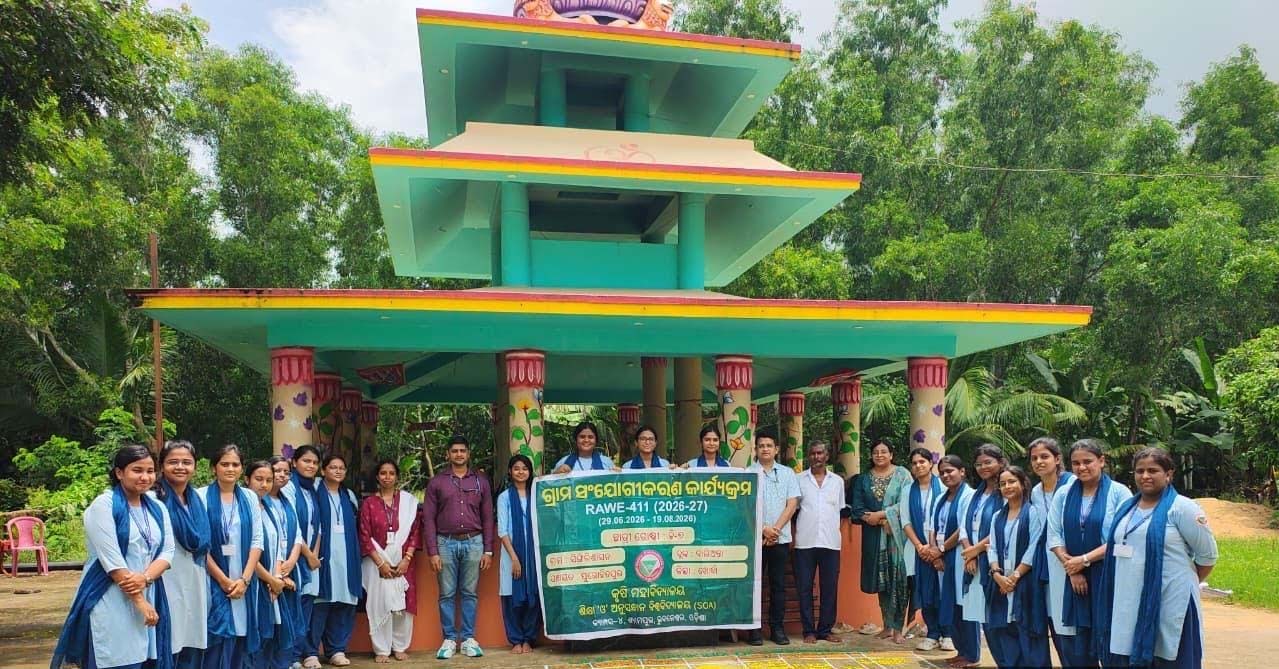
BHUBANESWAR:Reinforcing its commitment towards farmers’ empowerment, sustainable agriculture and experiential learning of students of agriculture, the Institute of Agricultural Sciences (IAS), faculty of agricultural sciences of SOA Deemed to be University here, has successfully completed the first phase of Farmers’ Training Program under the Rural Agricultural Work Experience (RAWE) 2026–27.
The week-long program, conducted as part of the Village Attachment Programme (VAP) between July 22 to 29, covered 11 villages under three blocks of Bhubaneswar, Jatni and Balianta in Khordha district. The villages covered included Jhintisasan, Panikata, Chhatabar, Purohitpur, Mendhasal, Budhipada, Barudakhana, Purana Padhan, Kujimahal, Bhola and Singirisasan.
A total of 16 need-based farmers’ training programs were organised focusing on practical, low-cost, climate-resilient and income-enhancing agricultural technologies. The training modules were carefully designed based on the farming systems and local needs of the villages enabling farmers to adopt scientific practices for improving productivity, reducing cultivation cost and promoting sustainable agriculture.
The program covered a wide range of contemporary agricultural technologies including Azolla cultivation for livestock feed and soil health improvement, Integrated Nutrient Management (INM) and Integrated Pest Management (IPM) in paddy cultivation, mushroom cultivation and value addition for generating supplementary income, preparation and use of neem-based botanical pesticides, seed treatment and banana sucker treatment for healthy crop establishment, preparation of organic inputs for eco-friendly farming, production and application of Neem Seed Kernel Extract (NSKE) and neem cake, compost preparation using compost enhancers.
Other agricultural practices such as beekeeping and honey extraction as profitable allied enterprises, Pro-Tray technology for raising quality vegetable seedlings, use of insect traps for eco-friendly pest management, vermi rearing, vermin composting and vermin wash production and integrated pest management in cucurbits and paddy were also explained to the farmers. All the programs included live demonstrations, hands-on practical sessions, interactive discussions and on-field problem-solving to facilitate immediate adoption by farmers.
The entire training program was coordinated by the RAWE Committee faculty members who worked closely with village communities to ensure its effective implementation. The enthusiastic participation of farmers including women, rural youth and RAWE students contributed significantly to the success of the program. Farmers actively interacted with faculty members and students, discussed field-level challenges and received scientific recommendations tailored to their local conditions.
Speaking about the RAWE program, Prof. Santosh Kumar Rout, Dean, IAS, said it served as an important bridge between agricultural education and rural development. It provided students with first-hand exposure to real farming situations, local resources, farmers’ challenges and rural livelihood systems thereby preparing them to become competent agricultural professionals, extension workers and change agents. He said that SOA’s faculty of Agricultural Sciences remained committed not only to impart quality agricultural education but also to impart scientific knowledge that improved farmer’s livelihood and promoted sustainable agricultural development.
Dr. Anshuman Jena, Chairman, RAWE Program, said all the Phase-I training programs were completed with remarkable success with the wholehearted support and active participation of village communities, farmers and students. He emphasized that IAS was dedicated to strengthening the farming community by disseminating location-specific technologies, promoting climate-smart and sustainable farming practices and enhancing farmers’ knowledge through continuous extension activities.
Dr. Jena further informed that Phase-II of the RAWE program would include a series of farmer need-based awareness campaigns, demonstrations and specialised training programs on emerging agricultural technologies, integrated farming systems, natural resource management, entrepreneurship and other locally relevant themes. These initiatives aimed to further enhance farmers’ knowledge, improve farm income, encourage sustainable agricultural practices and strengthen the university’s engagement with rural communities while providing agricultural students valuable grass root learning experience.