








By Rabinarayan Panda
BHADRAK: A student in school asked his teacher about the best path to success. “Which path will make a person successful the fastest?” Instead of answering, the teacher handed the student a small piece of paper. He instructed the student to list his faults and mistakes on it. He advised him not to write anyone else’s faults except his own anywhere in the writing.
The child could not understand the subject. How can one achieve success by writing his faults on paper? He looked at the teacher with a questioning look. The teacher tried to clear his doubts and said, “When you start seeing your faults, you will start to be purified. Just as gold returns to its original form and starts to shine when dirt is removed, similarly, when faults and weaknesses are removed from a person, he starts to shine. Success will start to depend on the feet of the person. When a person is busy removing his faults, he does not have time to see the faults of others. The desire to see the faults of others does not arise.” Truly, success depends on self-improvement. This is the simplest and most reliable path in the world. Many people have followed this path and achieved success. It is also a much-tested path.
When a person changes himself, the environment and circumstances around him start changing. Gandhiji was a strong advocate of this path. He gave more importance to building a blameless person. At the time of Gautam Buddha’s death, his advice to his disciples was “Atmadeep Bhava”. Accept the divine power within you as your guide. That will take the work forward. Self-power will pave the way for the future. Acharya Chanakya asks Taponidhi, the Chancellor of Takshashila University, “Both the sun and the Guru help a person to see, who is the best of the two?” Taponidhi’s clear answer was that the Guru is the best. The sun helps a person to see the external world through its light. The Guru helps a person to see the external world along with the external world. Only the Guru has the power to remove the darkness within. Until a person becomes pure within, he cannot see the external world properly using the light of the sun. That is why the Guru is the best and greatest.
The divine message within a good person is self-evident. That divine message guides the good person along the path of light. The innocent person controls the external situation with his inner strength. He succeeds in realizing his true bliss. That true bliss, in the form of Aharnishi, continues to inspire him to take correct and far-sighted decisions.
A person starts changing his personality with his own changes. A good personality influences the society. A society influenced by a good person moves on a good path. As soon as the society moves on a good path, success starts coming for a good person. The identity of a successful person is seen in building a successful society. Behind the building of all successful nations and societies, the penance of a successful person is seen. Character correction is as beneficial for the individual as it is necessary for the society and the nation. A flawless personality is like a priceless gem for national unity and social harmony. Building a personality is the best way to build a nation.
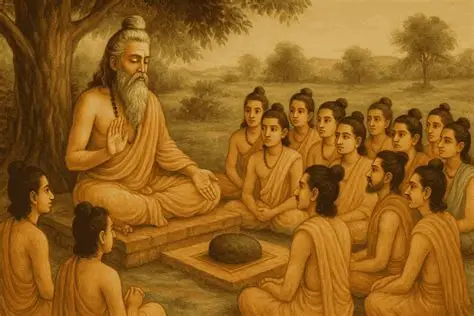
India of the past developed a unique method of personality development through the Guru tradition. In the Indian tradition, the Guru worked as a lifelong devotee to create a perfect person. Many things like knowledge, character and values were transferred from the Guru to the disciple. The individual became capable of preserving social and national values. India acquired the ability to guide the world due to the great work of the Guru like personality development. Through which India got itself out of the state of character bankruptcy for thousands of years. Only teachers, professors and people with the title of Guru can correct today’s character bankruptcy. A teacher is not just a professional person, he is the backbone of the national system. Their Satsankalp will not only save India but will also help in respecting India in the world court.