





By Our Correspondent
BHUBANESWAR:The legendary Prime Minister Shri Narendra Modi had launched the Jala Jeevan Mission in 2019. Its aim was to provide sufficient and safe drinking water through piped water to every rural household by 2024. But the Comptroller and Auditor General (CAG) report on its implementation in Odisha from August 2019 to March 2024 has raised serious questions about the planning, supervision and performance of the previous government. State spokesperson Shri Satyabrat Panda said that it has clearly proven that the BJD government was incapable of providing drinking water to the people of Odisha.
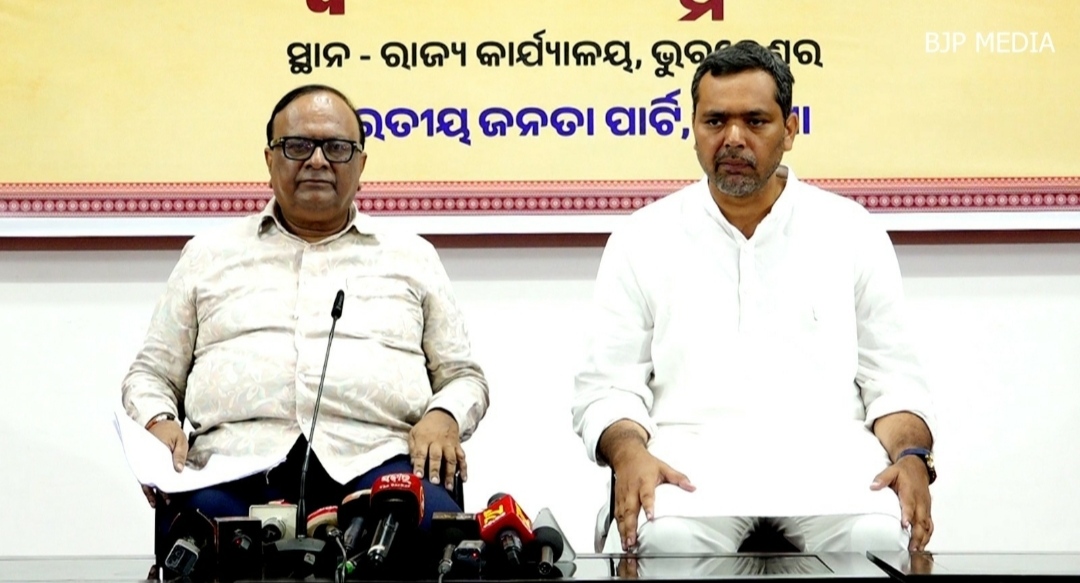
At a press conference held at the state office, state spokesperson Shri Panda said that out of 88.68 lakh rural households in the state, 64.71 lakh households had been provided with piped drinking water as on March 2024. About 31 percent of households in Odisha were excluded from this scheme. This figure is 24 percent for India. Out of 207 mega water supply projects taken up in 2019-24, only 2 were fully operational by June 2024. These figures highlight not only the delay in the projects but also the need to determine the accountability of the project management and supervision system at that time.
According to the CAG’s study, out of 8,800 villages in 5 districts, 1,237 did not have a Village Programme Plan and 1,230 did not have a Village Water and Sanitation Committee. Instead of the required 255 meetings of the District Water and Sanitation Mission, only 33, or about 13 percent, were held. “There is no village water plan, there is no village water committee” When district-level monitoring meetings were also not held regularly, Shri Panda questioned how the plan was being implemented at the grassroots level. The CAG’s data on the quality of drinking water is also worrying.
Out of 77 water quality laboratories, 26 were accredited by the “National Accreditation Board for Testing and Calibration Laboratories”, 17 were accredited and 34 were neither accredited nor accredited. The CAG also mentioned the lack of human resources, low training and obsolete equipment. The expenditure on water quality management and monitoring was only 0.38 percent, which should have been 2 percent. In this regard, the research of Nobel laureate in economics Professor Michael Kremer is of particular relevance. According to Kremer and co-researchers, the under-five mortality rate can be reduced by about a quarter by purifying drinking water.
It is worth noting that in Odisha, the under-five mortality rate is 37 per thousand, the fourth highest in India. They estimated that if the Jala Jeevan Mission successfully achieves the target of providing clean water, about 1.36 lakh deaths of children under the age of five can be avoided every year. Shri Panda said that the CAG data raised questions about the implementation period of the previous government in 2019-24, and the financial data should be brought to the fore.One of the state’s spokespersons, Mr. Tejeshwar Parida, was present at the press conference held at the state office.