By Our Correspondent
BHUBANESWAR:The MMDA Act was first enacted in 1957 to regulate the mining sector in India. After a long 48 years, i.e. in 2014, after the government of Prime Minister Shri Narendra Modi came to power, a revolutionary reform was introduced in the MMDA Act in 2015. Before 2015, mining meant only ‘corruption and theft’. Before 2015, there was no transparency in the allocation of minerals and there were complaints of nepotism, family favoritism and corruption. After the 2015 reform, the e-auction process was implemented, through which permission was given to individuals or organizations that prioritized the interests of the state and the poor. Due to this, Odisha’s revenue increased tremendously. Before 2014-15, the Odisha government was getting only Rs 3300 crore to Rs 5000 crore annually from the mining sector, but after 2015, this amount has increased by about 10 times and has now reached Rs 55,000 to Rs 60,000 crore and this amount will increase further in the coming years.
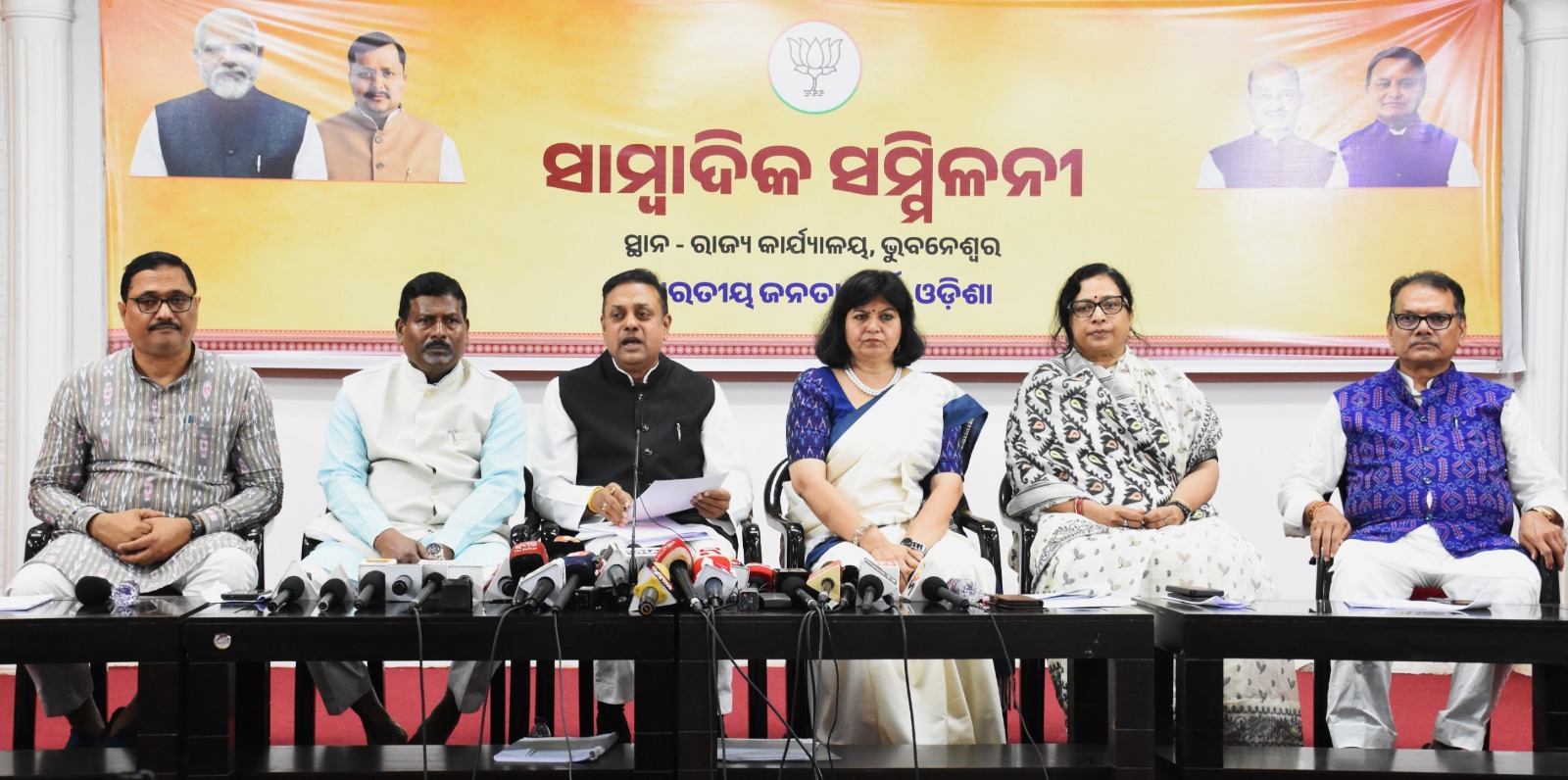
In addition, Odisha has received about Rs 37,000 crore due to the formation of DMF fund for the first time. Since 2015, the auction premium has increased by 150 percent and the royalty has been increased from 10 percent to 15 percent. A state like Odisha has benefited the most due to the amendment of the MMDA Act in 2015. The allegations of the opposition that the federal structure is being undermined and the right to collect revenue tax is reduced are completely baseless and false. The amended MMDA Act is in the interest of Odisha and the people of Odisha, said Puri MP Dr. Sambit Patra.
For the welfare of the people of the mining areas, tribals and the poor, the Odisha government brought the ORISED Act in 2004, which provided for imposing additional taxes on minerals like bauxite (20%), iron ore (15%). The central agency NALCO approached the Hon’ble Court against the ORISED Act and at that time the Congress government was at the Centre. But the Hon’ble Odisha High Court stayed the said Act in December 2005. In 2006, the then Odisha government filed an SLP (Special Leave Petition) in the Hon’ble Supreme Court, which later turned into a civil suit. This civil suit was pending in the Hon’ble Court for 18 years from 2006 to 2024. What was their Advocate General doing? During this period, the Hon’ble High Court gave the opportunity to amend and reinstate the law, but the then BJD government did not bring the necessary reforms in the law, Dr. Patra asked, why and in whose interest?
On 25th July 2024, a 9-judge bench of the Hon’ble Supreme Court, while hearing the ‘Mada vs. Seal’ case, ruled that the states can recover the arrears of fines from the defaulters between 1st April 2005 and 1st April 2026. Based on this, the opposition parties are now alleging that the state has lost Rs 1 lakh crore, which is actually completely false. Since the BJD government has not made legal amendments and the case has been dragging on for 18 years, today Odisha has lost an arrears of revenue worth about Rs 62 thousand crore.
The states have every right to get the old arrears of tax money, but when the proper law has not been enacted and when the ORICED law is under consideration, then on what basis will the arrears be recovered? Collecting arrears based only on the policy without a framework is like ‘having brass but no dust’. That is, since there is no legal amendment, it is impossible to actually collect taxes. “We are holding on to our reports, those who are spreading lies against us, they should tell us how much money they have collected,” Dr. Patra asked.
We all know very well that in 2010, the Shah Commission report mentioned that there was widespread corruption in the mining sector in Odisha and imposed a fine of about 60 thousand crore rupees on the miners involved in mining corruption. In 2017, a two-judge bench of the Hon’ble Supreme Court (Justice Madan Lokur and Justice Deepak Gupta) gave an important verdict that there was widespread mining corruption in mining districts like Keonjhar, Sundargarh, Mayurbhanj, causing immense environmental damage and unbearable hardship to the local tribals. Similarly, despite the release of 16 thousand crore rupees by the Central Government for the DMF fund created for Keonjhar district, the welfare of the people of Keonjhar district has not improved. Therefore, even today, Keonjhar district is called ‘Rich Land, Colourful People’. Even out of the 30 districts of the state, Keonjhar district ranks 24th in the list. Dr. Patra said that the previous BJD government is fully responsible for this.
The CAG report has revealed that DMF money was embezzled and looted on a large scale during the BJD government. Out of more than Rs 983 crore, Rs 976 crore was spent on non-affected villages. 584 mine-affected villages remained deprived of the grant. The CAG report has revealed that 1730 projects were implemented without the permission of the village council. Dr. Patra said that tax money collected on minerals was looted on a large scale during the BJD regime.
Mineral resources are not just assets, they are also related to national security. There must be uniformity in mining policies and taxes across the country. If the price of minerals in the country increases, then industries will import raw materials from China or abroad, which is harmful to the Indian economy. If the price of minerals like coal, iron ore, bauxite etc. increases, then the prices of iron ore, cement, electricity will also increase. This will have a direct impact on the common man. Therefore, there is a need for an amended MMDA Act, said Dr. Patra.
While the annual average annual revenue of Odisha from the Railway Budget during 2009-14 was only Rs. 838 crore, it has increased to Rs. 10,599 crore in 2025-26. The state GST revenue has increased from Rs. 6,609 crore in 2017-18 to Rs. 2,561 crore in 2024-25. While the states were given 32 percent in the 13th Finance Commission, it has been increased to 42 percent in the 14th Finance Commission, and this has significantly increased the share of central taxes received by Odisha. Dr. Patra said that the central government, under the leadership of Prime Minister Shri Narendra Modi, is continuously working for the welfare of the poor, tribals and the underprivileged sections of Odisha under the policy of ‘Sabka Saath, Sabka Vikas’.
Bhubaneswar MP Aparajita Sadangi, who was present at the press conference, said that Odisha and the people of Odisha have suffered losses of about Rs 103,220 crore due to the mismanagement of the BJD’s 25 years of rule. The Shah Commission report mentions that there was a loss of Rs 60,000 crore between 2010 and 2013. Eight audit reports of the CAG have shown losses of thousands of crores. The then BJD government failed to present its side effectively in the ORISED case, due to which it was quashed by the Hon’ble High Court. On the other hand, the protest and uproar of the Biju Janata Dal after the passage of the amended MMDA Act in the Parliament is very funny.
Those who are guilty are causing a ruckus. 20 BJP MPs from Odisha have read and understood the purpose and spirit of this amended law well. This law has come with the right purpose. That is why we have passed it in the Parliament. Opposition BJD and Congress leaders should read and understand the amended MMDA Act repeatedly. The double-engine government is working with the interests of the four and a half crore people of Odisha and the people of the mineral-rich areas as its top priority, Ms. Sarangi advised.
MP Dr. Bibhuprasad Tarai, Smt. Anita Subhadarshini, Dr. Rabinarayan Behera and State General Secretary Shri Biranchi Narayan Tripathi were present on this occasion.