





By Our Correspondent
BHUBANESWAR/NEW DELHI:The controversy over the selection of Odisha’s next Director General of Police (DGP) has acquired a new dimension, with official correspondence between the Odisha Government and the Ministry of Home Affairs (MHA) raising questions over the manner in which vacancies in the DG grade were calculated and utilised during the selection process.
The issue assumes significance as the Supreme Court is seized of a petition filed by Balasore-based Jayanta Das challenging the procedure adopted for selection of the next DGP. On September 2, the Supreme Court deferred the matter to September 7 after the petitioner’s counsel and the amicus curiae sought further consideration.
At the heart of the controversy is a seemingly simple question: How many DG-rank posts were actually vacant in Odisha when the State moved to promote two 1994-batch IPS officers, Sanjeeb Panda and Yeshwant Kumar Jethwa, to the DG grade on August 10?
Five DG-rank officers against four posts
According to the cadre position and official documents, Odisha has four DG-rank posts — two cadre posts and two ex-cadre posts.
The four posts were occupied by:
• Y.B. Khurania, IPS — cadre DG post;
• Sudhanshu Sarangi, IPS — cadre DG post;
• Vinaytosh Mishra, IPS — ex-cadre DG post; and
• R.P. Koche, IPS — ex-cadre DG post.
Meanwhile, Susanta Kumar Nath, IPS (1993), while serving on Central deputation, was granted proforma promotion to the DG grade in January 2025. Contemporary reports also recorded that Odisha consequently had five DG-rank officers against four DG-level posts. (indianewsdiary.com)
This created an apparent one-officer excess in the DG grade.
The position was therefore:
5 DG-rank officers : 4 DG-rank posts = 1 officer in excess.
The next development becomes crucial.
Khurania’s retirement did not, by itself, create an additional DG-rank vacancy
Y.B. Khurania retired on August 16, 2026.
With his retirement, the number of DG-rank officers would fall from five to four, while the sanctioned DG-level posts remained four.
Thus:
4 DG-rank officers : 4 DG-rank posts = No vacancy.
The first further actual vacancy in the four-post structure would arise on November 30, 2026, when Vinaytosh Mishra is due to retire.
At that stage:
3 DG-rank officers : 4 DG-rank posts = 1 vacancy.
This arithmetic assumes, as the documents indicate, that Nath’s proforma promotion is recognised for determining the DG-grade strength.
MHA itself had earlier acknowledged “no vacancy”
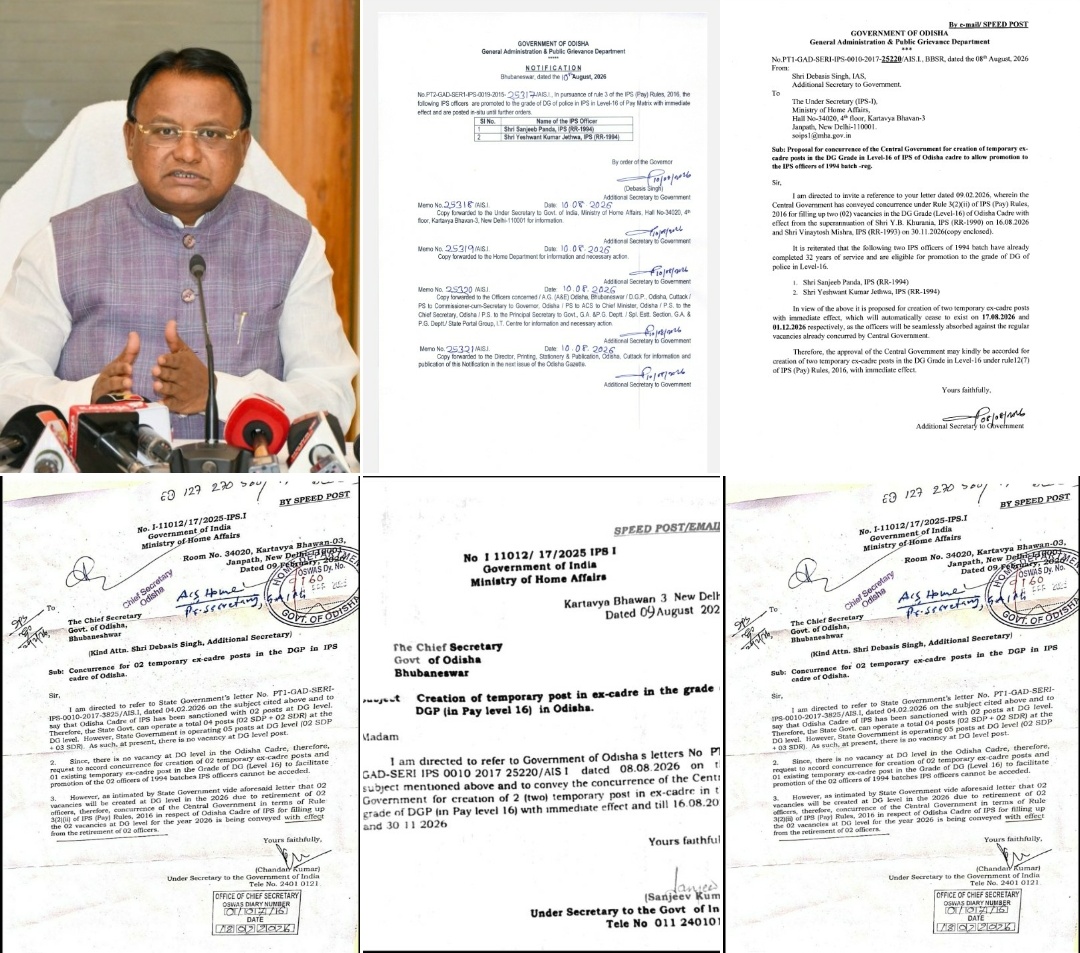
The most striking evidence comes from an MHA letter dated February 9, 2026, concerning Odisha’s request for creation of two temporary ex-cadre DG posts.
The letter records that Odisha had four DG-level posts — two State Police cadre posts and two State Police ex-cadre posts — but was already operating five posts at DG level: two SDP and three SDR posts.
The MHA letter expressly states:
“As such, at present, there is no vacancy at DG level post.”
It consequently declined to concur with the request for creation of two temporary ex-cadre posts and one additional temporary ex-cadre post.However, the same letter stated that two DG-level vacancies were expected to arise during 2026 due to retirement of two officers and conveyed concurrence with effect from their respective retirements.
This correspondence becomes particularly relevant in the light of what happened subsequently.
August correspondence: two temporary DG posts
On August 8, the Odisha Government again sought creation of two temporary ex-cadre posts in the grade of DGP (Pay Level-16).
The following day, August 9, the MHA conveyed concurrence for creation of two temporary ex-cadre DG posts — one with immediate effect up to August 16, 2026, and another up to November 30, 2026.
The two dates correspond precisely with the superannuation dates of Y.B. Khurania and Vinaytosh Mishra.
The documents therefore raise a fundamental administrative question:
If the retirement of Khurania merely reduced the existing excess of DG-rank officers from one to zero, on what basis was a temporary DG post required to be created up to the very date of his retirement?
The answer to this question is significant because it directly affects the number of officers who could legitimately occupy DG-level posts immediately before the DGP selection exercise.
The timing of the Panda-Jethwa promotions
The vacancy issue assumes greater significance because, on August 10, immediately after the inconclusive UPSC empanelment meeting of August 7, the Odisha Government promoted Sanjeeb Panda and Yeshwant Kumar Jethwa, both 1994-batch officers, from ADG to DG grade.
The timing attracted immediate attention because the State had earlier sent 11 names to the UPSC, including three DG-rank officers — Sudhanshu Sarangi, Susanta Nath and R.P. Koche — along with eight ADG-rank officers.
The Supreme Court challenge subsequently alleged that the State was attempting to alter the pool of eligible officers by promoting an ADG-rank officer to DG rank immediately before the selection process.
On August 13, the Supreme Court directed the UPSC not to finalise the selection pending further consideration of the matter.
The Nath question
There is another important strand to the controversy.
Reports following the August 7 UPSC meeting stated that the Odisha Government had indicated that it proposed to withdraw the integrity certificate of Susanta Kumar Nath. Subsequently, reports suggested that Nath might be excluded from the revised list, potentially moving Sanjeeb Panda up in the seniority sequence.
The documents now available show that the Government had separately sought information from the CBI regarding its investigation into alleged malpractice in the 2025 Odisha Sub-Inspector recruitment examination.
The CBI’s response is important because it does not state that Nath has been accused or chargesheeted.
Instead, the CBI says that the entire examination process, including the role of the examination-conducting agencies and the Odisha Police Recruitment Board, is under investigation. It further states that permission under Section 17A of the Prevention of Corruption Act had been sought in respect of officials of ITI Ltd. and was pending, and that after examination of those officials, Susanta Kumar Nath “may be required to be examined.”
That distinction is crucial.Being potentially required to be examined in an investigation is not the same as being an accused in the case.
A sequence that now demands scrutiny
Taken together, the documents and the chronology present a sequence that warrants independent scrutiny:February 2026: MHA records that Odisha has no DG-level vacancy and is already operating five DG-level posts against four.
May 2026: Odisha sends 11 officers to the UPSC, including DG-rank officers Sudhanshu Sarangi, Susanta Nath and R.P. Koche.
August 7: UPSC empanelment meeting remains inconclusive; the State reportedly raises the issue of Susanta Nath’s integrity certificate.
August 8: Odisha seeks creation of two temporary ex-cadre DG posts.
August 9: MHA concurs with two temporary DG posts, linked to August 16 and November 30.
August 10: Sanjeeb Panda and Yeshwant Jethwa are promoted from ADG to DG grade. (
August 11–13: The Supreme Court is moved by Jayanta Das challenging the selection process, and the UPSC is asked to defer finalisation.
September 2: The Supreme Court again defers the matter, with the next hearing scheduled for September 7.
The larger question
The controversy, therefore, is no longer merely about who should become Odisha’s next DGP.
It is about whether the composition of the eligible pool itself was altered at the critical stage of the selection process.
The Supreme Court’s directions in Prakash Singh v. Union of India require the DGP to be selected through a UPSC process based on merit, from eligible officers with the prescribed residual service. The Court clarified in 2019 that the UPSC’s recommendation should be based purely on merit among officers having at least six months’ residual service.
Against that background, the sequence of:
vacancy calculation → creation of temporary DG posts → last-minute promotions → possible exclusion of an existing DG-rank officer → revised UPSC consideration
deserves close examination.
The documents do not, by themselves, establish that the entire sequence was designed to favour any particular officer. But they do establish enough of a chronological and administrative anomaly to justify questions about whether the cadre position and eligibility pool were altered immediately before the DGP selection process. And that is precisely the issue now before the Supreme Court.