






By Our Correspondent
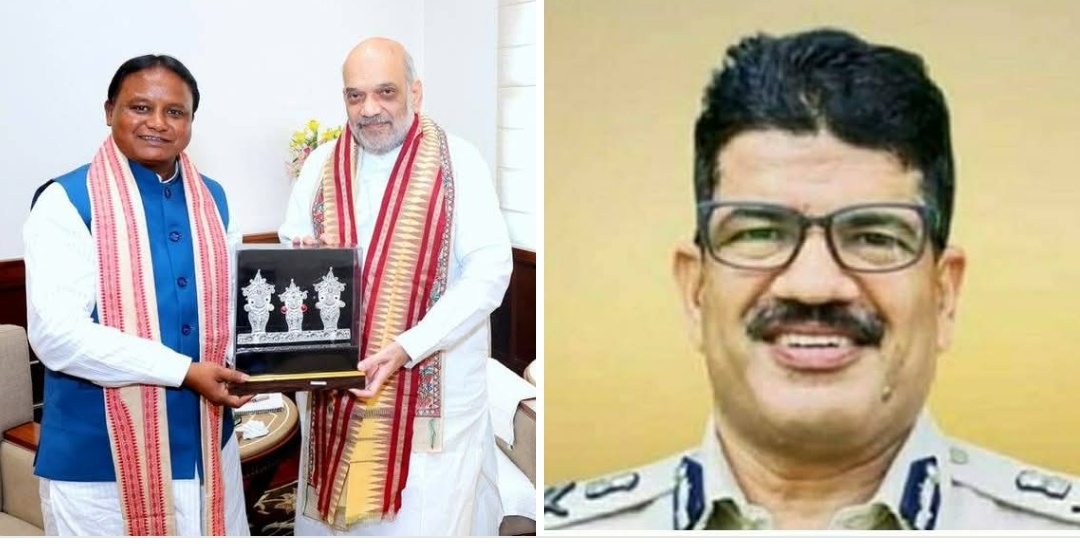
BHUBANESWAR: Social Activists and Lawyers have petitioned to Union Home Minister Amit Shah seeking an Independent Inquiry and verification of all allegations against 1994 batch IPS Officer Sanjeeb Panda before considering his possible appointment as Odisha DGP.
“We the concerned citizens of Odisha , social activist, RTI activist, committed to good governance , transparency and accountability, wish to express our deep concern regarding the appointment to the office of the DGP. The highest position in the Odisha Police,” the letter addressed to Amit Shah said which was signed by senior Odisha High Court Advocate Sudhir Charan Mohanty, Leading RTI activist and Advocate Odisha HC, Prakash Das and RTI activist Hrudananda Kodamsingh said
“It is our considered view that the head of the State Police should be an officer whose impartiality, administrative integrity and public credibility are beyond question. The Police department is not merely a law enforcement agency, but one of the fundamental pillars democracy, therefore, its leadership must be entrusted to an officer who enjoys the unquestioned confidence of the people,” the letter argued.
The letter further argued that “ over the course of Sanjeeb Panda’s service, various questions, allegations, and controversies have arisen in the public domain, in particular concerns have been expressed regarding political neutrality during the tenure of previous government , the conduct of the police towards opposition leaders and workers, certain action taken against social activist, journalist, the role of police in several high profile incidents, which generated widespread pubic discussion and concern,”.
They further alleged that “ It has been alleged that during the previous Naveen Patnaik Government, Sanjeeb Panda acted at the behest of the BJD and former IAS officer VK Pandian, it has further been alleged that he worked towards ensuring electoral successes of BJD and functioned not merely as a police officer but effectively as an agent of the BJD, it is further alleged that excessive action was taken against several social organisations, activist. Journalist, opposition leaders, particularly BJP leaders and during the 2024 general elections, Panda worked to facilitate the electoral victory of BJD,”.
“During the 2024 elections, certain social activist in Odisha held a press meet in Bhubaneswar, alleging that the then 5T Chairman and BJD leader VK Pandian had misused his position by availing the services of 74 police security personnel , acting on behest of VK Pandian, Sanjeeb Panda caused criminal cases to be registered against those social activist, subjected to them mental harassment, intimidation, and made false statements against them during a press meet, it has also been alleged that IPS officers DS Kutey and Ashish Singh similarly acted in favour of BJD,” they drew attention of Amit Shah.
“During the 2024 general elections, it had also been alleged that Sanjeeb Panda caused BJP MLA candidate , later won, Prashant Jagdev to be arrested from the vehicle of BJP Bhubaneswar MP Aparajita Sarangi in a false criminal case and sent to jail, it was alleged that such action was taken at the instance of BJD , Naveen Patnaik and VK Pandian, and that the arrest of a sitting MLA from the vehicle of a sitting BJP MP in such circumstances shocked many people,” activists said.
“During Sanjeeb Panda’s tenure as Police Commissioner , several BJP leaders were arrested from protest places , subject to them harassment and sent to jail, it was alleged that pressure was exerted upon them not to work for the BJP that during his tenure , BJP workers suffered the highest number of instances of harassment and false criminal cases,” they said.
They added “ Odisha is presently undergoing a new phase of governance , in these circumstances, maintain the neutrality of the police force, public confidence, and institutional integrity of the police department is of paramount importance. Appointment to the sensitive office of DGP should not be based on solely on seniority but should also take into account integrity , impartiality , professional competence and public confidence’.
Meanwhile, the emergence of rumors regarding former Police Commissioner Sanjeeb Panda’s contention for the State’s top police post places the Mohan Charan Majhi-led BJP government at a critical administrative and political crossroads. Elevating an officer who was unceremoniously shunted out of a prime posting due to unprecedented institutional insubordination would carry heavy political costs.
Rewarding an officer linked to a breakdown of command and control would send a damaging signal. It creates the impression that the political executive can be pressured, bypassed, or strong-armed by the uniform.
The Bharatpur custodial violence case—involving the brutal mistreatment of an Army officer and his fiancée—drew national outrage, severe strictures from judicial bodies, and condemnation from prominent figures across the political spectrum. Elevating a figure central to that administrative machinery risks dragging a closed controversy back into the headlines, handing critics a narrative that the government cannot—or will not—enforce accountability.
An appointment based on legacy alignments rather than unblemished administrative command alienates upright officers who adhered to protocol during past crises.
The friction between the state’s police hierarchy and the nascent BJP administration stems from a fundamental clash of institutional cultures:
Having come to power after decades of entrenched rule by the previous administration, the BJP government faced a deep-rooted civil-police apparatus whose loyalties and operational styles were deeply institutionalized.
The unauthorized assembly of over a hundred police personnel at the Bhubaneswar Reserve Ground was unprecedented. Operating as a quasi-syndicated pressure tactic while the Chief Minister was out of the capital, it exposed an underlying defiance within the ranks against civilian oversight and disciplinary actions.
The standoff forced the government to draw a hard line: either assert political and administrative supremacy or surrender institutional governance to bureaucratic defiance. Shunting Panda out of the Commissionerate was treated at the time as a necessary assertion of executive authority
The Biju Janata Dal (BJD), transitioning from ruling party to opposition, strategically exploited the governance turbulence:
The BJD leveraged the police-public standoff and the internal security breakdowns to paint the 100-day-old BJP regime as “inexperienced, amateurish, and incapable of managing the state apparatus.”
By framing the Bharatpur incident and the subsequent police protests as proof of crumbling governance, the opposition successfully shifted public focus away from its own historical legacy, putting the ruling party permanently on the defensive.
Every misstep or rumor regarding police appointments has been utilized by the opposition to drive a wedge between the government, civil society, and institutional stakeholders.
Allowing an officer whose tenure was marred by high-profile controversies and open institutional defiance to ascend to the highest law enforcement office would represent a self-inflicted strategic defeat for the state government. For an administration seeking to project strength, reform, and strict rule of law, maintaining a zero-tolerance stance on command failures is essential to preventing history from repeating itself.