





By Our Correspondent
BHUBANESWAR: Red Carpet Oiling to Anil Agarwal led Vedanta Group by Odisha Chief Minister Mohan Charan Majhi led BJP Government in Odisha may invite Kalinga Nagar type Tribal resistance in Rayagada and will promote Economic Blockade and collapse of law and order situation.
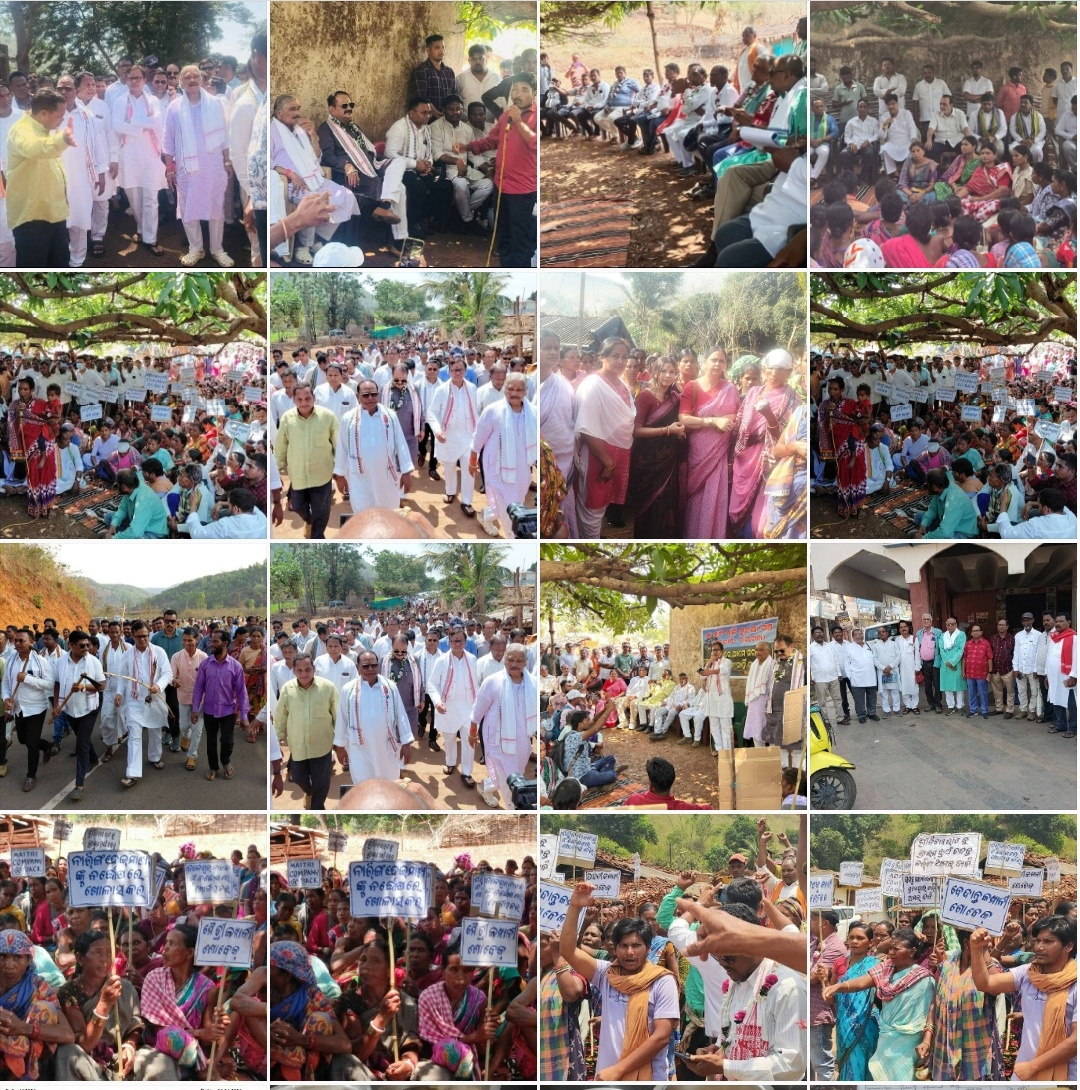
Opposition parties including BJD, Congress and Left Parties have sent delegations/fact-finding teams to the Sijimali area in Rayagada district, Odisha, following the violent clash on April 7 between tribal protesters and police over the approach road construction for Vedanta’s proposed bauxite mine.
A Biju Janata Dal (BJD) fact-finding team visited Kantamala village in the morning.The team was led by senior leaders, including former minister and MLA Ranendra Pratap Swain and district president/former minister Jagannath Saraka .
They interacted directly with local tribal residents, discussed alleged police excesses during the April 7 pre-dawn operation (lathi-charge, tear gas, power disconnection, etc.), and assessed the ground situation amid ongoing tension and prohibitory orders.
The delegation aimed to understand villagers’ grievances regarding the road project, potential displacement, forest rights violations, and environmental concerns linked to the Sijimali bauxite mine allotted to Vedanta.
BJD leaders demanded a fresh Gram Sabha consultation on the project. The team planned to submit its report to BJD president Naveen Patnaik.
This visit came as BJD (along with Congress) publicly condemned the alleged police action on tribals and highlighted human rights and tribal livelihood issues.
A joint delegation of four Left parties — CPI (Communist Party of India), CPI(M) / CPIM (Communist Party of India Marxist), CPI(ML) Liberation, and All India Forward Bloc visited the Sijimali area on April 10 to assess the situation. Dr. Prashant Kumar Mishra (CPI State Secretary), Suresh Chandra Panigrahi (CPI(M) State Secretary), Yudhisthir Mahapatra and Jyoti Ranjan Mahapatra Forward Bloc were among those in the delegation.
They evaluated police repression, the impact of prohibitory orders (Section 163), alleged violations of tribal rights, and the push for the mining-related road. They described the police action as an “assault on constitutional and democratic rights” of tribal communities and warned of potential state-wide protests if repression continued.
The Left parties had earlier issued strong statements condemning the April 7 operation (surrounding villages, cutting electricity, lathi-charge, etc.) and demanded withdrawal of restrictions, halting of the road project, and enforcement of laws protecting tribals (e.g., Forest Rights Act, Fifth Schedule provisions).
These visits occurred amid continued tension in the area (heavy police presence, villagers maintaining vigilance, uneasy calm reported in prior days). No major new clashes were widely reported on April 10 itself.
BJD and Congress formed fact-finding teams and raised concerns at higher levels (e.g., BJD MP Niranjan Bishi wrote to the President). The visits reflect opposition unity in highlighting tribal resistance to the project, which locals fear will destroy livelihoods, water sources, and sacred hills.
The Sijimali bauxite mine (arge reserves, linked to Vedanta’s Lanjigarh operations has faced long-standing opposition from Adivasi and Dalit communities over consent issues and environmental impacts.
The situation remains sensitive, with calls for dialogue, respect for Gram Sabha consent, and protection of tribal rights versus the state’s push for industrial development. For the absolute latest on-ground updates, local Odisha media or official statements are recommended, as developments can shift quickly.
The major clash at Sijimali (also spelled Sijimali or Tijmali) in Rayagada district, Odisha, occurred on Tuesday, April 7. It involved tribal (Adivasi) and Dalit villagers protesting against the construction of a 3 km approach road (from Purulang/Porolang to Sagabari Ghati/Sagabari village under Kashipur block). This road aims to provide access to the Sijimali bauxite mine allotted to Vedanta Limited.
Villagers have maintained protests and nightly vigils to block road work and police entry, fearing the project will lead to displacement, loss of forest rights/livelihoods, depletion of water sources, and environmental damage in the ecologically sensitive Sijimali hills (considered sacred by locals).
Police reportedly conducted a pre-dawn operation (around 3 AM) involving lathi-charge, tear gas, and attempts to clear protesters or execute warrants. Villagers allegedly resisted with stones, axes, traditional weapons, and other objects.
Reports vary slightly — around 60-70+ people injured total. This includes 40-58 police personnel and 25+ villagers. Some senior officers were reportedly hurt; one account mentions a cow killed in the chaos.
Police claimed protesters attacked first; villagers and activists allege police excesses, repression, and favoritism toward Vedanta. Section 163 (prohibitory orders restricting gatherings) was imposed in the area.
The clash forced police to withdraw or retreat in some descriptions, with ongoing tension in villages like Sagabari, Kantamal, and Shagabari.
Tribals have opposed the Sijimali bauxite project (estimated 311 million tonnes reserves, proposed 9 MTPA mining over ~1,548 hectares across Rayagada and Kalahandi districts) since Vedanta was declared the preferred bidder in March 2023.
Key grievances:Alleged lack of genuine Gram Sabha consent (villagers claim forgery or manipulation of signatures).Violation of Forest Rights Act and threats to community forest land/livelihoods (affecting 18+ villages, hundreds of families). Proximity to Vedanta’s Lanjigarh alumina refinery.Long-standing resistance similar to past Niyamgiri protests against mining in the region.Protests intensified recently with road construction attempts, leading to earlier demonstrations (like women-led actions defying prohibitory orders around April 3-4, 2026).
No reports of fresh large-scale violence or new clashes on April 10 or 11. The situation remains tense, with continued local resistance, nightly vigils in some areas, and heavy police/administration presence.
Videos and statements from tribal women and leaders emphasize protecting “maati, jungle, and jal” (land, forest, water) from corporate mining. Some reports mention ongoing demands for land pattas (titles) and assertion of rights.
Focus on facilitating infrastructure for the allotted mine while maintaining law and order. District Collector reportedly questioned lack of pattas/forest rights claims in prior interactions.
As of April 11, 2026, media coverage highlights the broader debate on tribal rights vs. industrial development, with calls for dialogue and respect for consent. Protests are rooted in years of opposition, not limited to a single day.
It may be noted here that , on January 2, 2006, in Jajpur district, Odisha, police opened live fire on hundreds of Adivasi protesters (mainly Ho tribe) opposing land acquisition and boundary wall construction for a proposed Tata Steel plant. 13 tribals killed (including women and a child), dozens injured. One policeman also died. The incident became a major symbol of state repression against tribal resistance to industrial projects. It followed months of protests over displacement and inadequate compensation, with allegations of excessive force to protect corporate interests.
The area in Rayagada remains tense with heavy police presence, ongoing prohibitory orders, and deep-rooted opposition similar to past Odisha protests (Niyamgiri, Kalinga Nagar, Maikanch). If road, mining work is pushed aggressively without dialogue or fresh Gram Sabha consent, further clashes could occur. Activists warn of “repression” and potential for wider mobilization.