









By Our Correspondent
BHUBANESWAR:Bhubaneswar is witnessing rapid urbanization and unprecedented infrastructure development, making the protection and scientific development of its stormwater drainage network more critical than ever. To address future climate challenges, increasing urban runoff, and recurring waterlogging, the Bhubaneswar Municipal Corporation (BMC), with technical support from IIT Roorkee, is undertaking a comprehensive survey and preparation of the Storm Water Drainage Master Plan for the city. This landmark initiative aims to develop a scientifically designed, sustainable, and climate-resilient drainage network capable of efficiently managing stormwater and minimizing the risk of urban flooding.
While this important exercise is in progress, BMC has simultaneously intensified its efforts to remove unauthorized encroachments and illegal constructions over the city’s main drains. These primary drains form the backbone of Bhubaneswar’s natural stormwater drainage system. They carry stormwater from various parts of the city to downstream channels and ultimately prevent inundation of residential and commercial areas. Their hydraulic capacity, designed width, CDP (Canal/Drain Protection) width, maintenance corridor, and right-of-way must remain completely free from encroachment to ensure uninterrupted stormwater flow during heavy rainfall.
Main Drains – The Arteries and Veins of the City
The primary stormwater drains of Bhubaneswar function like the arteries and veins of the human body. Just as arteries carry blood to sustain life, the city’s main drains safely convey stormwater away from urban areas, protecting life, property, and public infrastructure.
Any obstruction, encroachment, narrowing, or reduction in the designed width or CDP width of these drains restricts the free flow of stormwater. Such restrictions reduce hydraulic carrying capacity, increase water levels during rainfall, obstruct maintenance operations, and significantly elevate the risk of urban flooding. Even seemingly minor encroachments can have cascading effects downstream, resulting in severe waterlogging across multiple localities.
Therefore, no compromise should be made on the approved CDP width, maintenance corridor, or right-of-way of any primary stormwater drain under any circumstances. These corridors are indispensable for routine desilting, emergency maintenance, future widening, and ensuring the long-term flood resilience of the city.
Encroachment – A Major Cause of Urban Flooding
One of the greatest threats to Bhubaneswar’s drainage infrastructure is the increasing incidence of unauthorized construction along the banks and within the protection corridors of major drains. Such activities obstruct natural stormwater flow, reduce channel capacity, weaken embankments, hinder maintenance operations, and increase the likelihood of flooding in surrounding residential areas.
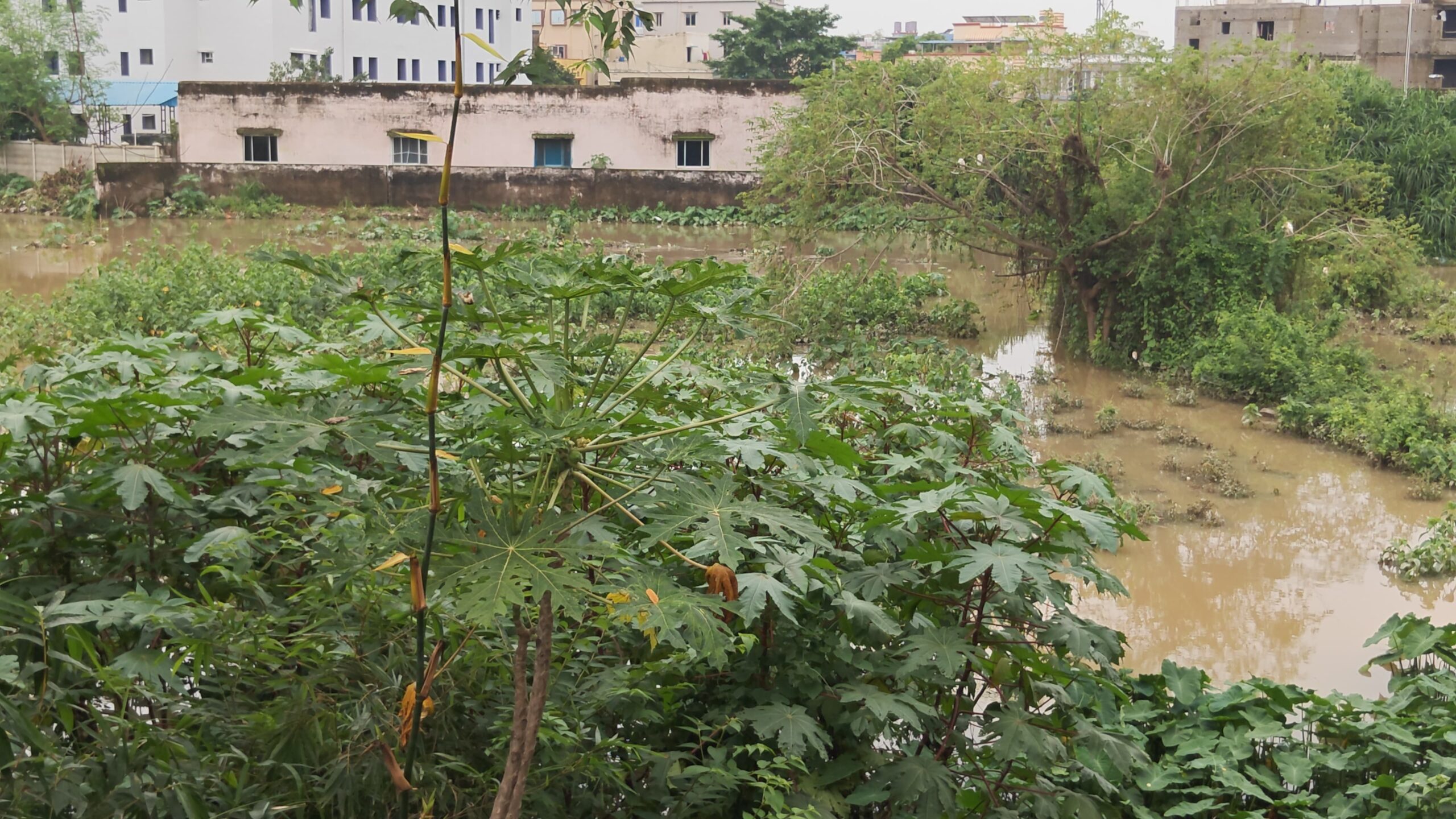
A recent instance has been observed along Main Drain No. 9 near the ITER College Culvert at Panchasakha Nagar, where construction activities have reportedly commenced without obtaining the necessary clearance from the Bhubaneswar Municipal Corporation and the concerned Storm Water Drainage authorities. Such development has the potential to obstruct the natural drainage corridor, reduce the effective waterway, and adversely affect the hydraulic performance of the drain.
The consequences of such activities are already evident. Flooding and waterlogging have been experienced in nearby residential areas, including Krishna Annex and surrounding localities. Photographic evidence of these flood incidents demonstrates the urgent need for timely intervention before permanent structures further compromise the drainage network.
Stormwater Clearance Must Be Mandatory
Urban development should not be viewed solely from the perspective of building construction. Every development located adjacent to or within the influence zone of a primary stormwater drain must undergo scientific evaluation of its impact on drainage.
Accordingly, no building permission should be granted without obtaining Storm Water Planning and Drainage Clearance from the competent authority wherever applicable. Such scrutiny ensures that proposed developments do not obstruct natural drainage, reduce channel capacity, interfere with maintenance access, or increase flood risks to surrounding communities.
Integrating stormwater planning into the building approval process is essential for sustainable urban development and long-term climate resilience.
Immediate Administrative Action is Essential
Protection of Bhubaneswar’s drainage infrastructure requires coordinated and sustained efforts from all government agencies. The following actions are essential:
– Immediate stoppage of all unauthorized construction activities over or adjacent to Main Drain No. 9 and other major drains.
– Prompt intervention by the BMC Enforcement Wing to prevent further encroachment.
– Strict verification of statutory approvals before permitting construction near primary stormwater drains.
– Joint enforcement by BMC, BDA, Commissionerate Police, Revenue Authorities, Tahasil Administration, and all concerned line departments.
– Periodic inspection and monitoring of all major drains to detect and remove fresh encroachments at the earliest stage.
– Restoration of the original designed width, CDP width, and maintenance corridor wherever encroachments have occurred.
– Public awareness regarding the importance of protecting stormwater drainage corridors.
Preserving Main Drain No. 9
Main Drain No. 9 is one of the most important components of Bhubaneswar’s primary stormwater drainage network. It serves a large urban catchment and plays a vital role in safely conveying stormwater during heavy rainfall.
The designed drain width, hydraulic section, CDP width, maintenance corridor, and right-of-way of Main Drain No. 9 must never be compromised. Any reduction in these essential engineering provisions diminishes the drain’s carrying capacity, obstructs maintenance operations, and substantially increases the likelihood of flooding in downstream areas.
Protection of Main Drain No. 9 is therefore not merely an engineering necessity but a critical component of Bhubaneswar’s long-term urban flood management strategy.
A Collective Responsibility
Safeguarding Bhubaneswar’s drainage network cannot be achieved by BMC alone. It requires coordinated efforts from all stakeholders, including BMC, BDA, the Commissionerate Police, Revenue Administration, Water Resources Department, utility agencies, developers, institutions, and citizens.
Every encroachment prevented today is an investment in the city’s future safety. Every drain preserved in its original form strengthens Bhubaneswar’s resilience against climate change and extreme rainfall.
As IIT Roorkee continues preparing the Storm Water Drainage Master Plan, it is equally important to preserve the existing natural drainage system from further encroachment. Scientific planning must be complemented by strict enforcement of regulations and responsible urban development.
The city’s main drains are not merely concrete channels—they are the lifelines of Bhubaneswar. Protecting their designed width, CDP width, maintenance corridors, and natural flow paths is fundamental to ensuring a safer, healthier, flood-resilient, and sustainable capital city for present and future generations.
Protecting our drains today means protecting Bhubaneswar tomorrow.