



By Our Correspondent
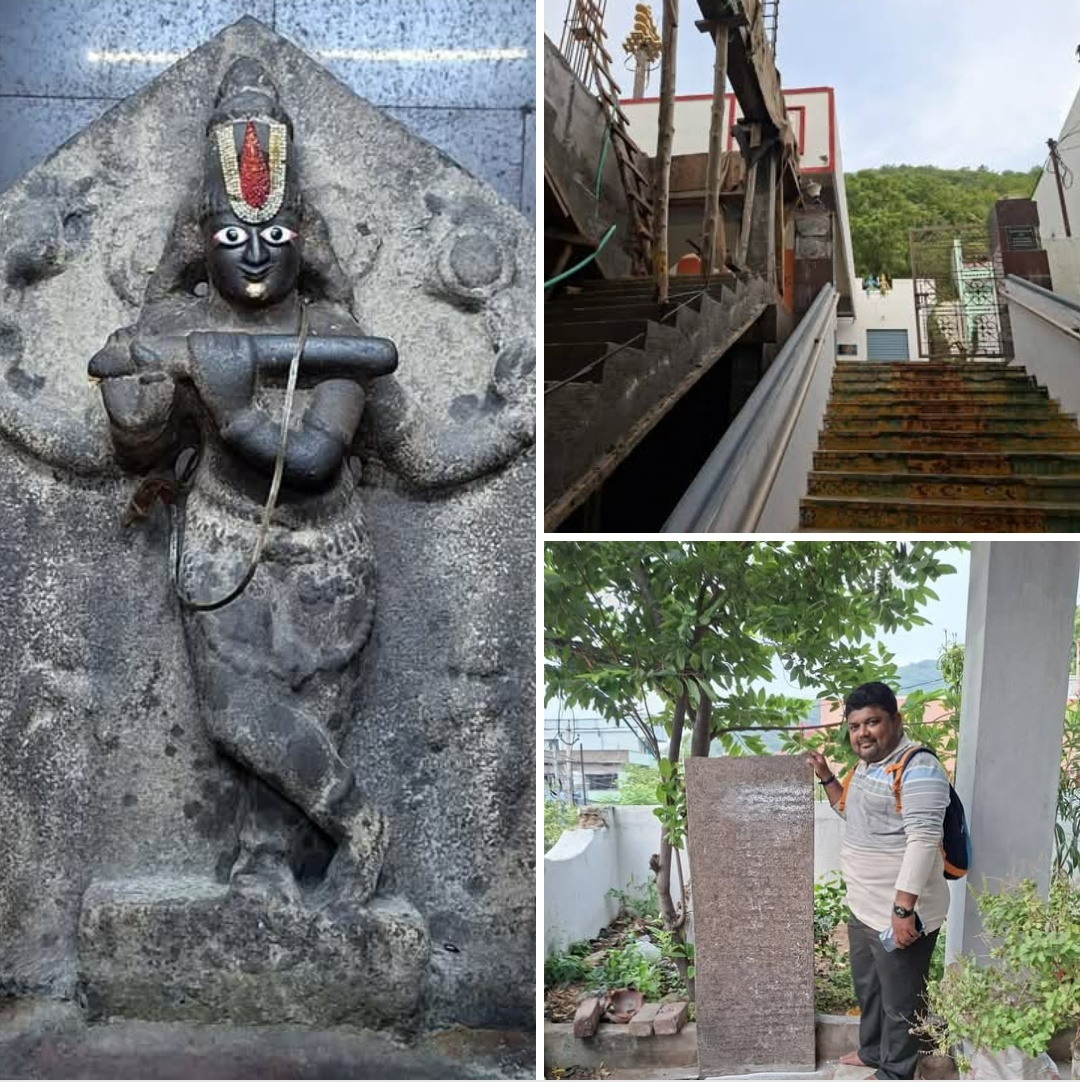
BHUBANESWAR:An important inscriptional evidence related to the medieval history of South Eastern India has been rediscovered at Undavalli Village in Guntur district of Andhra Pradesh near to Vijayawada city. The significant relic was identified by researchers of the Rediscover Lost Heritage Trust (RLHT), an organisation presently engaged in documenting Kalingan historical relics across South India. The RLHT survey team, comprising Project Co-ordinator Deepak Kumar Nayak along with surveyors Rabindra Kumar Rana and Bikram Kumar Nayak, rediscovered a stone inscription dated to Year 1526 CE (Saka Year 1448) belonging to the reign of the Suryavamsi Gajapati emperor Prataparudra Deva of Odisha.
Sharing details about the rediscovery, history researcher and Project Co-ordinator of RLHT, Sri Deepak Kumar Nayak, stated that the inscription had previously been mentioned in the Annual Reports on South Indian Epigraphy, Year 1909. During the course of the field survey, the team located the inscribed stone panel within the premises of the Bhaskareswara Shiva temple situated beneath the Undavalli Hills. Inscribed in Telugu script and partially using both Telugu & Sanskrit language, the epigraph records the construction of a temple dedicated to Bhaskareswara by four individuals namely Pappisetti, Malisetti, Tippisetti, and Krishnamasetti of the Murukula Gotra during the reign of Gajapati Prataparudra Deva of Odisha. The inscription reverentially describes the king with epithets such as Jagannatha Avatara, Virakedara, Apratihatapratapa, Sangita Sahitya Salaapa, and Purushottamanvaya Pradipa etc. It also mentions the grant of a flower garden containing mango, vilva, amalaka and other trees, along with land grants intended for the maintenance of the daily worship rituals of the Bhaskareswara temple.
Although primarily related to a temple donation, the inscription bears immense importance for the shared political history of the region, particularly because of its date — 26th February 1526 CE. According to several historical accounts, a treaty had earlier been concluded between the two powerful Hindu kingdoms of Vijayanagara and Kalinga following a fierce conflict that reportedly continued for nearly seven years. The forces of the Vijayanagara emperor Krishnadevaraya defeated the Kalingan army of the Gajapatis by around 1519 CE, after which a treaty was established. As per the agreement, the territories south of the River Krishna were to remain under the Vijayanagara Kingdom, while the regions north of the river would continue under the Kalinga rule.
However, the newly rediscovered inscription suggests that Gajapati Prataparudra Deva may not have continued to abide by the conditions of the treaty over the time. His presence in the Undavalli region, situated south of the River Krishna, along with the construction activity associated with the Bhaskareswara temple, strongly indicates continued Kalingan influence in the area even after the treaty period. The inscription additionally confirms that the king was undertaking an Andhra Desha expedition during this phase. Historical references indicate that during this expedition he also encountered the Muslim forces of Golkonda under Quli Qutb Shah.
According to Mr. Nayak, the presence of Prataparudra Deva south of the Krishna River during an active military expedition clearly demonstrates that he was no longer adhering to the treaty concluded with Krishnadevaraya in 1519 CE. He further remarked that this inscription constitutes an important epigraphic evidence against the long-standing historical perception that Prataparudra Deva neglected state responsibilities under the influence of the Bhakti movement associated with Sri Chaitanya, a claim often linked by some historians to the eventual decline of the Gajapati Empire.
Speaking on the rediscovery, Chiranjib Rout, Chairman of the Rediscover Lost Heritage Trust, stated that the organisation is currently documenting Kalingan relics across the South Indian states of Andhra Pradesh, Telangana, Tamil Nadu, and Karnataka. He said that while Part-I of the book Relics of Kalinga in South India was released in April 2025, our trust aims to publish the Part-II by late 2026.