







By Dr. Padmalochan Dash
BHUBANESWAR:For centuries, Bengal was never just a province on a map. It functioned more like a civilisational terrain within Bharat. The emotional energy of India’s renaissance, literary awakening, nationalist imagination, spiritual experimentation, reformist politics, and revolutionary consciousness repeatedly passed through Bengal before spreading across the rest of the country. Kolkata was not merely a city. For a long period, it operated as one of the intellectual theatres of Asia itself.
Few regions shaped modern India as deeply as Bengal did- Bengal produced economists, jurists, scientists, musicians, educationists, philosophers, theatre practitioners, and anti-colonial organisers in unusual density. That concentration mattered historically. In many ways, Bengal remained one of the principal genesis points of Indian nationalism and one of the most intense intellectual and revolutionary theatres of India’s independence movement.
Then history turned harsh-Successive phases of external domination first altered Bengal’s political structure and later dismantled its economic foundations. Under colonial extraction, Bengal transformed from one of the wealthiest manufacturing regions in the world into a zone increasingly marked by resource drain, agrarian distress, demographic instability, and industrial weakening. The old riverine-commercial civilisation that once connected ports, textile networks, inland trade, intellectual centres, and artisanal economies began fragmenting slowly.
Partition accelerated everything violently-The division of Bengal in 1947 was not simply territorial. It ruptured memory, trade geography, demography, and cultural continuity all at once. One half moved into Pakistan and later Bangladesh, while West Bengal inherited refugee shocks, communal anxieties, economic burdens, and prolonged political instability. The psychological consequences of Partition often remain under-discussed in mainstream political discourse. Bengal never fully recovered from that fracture.
Post-independence politics made recovery even harder-The tragedy was not that Bengal lacked resources or talent. It had both in abundance. The tragedy was that successive governments gradually converted one of India’s most intellectually advanced regions into a theatre of ideological rigidity, cadre dominance, industrial flight, bureaucratic stagnation, and perpetual political confrontation. Economic planning became deeply politicised. Organised street mobilisation often replaced institutional governance. Labour militancy without corresponding industrial modernisation damaged investor confidence for decades. Businesses migrated westward and southward. Manufacturing ecosystems weakened. Port potential remained underutilised. Urban decline became visible.
Over time, a deeper institutional fatigue entered public life-Educational deterioration in several sectors, over-politicisation of campuses, shrinking industrial employment, weakening civic discipline, corruption networks, and patronage-based local structures slowly eroded Bengal’s internal confidence. A generation of highly educated Bengali youth increasingly grew up with the assumption that serious professional success required leaving the state. That itself tells a larger story about regional decline.
Border instability and demographic pressures complicated matters further. Critics repeatedly pointed toward illegal migration networks, identity tensions, political appeasement structures, and the emergence of radical elements in certain pockets of the state. Whether exaggerated or not in political rhetoric, these anxieties became part of Bengal’s social atmosphere. And atmospheres shape political transitions.
Yet Bengal never became spiritually bankrupt -that is the important distinction-Even during prolonged political exhaustion, the deeper cultural and spiritual structure of Bengal survived underneath electoral cycles and ideological conflicts. The civilisational memory remained intact. The influence of countless smaller sacred geographies continued quietly through everyday life. The philosophical currents associated with Ramakrishna Paramahamsa, Sri Chaitanya Mahaprabhu, Swami Vivekananda, and Sri Aurobindo never fully disappeared from Bengal’s civilisational consciousness.
Nor did Bengal lose its cultural instinct-Its literature survived. Music survived. Durga Puja retained its emotional intensity. Intellectual debate survived in homes, tea stalls, universities, theatre circles, and literary spaces despite institutional decline elsewhere. Bengal may have become politically fragmented and economically weakened, but culturally it never collapsed completely. There was always a lingering memory of what Bengal once was.
Which is why the present political moment is being interpreted by many supporters as something larger than a normal transfer of power-
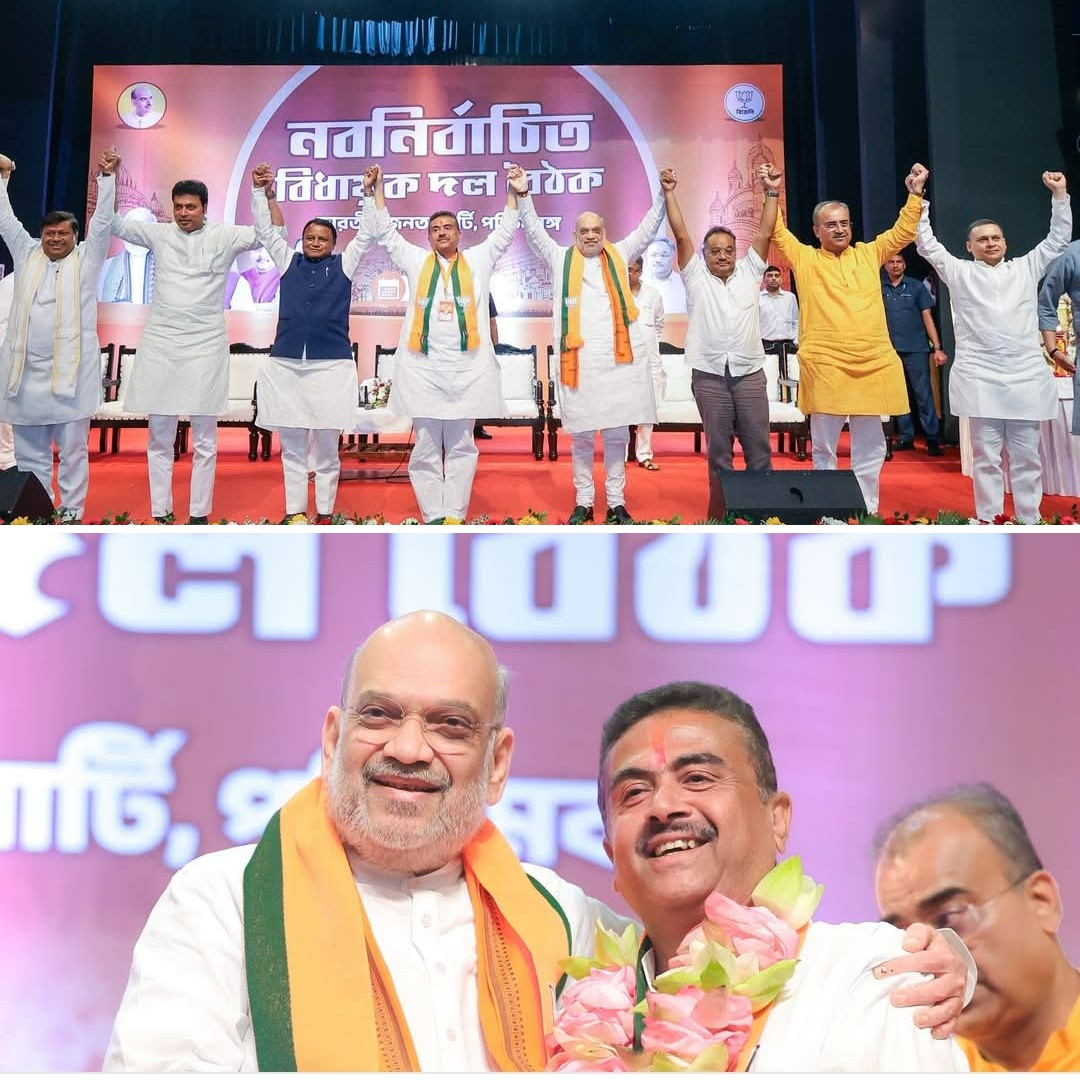
The rise of the BJP in West Bengal marks the beginning of a corrective phase after decades of accumulated institutional exhaustion. This is less about electoral arithmetic and more about recovering civilisational confidence. Whether one agrees politically or not, that emotional undercurrent clearly exists.
The expectations are enormous –When the new government inherits structural economic stress, unemployment, industrial decline, infrastructure gaps, political polarisation, administrative distrust, and long-standing governance distortions- repairing Bengal can never remain a short-term exercise. It requires institutional reconstruction, industrial revival, logistics modernisation, border management, educational reform, urban renewal, investment confidence, and social stabilisation simultaneously. Few states carry this level of layered complexity.
Still, Bengal retains unusual strategic advantages that, if properly identified and strategically harnessed, can help the government rise above many of the long-standing impediments facing the state-
Its geography alone gives it long-term relevance. Access to the Bay of Bengal, proximity to the Northeast, river systems, ports, rail corridors, maritime routes, border trade points, and cultural connectivity with eastern South Asia place Bengal in a potentially decisive position within India’s eastern growth architecture. If managed properly, Bengal can become one of the principal logistical and economic gateways linking mainland India with BIMSTEC economies, Southeast Asia, and the Indo-Pacific space.
What Bengal now requiring is less politics more statecraft-The future of eastern India will likely depend heavily on logistics corridors, manufacturing revival, digital infrastructure, inland waterways, energy connectivity, maritime commerce, and cross-border trade ecosystems. Bengal sits at the centre of many of these possibilities. A revitalised Bengal changes the economic geometry of eastern India itself.
The aspiration is for a Bengal that is economically functional, intellectually respected, culturally rooted, spiritually confident, and nationally consequential again.
For generations, Bengal gave India philosophical depth, emotional force, artistic imagination, revolutionary courage, and intellectual direction. The hope now is that Bengal rises once more, not only for electoral change or economic growth, but as part of a larger civilisational continuity that history interrupted but never fully erased.