






By Our Correspondent
KOLKATA:As of April 29, afternoon (Phase 2 of West Bengal Assembly elections), voting is ongoing in the remaining ~142 seats, with Phase 1 (152 seats, held on April 23) already completed at a record ~93% turnout.
Recent reports show ~61.11% turnout till 1 PM in Phase 2 (with some sources noting a surge toward 78.8% by 3 PM in related updates). High turnout (often 60%+ by early afternoon) is common in Bengal due to strong mobilization, and final figures for Phase 2 could easily reach 85-90%+ by evening, similar to Phase 1’s historic 92-93%.
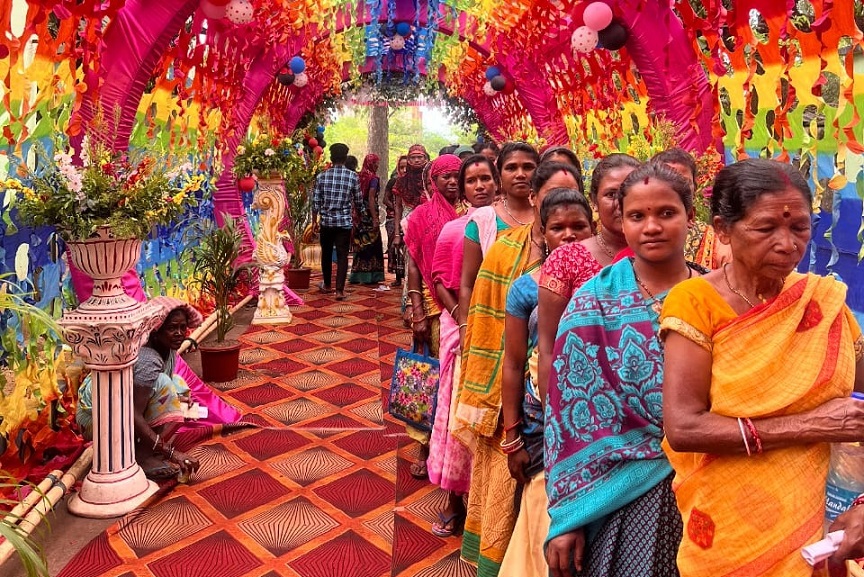
Phase 1 (April 23): Record 93.19% turnout after scrutiny — the highest ever in the state. Districts like Cooch Behar (~96%), South Dinajpur, Malda, etc., saw massive participation. High turnout occurred even in areas with voter list revisions (Special Intensive Revision/SIR deletions).
Phase 2 (today, April 29): ~61% by 1 PM, with higher figures in districts like Purba Bardhaman (66.8%), Hooghly (64.5%), etc. Many reports highlight strong participation in Hindu-majority areas, though both TMC and BJP are claiming the surge favors them.
Overall election: 294 seats total; majority needs 148. Voting in two phases; counting on May 4, 2026.
High turnout doesn’t automatically predict a winner — parties spin it differently (TMC often links it to consolidation in its bases/minority areas; BJP to anti-incumbency and “change” sentiment). Historical patterns show Bengal has very high baseline turnout, and surges can reflect mobilization on both sides rather than a clear wave.
Pre-poll surveys and early trends point to a tight contest between TMC (All India Trinamool Congress, led by Mamata Banerjee) and BJP, with no clear landslide:
Opinion polls (pre-poll, various agencies like Matrize-IANS, Vote Tracker, etc.): TMC projected at 155-200+ seats (still majority in many surveys), BJP at 100-115+. Some give TMC a clearer edge (180-190+), while others show BJP gaining significantly from 2021’s 77 seats.
Prediction markets (e.g., Polymarket with real money bets): Very close, with BJP holding a slight edge (~52% chance of forming government) vs. TMC (~47-48%). This reflects bettors seeing momentum for change but acknowledging TMC’s organizational strength.
TMC strengths: Strong rural/muslim/minority consolidation, incumbency in many areas, welfare schemes, and local cadre mobilization. High turnout in certain pockets (including minority-dominated ones) is often interpreted as favoring TMC.
BJP strengths: Gains in Hindu-majority and urban/semi-urban areas, national anti-incumbency narrative (jobs, development, “poriborton”/change), and claims of fear-free voting. Leaders like Amit Shah have predicted BJP crossing 110+ in Phase 1 alone and forming government overall.
Regional splits: Phase 1 (more rural/northern areas) and Phase 2 (including parts of South Bengal, Kolkata influence) may show variations. Past elections show Bengal votes can defy simple “high turnout = anti-incumbent” logic.
Most probable as of now (pre-counting): TMC likely to retain power with a reduced majority (possibly 150-180 seats), while BJP makes substantial gains (110-130+ seats) and emerges as a much stronger opposition. A BJP upset majority is possible but less probable based on most polls — it would require a bigger swing among non-minority voters than currently projected. Smaller parties/Left/Congress are expected to be marginal.
This is highly fluid — actual results on May 4 could shift based on booth-level trends, violence reports, voter list issues, and last-minute swings. Exit polls (if released) and early counting trends will clarify more. Bengal elections are often decided by narrow margins in many seats, with strong local factors (candidates, booth management, alliances).