







By Our Correspondent
BHUBANESWAR: Even as India advances steadily towards becoming a leading
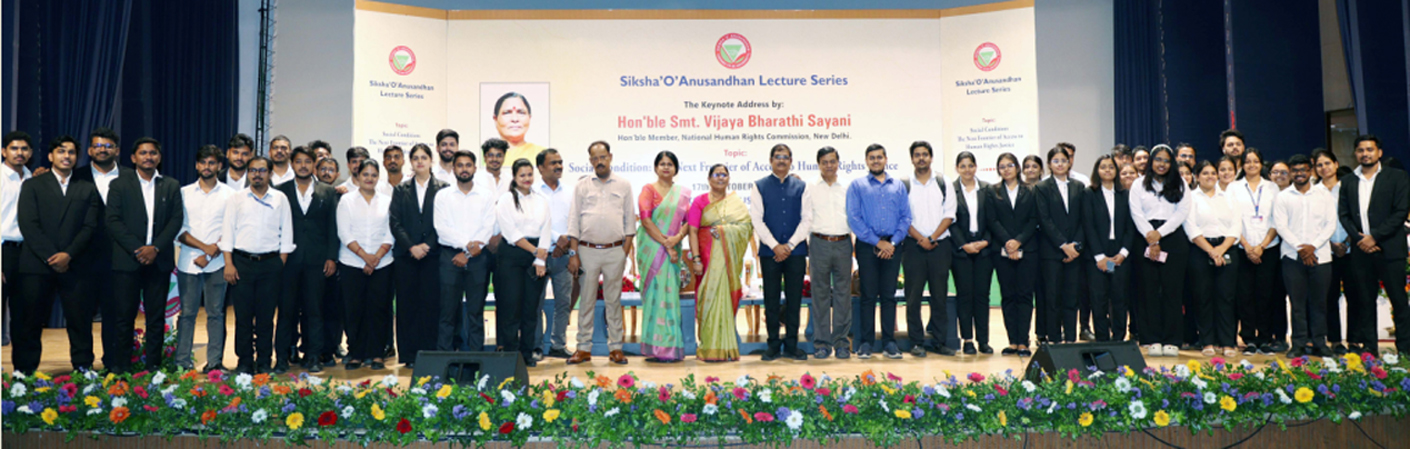
global economic power, challenges such as poverty, caste discrimination and gender inequalitycontinue to focus on the collective effort required to strengthen the foundations of thedemocracy, Ms. Vijaya Bharathi Sayani, Member of the National Human Rights Commission(NHRC), observed .
“India is witnessing an era of rapid technological advancement and economic
transformation. Yet, alongside this remarkable progress, we are also reminded of the social
realities that call for renewed commitment to inclusivity and justice,” Ms. Sayani said while
addressing students and faculty members at Siksha ‘O’ Anusandhan Deemed to be University here.
Referring to the October 2025 World Bank Report, she pointed out that around 342
million Indians—accounting for about 23.8 per cent of the population—lived on an income
equivalent to 4.20 US dollars a day, with states like Uttar Pradesh, Bihar and Maharashtra facing higher rates of poverty. “These three states account for nearly 46 per cent of India’s poor.
The government has been making lots of efforts to alleviate poverty over the last 15 years, yet deprivation continues to remain a pervasive shadow,” she noted. Highlighting the gap between legal entitlements and lived realities, Ms. Sayani emphasized that ensuring affordable and equitable access to justice was essential, so that no
citizen was deterred from seeking redress due to financial constraints.
Referring to the India Justice Report 2025, she highlighted the importance of
strengthening access to justice so that no individual was denied liberty due to economic hardship.
She noted that enhancing legal aid and ensuring timely bail can help reduce overcrowding inprisons, particularly in states like Uttar Pradesh, Bihar, and Maharashtra. “Empowering the underprivileged with equal legal opportunities is vital to fulfilling the Constitution’s promise ofequality before the law,” she emphasized.
Presided over by Prof. Pradipta Kumar Nanda, Vice-Chancellor of SOA, the program
also featured addresses by Prof. (Dr.) Neeta Mohanty, Pro-Vice Chancellor and Prof. Jyoti
Ranjan Das, Dean (Students’ Welfare).
Ms. Sayani described the National Human Rights Commission, established under the
Protection of Human Rights Act, 1993, as a crucial guardian of justice and dignity for the
marginalized. “The NHRC is not merely a bureaucratic entity but has become a lifeline for the poor and underprivileged,” she affirmed.
Over the past 32 years, the NHRC has handled more than 23.79 lakh cases, including
2,981 of which had been taken up suo motu, and has provided monetary relief amounting to Rs. 263 crore in 8,924 cases, she informed. “These figures reflect not just the scale of our work, but our unwavering commitment to upholding the rights and dignity of every citizen,” Ms. Sayani concluded.