



By Our Correspondent
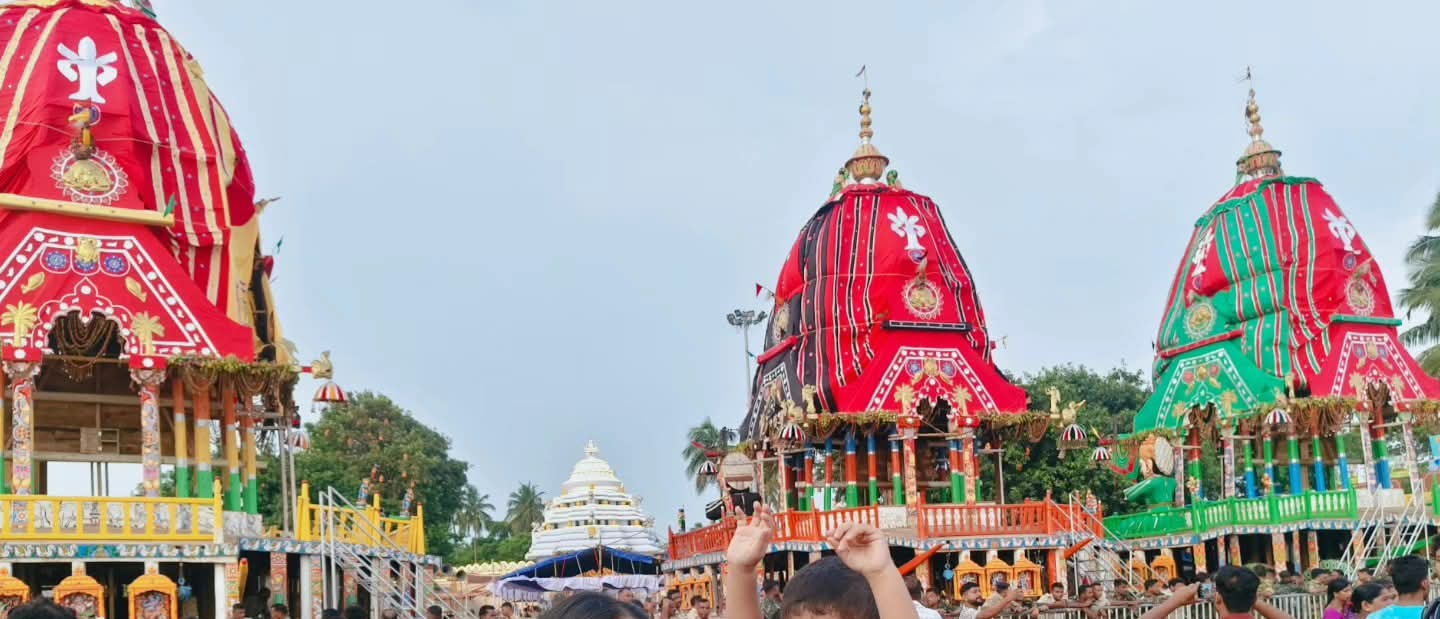
BHUBANESWAR: The “Tahiya issue” refers to the controversy during the 2026 Rath Yatra in Puri, Odisha, where Lord Jagannath appeared without his traditional floral headgear (Tahia) during the Pahandi procession.
What is Tahia?
Tahia is an elaborate, large floral crown (tiara/headgear) made of flowers, bamboo, cane, and other materials. It is a key traditional adornment for the deities (Lord Jagannath, Balabhadra, and Subhadra) during events like Snana Purnima, Rath Yatra (Pahandi), Bahuda Yatra, and Niladri Bije. It is prepared at places like Raghab Das Mutt and symbolizes beauty and devotion. Devotees often seek pieces of it as prasad.
What Happened?
During the Pahandi (procession carrying the deities to the chariots) on or around July 16-17, 2026, heavy monsoon rains soaked the Tahia. It became extremely heavy, fragile, and broke/slipped off near the Anand Bazar area. Servitors removed the remnants to avoid delaying the procession and ensure safety. This was unprecedented in recent memory, leading to widespread dismay among devotees.
Explanations from Authorities
Servitors (Sevayats): They decided to remove it. The Daitapati Nijog Secretary and others explained that continuous downpour saturated the flowers, cane, and bamboo, increasing weight significantly. Combined with the swaying movement during Pahandi, it broke. It was secured initially at Chahani Mandapa, but conditions made it unsustainable. They emphasized no disrespect to tradition.
SJTA (Shree Jagannath Temple Administration): Chief Administrator Dr Arabinda Padhee clarified that rituals and adornments are under the autonomy of servitors. The administration oversees but did not direct removal. They viewed it positively as a practical decision. Rain during Rath Yatra is common, but this year’s intensity apparently exceeded what the structure could handle.
Who is Being Blamed?
Opposition Parties (BJD and Congress): They launched a strong attack on the ruling BJP-led government under Chief Minister Mohan Majhi. They accused it of “colossal administrative failure,” poor management of the festival, and failing to protect the Tahia despite predictable monsoon rains. Senior BJD leader Pramila Mallik and others claimed it hurt religious sentiments of millions of devotees. This has turned into a political storm.
Defence/Neutral View: Servitors and SJTA attribute it to unavoidable weather, not negligence. Some devotees and commentators urge against politicizing it, viewing such events as part of divine “leela” (play) of Lord Jagannath, and call for faith over blame.
Primarily weather-related (heavy rain), with the on-ground decision taken by servitors for practical reasons. The administration/SJTA’s role is more supervisory. The intense politicization by opposition parties frames it as government failure, which is typical in such high-visibility religious events in Odisha. There is no evidence of deliberate sabotage or major lapse beyond the challenges of managing a massive rainy-season festival.
Such incidents spark emotions because of deep devotion to Lord Jagannath. Focus remains on the smooth completion of the Yatra and respect for traditions.
No, the 2026 incident—where Lord Jagannath’s Tahia was removed/broke and was absent during the Pahandi procession due to heavy rain—appears to be unprecedented in recent history. Opposition leaders and reports described it as an “unprecedented” lapse, noting that for centuries, the deities have traditionally emerged fully adorned with the Tahia regardless of heavy rains or storms.
While no exact parallel (Tahia missing entirely during procession due to weather or administrative reasons) was found, there have been notable issues involving the Tahia:
2018 Rath Yatra: Significant controversy over devotees and volunteers tearing/damaging the Tahia of Lord Jagannath while it was being dismounted or removed. SJTA launched a probe using CCTV footage. Servitors and police were involved in the tearing, despite instructions for careful handling. This violated norms against damaging or touching the Tahia improperly. Similar lapses occurred with devotees trying to touch the deities during Pahandi.
These cases typically involve post-procession damage or over-enthusiastic devotees snatching pieces (a common devotional practice, though regulated), rather than the Tahia failing or being removed mid-Pahandi.
Tahia-related problems are often linked to crowd management, devotee fervor, or minor handling issues during removal. Historical Rath Yatra disruptions (cancellations or major issues) were usually due to invasions, attacks on the temple, or epidemics—not specifically Tahia failures.
The 2026 case stands out because of the weather-induced breakage during the procession itself, leading to political blame on the administration (unlike past handling controversies).
In short, the 2026 event is unique in its specifics, though Tahia damage/tearing has precedents, especially in 2018. Such incidents highlight the challenges of managing massive crowds and weather during this grand festival.
The perception that the Mohan Majhi (BJP) government has “failed” in managing the Rath Yatra since taking over in 2024 is a strongly held view among opposition parties (BJD and Congress), but it is contested.
Rath Yatra is a massive logistical and cultural event drawing lakhs (often millions) of devotees, so challenges like crowd surges, weather, and rituals are perennial. Smooth execution is often seen as a political benchmark in Odisha.
Here’s a balanced, fact-based overview:
Key Criticisms (Opposition Narrative)
2025 Rath Yatra: A major stampede near Gundicha Temple resulted in 3 deaths and dozens of injuries. Opposition (Naveen Patnaik/BJD, Congress) blamed poor crowd management, delayed medical response, and alleged prioritization of VIPs (e.g., Adani references in some critiques). The government faced heavy backlash, leading to transfers/suspensions of officials (Collector, SP, etc.), an administrative probe, and CM Majhi publicly apologizing/seeking forgiveness
2026 Rath Yatra (recent): The Tahia incident (missing headgear due to rain/breakage) was called an “unprecedented” lapse and “administrative failure” hurting sentiments. Additional complaints included crowd management issues and general mismanagement. Opposition launched joint attacks.
Critics argue repeated lapses (chariot pulling delays in some years, injuries, etc.) show incompetence compared to the long BJD era under Naveen Patnaik, when such events were seen as more tightly managed.
The administration has conducted reviews, deployed thousands of police/CAPF, installed CCTVs, set up evacuation corridors (post-2025 lessons), and coordinated with Gajapati Maharaja/servitors. CM Majhi has personally reviewed preparations multiple times.
Unavoidable weather/crowd dynamics, or isolated (not systemic failure). They point to action taken (probes, suspensions, compensation) as responsible governance.Rath Yatra has seen issues (stampede risks, devotee deaths, ritual lapses) across governments historically — it’s inherently complex.
There have been notable lapses and tragedies under the Majhi government (especially the 2025 stampede), giving opposition ammunition to claim failure. However, claiming total “failure since 2024” is partisan exaggeration — large festivals always carry risks, and the government has invested in scale (security, infrastructure). Public perception in Odisha often ties such events to the ruling dispensation’s competence, which explains the heat. Long-term, outcomes depend on investigations, preventive measures, and devotee feedback rather than political blame games.