









By Our Correspondent
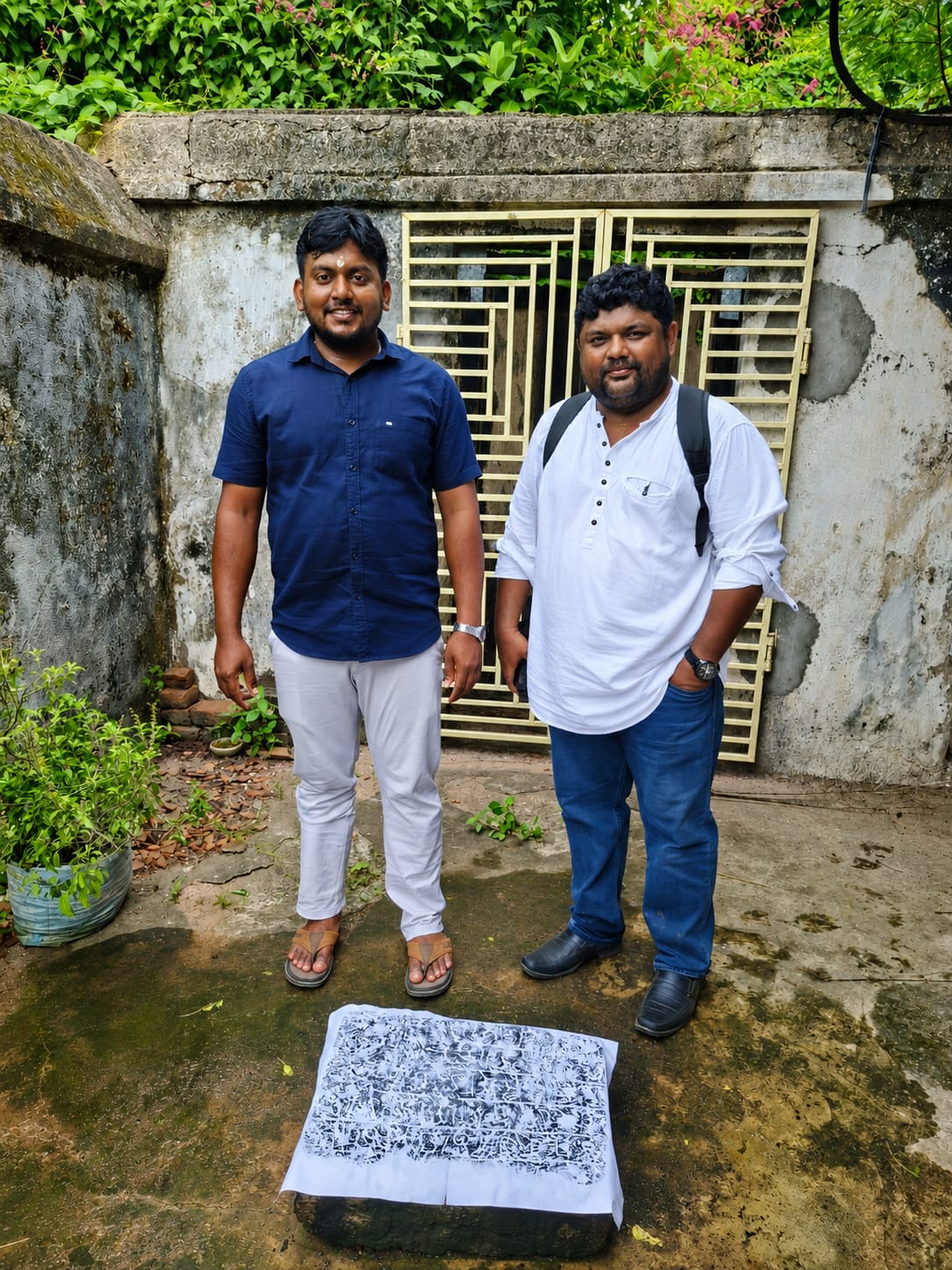
BHUBANESWAR:An inscribed stone dating to the period of Gajapati Kapilendra Deva has been found in Tekkali town of Srikakulam district, Andhra Pradesh. The inscription, which is of considerable significance to the history of Odisha, was traced by Deepak Kumar Nayak and Bikram Kumar Nayak, members of the Rediscover Lost Heritage Trust, an organisation engaged in researching and documenting the Kalinga heritage of South India.
Speaking about the finding, heritage researcher Deepak Kumar Nayak stated that information about this inscription had previously been published in the Annual Report on Indian Epigraphy for 1926–27. Based on this reference, the researchers contacted Sri Lalit Kumar Dev, a member of the Tekkali royal family. With Mr Dev’s assistance, they were able to locate the inscribed stone within the Tekkali royal palace.
The inscription had been lying beneath a Tulasi Choura, and a considerable portion of it had been damaged or lost over time. However, the researchers were able to collect an estampage of the inscription for further study and documentation.
The inscription is engraved in the Odia script and language. Although the first line has been completely damaged, the second and third lines contain the name of Pratapa Kapileswara, or Gajapati Kapilendra Deva. The fourth line contains the expression “Bijeraije”. Due to the damaged condition of the inscription, it is presently not possible to determine the regnal year of Kapileswara Deva in which it was engraved or the specific purpose for which it was issued.
Gajapati Kapilendra Deva ruled Odisha during the 15th century. Therefore, based on the palaeographic and historical context, the inscription may possibly belong to the 15th century, although its precise date will require further scholarly examination.
It may be noted that during the reign of Gajapati Kapilendra Deva, the territory of the Odisha kingdom extended from the Ganga in the north to the Kaveri in the south. Tekkali was formerly an ancient Odia zamindari of Ganjam and became separated from Odisha during the formation of the separate state of Odisha. Even today, a significant number of Odia families continue to reside in Tekkali.
Several inscriptions belonging to the period of Gajapati Kapilendra Deva have previously been discovered from other parts of present-day Srikakulam district, including Mukhalingam and Srikurmam. The discovery and documentation of this inscription at Tekkali therefore represents a significant new addition to the study of the history of Gajapati rule and the wider Kalinga heritage of South India.
The Rediscover Lost Heritage Trust has stated that further examination of the estampage and available historical records may help scholars establish the inscription’s precise date, context and historical significance.