By Kahnu Charan Panigrahi
PURI/BHUBANESWAR:Rath Yatra is the universal manifestation of Jagannath culture. It is beyond words how it floods the innermost souls of the entire human race with the emotional waves of a communal gathering. Jagannath is not an idol with round eyes, it is a sign, a symbol of every human being’s vision and creativity, which was outlined by some artist at some point in time, which is truly mysterious. This timeless wonder of Odisha is not only a belief but also an indelible reflection of power and consciousness. This eternal life of Odisha has been expressing Indian culture in an irrevocable bond of unity, solidarity, and friendship for ages. Jagannath culture is indispensable in Indian lifestyle; it is acceptable regardless of caste, creed. Odisha is famous for this Jagannath today. It has given a message of divine humanity. Jai Jagannath, Jai Bharat, this Jai Yatra is an endless Rath Yatra. The chariot path is unique, Jagannath is omnipresent. Jagannath is an example of worldly life.
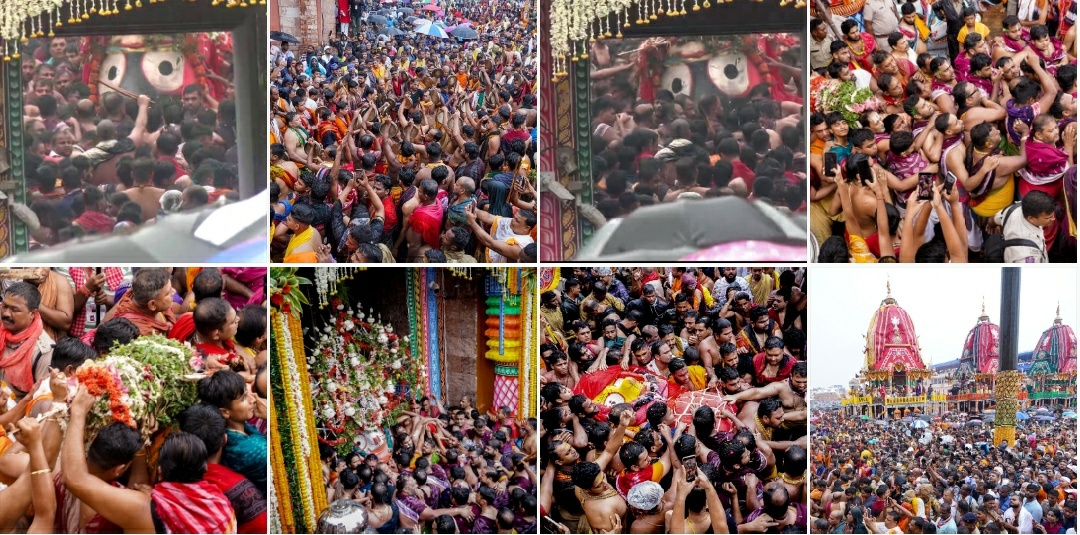
The day before the Srigundicha Yatra, the Netrosab ceremony is observed. The next day, the Srigundicha ceremony is observed and after the completion of the chariot construction work, the mesmerizing Pahandi ceremony of the Thakurs is performed. The procession of the procession arrives in a row on the Pahandi and the Chaturdhamurti is carried on the chariot. Then, the main attraction of the procession is the Chera Pahurra ceremony, which is completed by the Gajapati Maharaja, and three chariots are pulled towards the Gundicha temple. After the chariots are pulled and reach in front of the Gundicha temple, other rituals are performed on the chariot.
The Hera Panchami festival is an important event during the Rath Yatra celebrations. Usually, the Hera Panchami festival is celebrated on the fifth day of the Rath Yatra, i.e., the sixth day of the Asadha Shukla. It is said in the Yatra Bhagavata – Tato Gundichanantaram Panchami Diwase Hera Panchami Bhavati. It is known that the Hera Panchami ritual has been specially described in the Bamadeva Samhita. According to the description of the “Chakada Pothi” of the Puri Odia Matha, the chariot guarding the temple:
“After the seven kings had become kings under the name of Bhanu Vasudeva, Kapileshwar Dev made the order complete the Hera Yatra. Earlier, Lakshmi Narayan was worshipped with the help of mantras. On the fifth day of the Yatra, Kapileshwar made a golden Lakshmi and installed Hera Gohiri and performed Hera Panchami with the five Pandavas in a melodious manner.”
—-“Chakada Pothi”[24] Similarly, it is mentioned in Yatra Bhagavata –
“On the fifth day of Gundicaya, the goddess Sri Mahalakshmi is worshipped near the chariot of the goddess Grihatva.
Thus, the audience of Jagannath is the servant of the Devas.
He built a temple near Lakshmi, and the maidservant replied with these words. Then the great Lakshmi bowed down before the deity Jagannath. Then the deity Karpu night was dedicated. That night Lakshmi, who was a slave to the deity, offered obeisance to the deity. Then Jagannath offered Lakshmi alms in the palace. Then Lakshmi, with her heart full of love and affection, threw the deity Karpu at the deity. Then the deity respected her home. Lakshmi entered her own place. This was the journey of Hera.
There is a beautiful legend or legend about the Hera Panchami pilgrimage. That is, Jagannath, along with his brother and sister, was traveling to the Gundicha house in a chariot due to the death of his husband. Lakshmi Thakurani, the wife of the deceased, described the grief of her husband’s death to her sister, Vimaladevi, and sought advice on a remedy. This matter is described in the Bamadeva Samhita. Vimaladevi explained to Lakshmi in words of consolation that if the husband ever loses his conscience and considers the inaction to be actionable, then he has to be lifted up. Therefore, you should take the ashes and travel to the husband. In response to this advice, Lakshmi Thakurani went to the Gundicha temple on the fifth day of Srigundicha. Lakshmi secretly went from the temple to have darshan of Srijiu and, having darshan in private, enchanted the Lord in Mohanjan, she was ordered to turn the chariot southward for her return. As a result, the next day of Hera Panchami, the Lord’s blessings are given and the chariot turns southward.
As mentioned in the inscription of the Shri Jagannath Temple, on the day of Hera Panchami, the Lakshmi Thakurani who is worshipped in the Bhandar house of the Shrimandir is worshipped by the Palia Mahajan servants. After this, the Banak Lakhi, Pat Saree, Alankar etc. are put on and the Besh is done, and the Puja Panda servants offer Panti Bhog. Then, the Lakshmi Vijana kept under the Bat tree is worshipped.
The flight attendants carry the flight, carry it with a bell, a kahali, and an umbrella through the lion gate on a large pole and place it next to the chariot of Jagannath Mahaprabhu in front of the Gundicha house. Here, they offer the Patimahapatra prasad, perform the Vandanapana, perform the Chamar Alta, perform the Ghasa Bidiya, and perform the Hadi Patti. During this time, the Thakurs in the Gundicha house perform the noon incense and the saree and perform the alatti. After the alatti, the Panchamrut Mahasnan and the three Vads are performed in the enclosure of Jagannath Mahaprabhu and perform the Vesha. Then, in the evening, while the incense is taken, the Mahalakshmi chariot rises and sits, and the Jagmohan Jayavijay Dwara is approached. After the garland of prayers comes from the body of Jagannath and is given to Lakshmi, the worship is done, incense is lit, and the chariot is placed on the ground. After this, the flight of Lakshmi is placed near the Nachchana door of Jagmohan. There, the Bhitarchha Mahapatra Garabadu takes the handi from the Garabadu servant, performs the Bhandanapana, and performs the Dahi Patti. After the above rituals are completed, Lakshmi’s chariot is taken to Jagannath’s chariot and a wooden piece of the chariot is broken. After this, Lakshmi is taken to the big temple by the help of Hera Gohiri Sahi.
The humanistic trend is evident in the tradition of Jagannath consciousness. The pride and anger of husbands and wives are common. The pride of Lakshmi, the beloved wife, reaches its peak because she went to the birth altar with her brother-in-law and sister-in-law without taking Lakshmi on the Rath Yatra. She was very upset that she did not meet him after his wedding and did not take her with her brother-in-law. Therefore, to express her pride to her husband, at midnight on Heera Panchami, the Thakurani comes to the Gundicha temple in a Sankirtan procession on a Viman. Her maidservants come with her. Lakshmi performs the Rath Parikrama in their presence. At this time, the Rath is stopped in a special way. On the instructions of Lakshmi, the servant representing her breaks a piece of wood from the Nandighosha Rath. Who can tolerate a woman who ignores her and goes with her brother-in-law? A complete human drama takes place. Finally, Malakshmi sees Jagannath. Lakshmi and Jagannath are separated. Jagannath tries to explain Mahalakshmi, but the pride of the mother does not break. She returns to the temple in a rage and breaks the chariot. While leaving, she returns through the nasal door. The feminine anger and pride are clear from this. If there is no separation, there is no taste of union. Separation only brings intimacy in a relationship. Separation only increases the taste of sweetness in a relationship.
Then the preparations for the Bahuda Yatra begin. The Laxminarayan Bhet Nit, the Sunabesha on the chariot on Ekadashi, the Adarpana on Dwadashi, the Niladri Bije Pahandi on Trayodashi, the Laxmi Chahani Nit, the Manabhanjan, the offering of Rasagola, the installation of the Vibhishan in the Natamandap and then the installation of the Deity on the Ratnasinhasan are all observed with great devotion and devotion.
Although Sri Jagannath culture is the oldest culture in the world, it is always new due to its inherent creativity and flexibility. It has played a major role in creating harmony and harmony in human society by bringing unity among diversity. Devotion to the pursuit of the Supreme Truth is its pride, generosity, vastness and vastness are its glory and true faith is its glory. The aim of Jagannath culture is to create an ideal family, a prosperous society, a prosperous nation and a prosperous world.