






By Our Correspondent
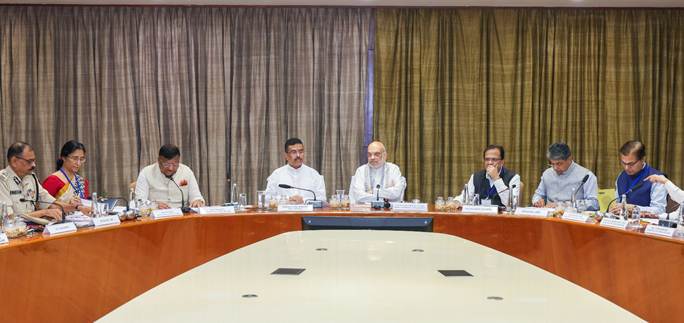
KOLKATA/BHUBANESWAR: Union Home Minister and Minister of Cooperation Shri Amit Shah chaired a review meeting on the West Bengal’s law and order situation in Kolkata, today. The meeting was attended by the Chief Minister of West Bengal, the State Chief Secretary, and senior officials from the Union Ministry of Home Affairs and the West Bengal government.
During the meeting, Union Home Minister Shri Amit Shah gave several important instructions to strengthen the state’s security apparatus, judicial system and police capabilities. Prioritizing women’s safety in rural areas, Union Home Minister directed the implementation of a ‘Women Outreach Programme.’ He emphasized the need to create awareness and empower rural women through regular interaction with officials. He also stated that the state government could directly contact the Union Ministry of Home Affairs (MHA) should any need arise in this regard.
To further strengthen the state’s internal security, emphasis was laid on taking necessary steps to establish an ‘Anti-Narcotics Task Force (ANTF),’ an ‘Anti-Terrorist Squad (ATS),’ and a ‘Special Investigation Agency (SIA)’—modeled after the NIA—within the state. Additionally, it was decided that the National Investigation Agency (NIA) would conduct a thorough review of all terrorism and UAPA-related cases concerning the state. Directives were also issued to remove illegal encroachments on government land in the state’s border areas.
Special emphasis was laid on capacity augmentation, infrastructure strengthening, and the development of state-of-the-art facilities for the West Bengal Police. Union Home Minister and Minister of Cooperation Shri Amit Shah assured that adequate budgetary support would be provided for the modernization of the state police and improvement of service delivery systems. In this process, a comprehensive review of the police force cadre will be conducted to increase its strength in line with the national average, and the number of police districts will be rationalized. Additionally, emphasis was placed on filling all vacant posts in a time-bound manner, reviewing training capacities, phasing out reliance on civic volunteers, and prioritizing the recruitment of constables.
A consensus was reached to convert one-third of the security camps established in areas formerly affected by Left-Wing Extremism into Public Service Centres to ensure the access to government services. Furthermore, directives were issued regarding capacity building in the cybersecurity sector, holding regular NCORD meetings to combat drug trafficking, and formulating a comprehensive flood management plan for Kolkata. At the end of the meeting, key priorities for immediate action were identified and the concerned agencies were directed to ensure their time-bound implementation.