








By Dr. Padmalochan Dash
BHUBANESWAR: The catastrophic crash of Air India 171—marked by dual engine flameout, control loss, and landing gear that remained deployed—demands urgent scrutiny of fuel manipulation as one among several covert sabotage vectors. While the official investigation has only just commenced and no conclusions can yet be drawn, the convergence of such anomalies necessitates a parallel inquiry into less-visible threat pathways. In an era of hybrid threats and symbolic infrastructure targeting, India must begin addressing the invisible vulnerabilities embedded within its aviation supply chains and maintenance ecosystems—before silence, oversight, or denial hardens into systemic failure.
Aviation Catastrophe Beyond Mechanical Failure
The Air India Flight AI171 crash, which resulted in the tragic loss of over 240 lives, presents a failure sequence so rare and so strategically anomalous that any standard mechanical diagnosis appears grossly insufficient. Within moments of take-off from Ahmedabad, the Boeing 787-8 Dreamliner suffered a catastrophic nosedive, preceded by a brief but frantic MAYDAY and followed by the complete disappearance of both propulsion and communications. This convergence of failures—dual engine flameout, frozen flight controls, and landing gear that remained deployed—suggests a scenario far more complex than pilot error or routine malfunction. In contemporary aviation, even a single engine failure triggers fallback protocols. The odds of both engines failing simultaneously, with zero mitigation response, indicate a systemic collapse that aligns more convincingly with the possibility of sabotage, particularly through tampering with the aircraft’s fuel systems. While causality remains to be determined through formal channels, these scenarios warrant strategic attention from parallel security and infrastructure protection perspectives.
Anomalies That Defy Operational Logic
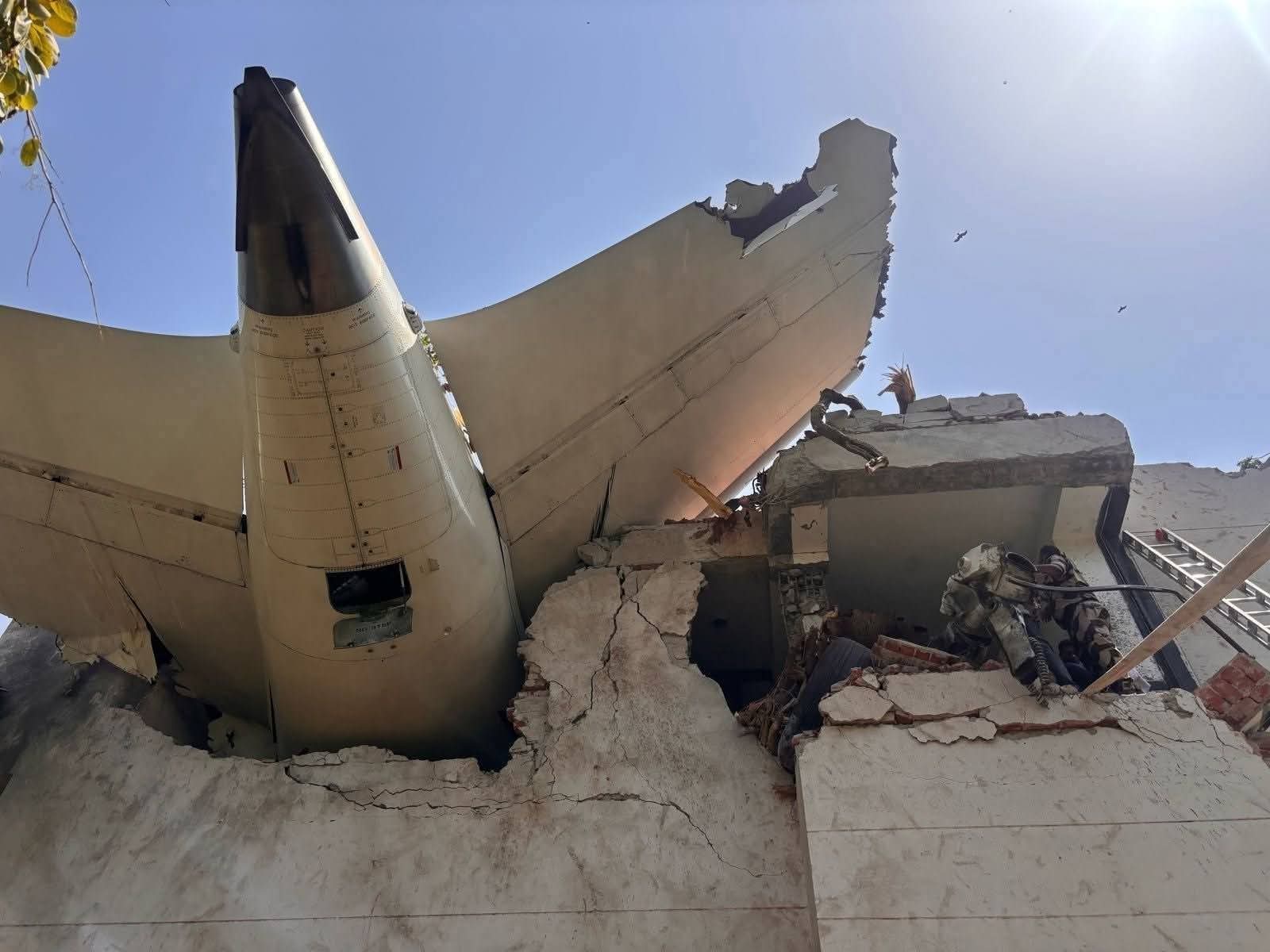
Several distinct anomalies surrounding the AI171 crash point to a sequence inconsistent with routine technical errors or pilot misjudgement. No external damage was reported—not because it was absent, but because the aircraft crashed within 30–60 seconds of engine thrust loss, descending vertically and impacting a medical canteen building before any external assessment could be made. This operational timeline conclusively rules out mid-air collision—which would have involved external disintegration—and primary investigation has also ruled out bird strike as a contributing factor. Furthermore, no environmental stress indicators have been observed that could explain the sudden systemic collapse. Flight data from cockpit voice and flight data recorders, so far indicative of a hard systems blackout occurring almost instantaneously after the MAYDAY call, with no indication of restart attempts, emergency glide procedures, or avionics recovery—each of which represents standard protocol during inflight engine failure. Additionally, ground-based surveillance shows the landing gear remained deployed during take-off, suggesting either a manual override or a cascading systems failure that disabled gear sequencing and retraction.
Critically, security audit trails must reveal gaps in vetting procedures for tarmac personnel and fuelling subcontractors, raising serious concerns about insider sabotage, fuel tampering, or unauthorised access to sensitive pre-flight systems. This tripartite failure profile—engines disabled, controls unresponsive, and landing gear deployed—closely mirrors operational sabotage, particularly scenarios involving chemical destabilisation or targeted contamination of fuel integrity, where multiple subsystems are compromised through a low-signature, non-explosive vector. These are investigable avenues that must now be weighed seriously alongside mechanical and procedural possibilities.
Geopolitical Undercurrents and Foreign Maintenance Contracts
The AI171 crash has exposed not only technical vulnerabilities but also geopolitical fault lines embedded within India’s civil aviation maintenance ecosystem. Of particular concern is the role of a Turkish aerospace and maintenance contractor reportedly involved in routine servicing or component overhaul of the aircraft in recent months. This association assumes heightened relevance given the deteriorating trilateral relations among India, Pakistan, and Turkey, with Turkey’s increasing alignment with Pakistan on diplomatic and strategic fronts, including vocal positions on Kashmir and open support for Pakistan in the recent India-Pakistan skirmish.
Recent developments indicate that the Government of India has issued exit notices and operational reviews to several foreign maintenance firms, including Turkish contractors, over security audit concerns and intelligence red flags. These moves come amid rising concerns that technical sabotage vectors—whether in the form of maintenance access, component swaps, firmware tampering, or fuel contamination—could be exploited by adversarial proxies under commercial cover. The potential exfiltration of maintenance logs, delayed reporting of component failures, or installation of compromised subsystems during routine servicing could form the basis of a strategic insider threat scenario.
In such a context, the absence of real-time oversight, indigenous maintenance capabilities, and secure audit trails transforms outsourced aviation maintenance from a technical necessity into a strategic vulnerability, one which adversarial states could have manipulated with plausible deniability. The case of AI171, when examined under this lens, strengthens the argument for a comprehensive overhaul of India’s foreign vendor policies, maintenance chain-of-custody frameworks, and geopolitical risk indexing within civil aviation protocols.
Fuel Sabotage: The Covert, High-Impact Vector
Fuel sabotage, despite its invisibility, is one of the most potent forms of infrastructure disruption, precisely because it bypasses conventional security detection mechanisms and leaves minimal forensic trace. Historically, chemical adulterants such as “viscosity disruptors,” “flash-point modifiers,” “microbial inoculants,” and “particulate destabilisers” have been introduced into jet fuel to subvert combustion efficiency under altitude stress. In the case of AI171, any such additive would have compromised the aircraft’s twin GEnx engines by preventing atomisation and sustained combustion at climb-out altitudes. These types of contaminants can evade basic fuel integrity tests, activate only under low-pressure thermal conditions, and generate a dual flameout scenario identical to what unfolded aboard AI171. Given the absence of visible wreckage patterns pointing to mechanical faults, this silent mode of disruption remains one of the most plausible vectors in this tragedy and must be assessed in parallel to technical forensics.
Even trace quantities of certain chemical agents can drastically alter the ignition profile of aviation turbine fuel. When such adulterants are introduced strategically—timed or targeted for altitude-based activation—they may cause “atomization failure,” “combustion dropout,” or “flameout under pressure variance,” which match precisely with the flight profile observed in AI171’s final moments.
Circumstantial Red Flags in the Ground Ecosystem
The investigation into the operational environment at Ahmedabad airport may reveal multiple fault lines that could have facilitated sabotage. Subcontracted fuel handling operations, minimal oversight in refuelling logistics, and low-tier security vetting of tarmac personnel converge to form a highly porous threat surface—a pattern that may emerge during the course of the inquiry. Pre-flight anomalies reported by crew and passengers—including unexplained odours, rattling components, and air-conditioning disruptions—suggest unresolved fluidic or electronic malfunctions potentially linked to fuel contamination or chemical sabotage. Compounding this are the inconsistencies observed during take-off, notably the landing gear remaining deployed, which may reflect a cascading systems failure initiated by the dual-engine flameout. In the absence of comprehensive cross-agency coordination and verification, this last-mile logistical interface remains dangerously exposed.
Fuel loading sequences must be scrutinised for irregularities in timing, last-minute tanker substitutions, or unscheduled personnel changes within the critical 72-hour pre-departure window. Surveillance blind spots, undocumented nozzle activity, or deviations in the secured fuel chain during this period could constitute actionable indicators of deliberate interference. The systemic failure to ensure real-time, tamper-evident chain-of-custody verification across these operational junctions warrants a comprehensive national security-level investigation, which may evolve as the official inquiry expands in scope.
Hybrid Threat Landscape and National Infrastructure Implications
India’s aviation sector is no longer a civilian-only domain; it has become a symbolic and strategic infrastructure arena vulnerable to hybrid attacks. Fuel manipulation as a sabotage vector is especially dangerous because it is low-profile, deniable, and easily replicable. The convergence of a Tata-owned Dreamliner, operated from an Adani-managed airport, amid rising geopolitical and ideological tensions, transforms AI171 from a civil aviation failure into a potential national narrative strike. Similar patterns can be seen in global precedents such as Pan Am Flight 103, where luggage sabotage was used to devastating effect, or EgyptAir Flight 804, where insider compromise was strongly suspected. The AI171 crash thus fits into a global continuum of high-value infrastructure disruption through covert, often under-investigated means. These linkages do not constitute conclusions but offer comparative indicators of risk.
Moreover, hybrid warfare increasingly leverages civilian platforms for symbolic destabilisation. The use of fuel sabotage as an invisible vector mirrors methodologies seen in broader fifth-generation conflict strategies—where “civilian infrastructure is weaponised via internal compromise.” If AI171 is treated as merely a technical error, India risks missing a critical inflection point in its threat-response architecture.
Immediate National Security and Policy Imperatives
India must urgently recalibrate its investigative and policy response frameworks to treat the AI171 crash as a possible act of strategic sabotage, to be considered alongside mechanical and procedural failures. This requires initiating a full-spectrum chemical audit of residual fuel, reconstructing the entire custody trail from refinery to aircraft, and deploying a multi-agency task force comprising DGCA, IB, RAW, NSG, and NIA under a sabotage-led threat matrix. It is imperative to bring civil aviation under the legislative purview of the proposed Critical Infrastructure Protection Act (CIPA), with statutory enforcement capabilities and doctrinal upgrades for ideologically vetted access controls. Moreover, silent filtration systems must be embedded across the contractor ecosystem using behavioural analytics, digital footprint tracing, and financial risk modelling to detect ideological infiltration or compromised insiders.
Also crucial is the institutionalisation of “sabotage simulation audits” and “red-teaming” exercises within civil aviation hubs to stress-test systems against insider-driven contamination vectors. These must become standard operating practices, not emergency responses.
A National Lens, Not Just an Aviation Inquiry
Fuel manipulation is one of the most elusive yet devastating tools in modern sabotage architecture. Its traceability is low, but its potential for mass casualty and symbolic impact is extreme. In the case of AI171, ignoring the fuel sabotage hypothesis would not only mean abandoning a plausible investigative pathway but would also signal to adversaries that India’s infrastructural resilience ends at the airport gate. If rigorously investigated, this incident could become a turning point in India’s approach to infrastructure protection, embedding counter-sabotage doctrine into the core of national aviation and security policy. The task now is not merely to identify mechanical errors but to confront a silent, invisible vector that could otherwise strike again.
This is not conjecture—it is pattern recognition. And if the nation fails to respond with structural intelligence, the next strike may not wait for ambiguity.
(The writer, Dr Padmalochan Dash, is an eminent researcher in geopolitics and international security. He extensively writes on India’s global partnerships, including its relations with South Asian and Southeast Asian countries. Views expressed are personal.)