By Our Correspondent
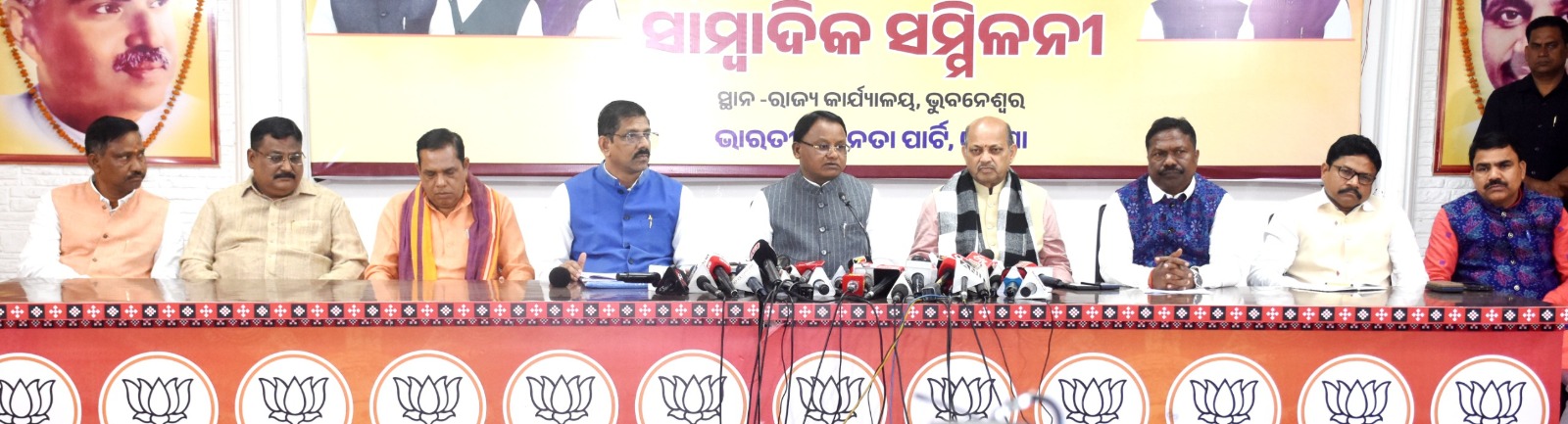
BHUBANESWAR:Under the leadership of the eminent Prime Minister Shri Narendra Modiji,VB-G RAM G Bill has been passed in the Parliament and enacted into law. The aim of this scheme is to create a developed India by 2047. The goal of developed India has been added through the name of this law. The purpose of developed India is how to actually achieve Mahatma Gandhi’s goal of rural self-employment. Our aim is not to gain political benefits by using his name alone. The opposition parties are doing various kinds of propaganda. They are describing it as anti-farmer and anti-poor. But extensive provisions have been made in this law for the welfare of farmers and workers, said Chief Minister Shri Mohan Charan Majhi at a press conference held at the state office.
Shri Majhi said that many attempts have been made before and after independence to increase the income of Indian farmers and the poor. There was a famine in India between 1876 and 1878. This was the last time a Famine Board was set up during the British rule in 1880. In this, work was compulsory to provide relief to the people. But the people had no rights. After independence, according to Article 41 of the Constitution, the Central Government realized that it was a moral responsibility to provide work to the people, keeping in mind the economic resources of the country. But the responsibility of implementing it was left to the state governments.
In 1960 and 1971, new schemes were made for rural employment. It was stated that if there was work, then work would be provided to them. But no work was created for the people at all. No priority was given to how people would get regular work and their financial income would increase. Due to the bottlenecks, poor farmers and labourers were exploited. Similarly, due to failure in administrative implementation, these schemes were often unsuccessful. Many such schemes were launched in the subsequent phases, but they all failed. Due to lack of focus, weak decentralization and corruption, these schemes have not been successful at various times. They have never been effective for the poor and the workers.
The National Rural Employment Guarantee Act (NREGA) was launched in 2005. This scheme has been implemented across the country for the last 20 years. In 2009, the scheme was renamed as Mahatma Gandhi National Rural Employment Guarantee Act (MGNREGA). But no changes were made to its basic structure. The UPA government implemented this scheme to gain political benefits using Gandhi’s name. Although there was a provision for providing 100 days of guaranteed employment, in reality only 50 days of work was provided. Similarly, the allowance that was given was very negligible. Corruption was also seen in this scheme in various states at that time. Dead and ineligible beneficiaries were added to this scheme by showing false master rolls. There were widespread irregularities in the payment of wages. During the UPA government, all these corruptions were planned. In Bihar, there was corruption of Rs 6,000 crore and in Uttar Pradesh, there was corruption of Rs 10,000 crore. Odisha was also not left out of this. In 2012, in Sambalpur, wage money was withdrawn in the names of some deceased, sick and old age pensioners. False employment opportunities were created in the master roll. Some road works were looted without even completing them. No attention was paid to the menstrual problems in Mrinnagar. Due to lack of administrative foresight, the real objectives of the scheme could not be achieved. This scheme failed due to structural weaknesses and inefficiency. This scheme was widely open to corruption. Similarly, there was a failure in the payment of unemployment allowance.
To prevent all these corruptions using technology and to successfully implement the scheme, the legendary Prime Minister Modi has introduced the VB-G RAM G Bill. The new scheme has made provisions on how to move towards development by implementing Gandhiji’s dream of bringing Gram Swaraj.
The framework has been made with a target of 2047. The period of employment has been increased from 100 days to 125 days. That is, it has been clarified that a family in rural areas is now entitled to employment for 125 days. The new scheme can help in increasing various products in villages. 90:10 for the North-Eastern states, 100 percent for the Union Territories and in other states, the Central Government will spend 60 percent and the State Government 40 percent. As a result, coordination between the Centre and the States will increase. In this, the responsibility of both the Centre and the States will increase. Four major sectors have been included in this scheme.
These are: promoting water security and water-related activities, strengthening basic rural infrastructure, expanding livelihood opportunities and preparing for adverse weather events. Keeping in mind the interests of farmers, this work will be completely stopped during the cultivation and harvesting seasons. This period has been kept for 60 days in a year. This will eliminate the problem of labor shortage in the agricultural sector and stop the problem of unreasonable wage increase. As a result, no one can commit corruption by saying that work is being done at that time. Sanitation can be brought about through AI, GPS and mobile. It has been made mandatory to pay an allowance if work is not provided within 15 days of requesting work. Chief Minister Shri Majhi said that these reforms in the law have been made to propagate the principles of Mahatma Gandhi.
On this occasion, State President Shri Manmohan Samal, Minister Shri Rabi Narayan Naik, Dr. Mukesh Mahaling, Shri Nityananda Gand, Government Deputy Chief whip Shri Govinda Das, MLA Shri Babu Singh, Shri Ashrit Patnaik, State General Secretary Shri Sarada Prasad Satpathi were prominently present.