



By Dr. Padmalochan Dash
NEW DELHI: Seen through global political practice, leadership success is rarely accidental. From Washington to Beijing, Moscow to Tokyo, durable power systems invest in execution-layer leadership long before public narratives register institutional shifts. It is within this global grammar of power that the Bharatiya Janata Party’s M.A. (MODI–AMIT) master stroke must be understood. The invention of Nitin Naveen as the top organisational authority reflects this same logic. It marks a calibrated intervention that transcends generational repetition and consolidates organisational continuity through reinvention rather than inheritance.
- With a Structural Logic of Power Continuity
Across contemporary political systems, a consistent structural logic of power continuity and leadership creation becomes visible once analysis moves away from individual personas and toward institutional design. In the United States, political authority is sustained through dense ecosystems of party organisations, legislative institutions, policy networks, donor structures, and state-level executive pathways. Leadership transitions are prepared well in advance of electoral cycles, while continuity persists even under polarisation. China institutionalises leadership continuity through cadre-based succession within the Communist Party. Authority is stabilised through long-term grooming, loyalty calibration, and sequenced generational elevation, rendering leadership change a managed internal transition rather than a public rupture. Russia follows a centralised vertical power model, where authority flows through disciplined intermediaries, limiting the emergence of parallel centres of command. Turkey operates through ideological–organisational discipline in which cadre loyalty and continuous internal renewal preserve dominance. Japan reinforces continuity through factional grooming and institutional memory, where leadership rotation coexists with policy stability.
Leadership across systems reflects a shared structural principle. It is cultivated rather than improvised. Execution-layer formations carry weight equal to vision-setting institutions. Organisational depth safeguards against political entropy. India mirrors this pattern through the organisational evolution of the Bharatiya Janata Party, where a three-tier architecture of political power has taken shape: strategic vision articulation at the national level, disciplined organisational control across party structures, and execution-oriented leadership. This institutional design, with the personal charisma factor aligned, sustains durability and adaptability within a competitive but degrading democratic ecosystem.
- The Master and the Art Factors
The selection of Nitin Naveen brings into relief the internal mechanics of the M.A. factors within the Bharatiya Janata Party. The move must be read within the party’s longer political history rather than as an isolated organisational adjustment. Since the 1990s, the party has expanded through ideological clarity, electoral discipline, and an accumulating record of governance credibility. This trajectory has produced durable public confidence in its capacity for continuity, stability, and decisiveness. That accumulated legitimacy now permits recalibration without systemic risk.
The M.A. framework reflects a division of political labour. National narrative consolidation, long-term strategic direction, and governance legitimacy associated with Narendra Modi operate alongside organisational discipline, cadre management, and electoral structuring shaped by H.M. Amit Shah. This synchronisation is made to follow the institutional ethos long cultivated by the Rashtriya Swayamsevak Sangh. Cadre formation, internal discipline, loyalty calibration, and generational grooming restrain drift and stagnation. Leadership within this system remains functional, accountable, and institutionally embedded.
The elevation of Nitin Naveen must also be read against the post–Ram Mandir movement political phase. With a central civilisational objective achieved, public expectations now concentrate on governance quality, institutional reform, and systemic reforms. These expectations extend beyond executive and legislative domains into bureaucratic and judicial functioning while advancing a wider project of social re-engineering toward a consolidated Sanātana reinvention.
Internal organisational discipline and executional clarity therefore become prerequisites for sustaining reform expectations without institutional incoherence. Within this coordinated structure, Nitin Naveen is experimentally made to function as an executional intermediary. His role therefore must embody the party’s preference for institutionally aligned leadership capable of translating strategic intent into disciplined organisational conduct, capable of vote harvest, which any party or government in a democracy must desire as its end goal.
So, the M.A. factors operate here to select him as Executive President and should not be seen as abstract leadership traits, but as a structured, calculated, and well-advised operating system shaped beyond the visible organisational surface. Here, execution-layer leaders are positioned to manage generational transition, preserve equilibrium, and prevent inertia and plausible opposition within entrenched senior strata.
- Where Nitin Naveen Fits In – The Ideological Organisational Judgement
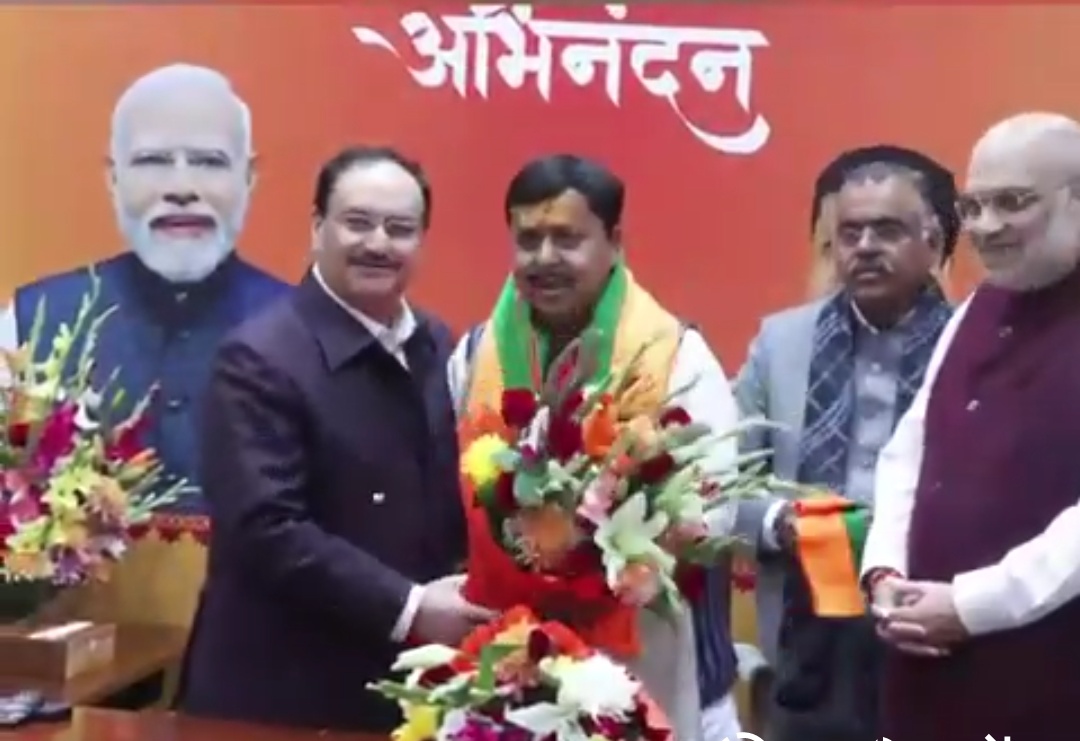
The placement of Nitin Naveen reflects the executional plane of the M.A. configuration operating at the national level. His elevation as National Executive President illustrates how decision-makers at the core engineer the translation of strategic vision into organisational command. This organisational choice therefore must follow the doctrinal discipline historically cultivated by the Rashtriya Swayamsevak Sangh. Through decisions so calibrated, it is for the core command to establish legitimacy within this system in accordance with the requirements of command, and therefore to present this move as a master stroke directed towards central command consolidation.
At the systemic level, this must be seen as positioning that functions as a calibrated internal corrective mechanism which renews leadership without rupture, moderate inertia within entrenched senior layers, and manages generational transition through structured institutional insertion rather than episodic adjustment. At the ground level, it also raises the question of whether it disturbs the corresponding expectations of senior workers who have worked to transform organisational depth and upon whom public expectations remain centred as pro-reform leadership. Therefore, if this is a decision of reform grounded in institutional performance across democratic pillars, it must be seen as apt. What is deduced is that national vision and organisational command remain stabilised at the apex, while execution is entrusted to leadership whose authority is derived from institutional embeddedness and command credibility rather than representational prominence.
- The Strategic Logic Behind the Move
The M.A. master stroke operates through a structured three-plane configuration. Long institutional logic defines its operation. The narrative plane places governance credibility and national purpose at the centre of legitimacy under Narendra Modi. In the post–Ram Mandir phase, civilisational mobilisation recedes, while reform expectations rise. At the structural plane, H.M. Amit Shah consolidates organisational effectiveness through disciplined cadre management, leadership calibration, and alliance structuring. Internal hierarchy and accountability prevent drift and complacency. At the execution plane, leadership of the Nitin Naveen type converts strategy into practice. This layer combines organisational credibility, administrative orientation, youth connect, and institutional loyalty. It stabilises the system while restraining inertia within entrenched leadership formations. Together, this triadic configuration aligns narrative authority, organisational discipline, and executional capacity into a single operating grammar. Transition and institutional recalibration are managed across electoral cycles rather than addressed reactively.
- Why It Matters Politically to the Future
The significance of the master stroke lies in its structural reinforcement of the BJP’s long-term political project. The party’s rise has been rooted in ideological clarity, organisational discipline, and governance outcomes. Accumulated credibility now permits leadership recalibration without systemic disruption. The organisational philosophy of the RSS privileges disciplined succession, cadre formation, and institutional accountability over personality-driven authority. In the post–Ram Mandir phase, governance performance and reform expectations dominate public perception. Internal recalibration becomes necessary. The master stroke restrains inertia, manages generational transition, and grounds the party’s future in institutional depth.
- The Bottom Line
The M.A. master stroke must not be read as an appointment manoeuvre. It reflects a system-design approach to political continuity shaped by organisational experience, governance delivery, and ideological consolidation. Leaders such as Nitin Naveen function as executional components within a larger institutional architecture. The move is anticipatory. It prepares the party for future political cycles through controlled transition, organisational preparedness, and institutional resilience. Public-facing visibility is rendered secondary to structural endurance once power consolidates.
Conclusion
The invention of Nitin Naveen is not incidental. It is a calibrated intervention that deliberately transcends generational repetition. It represents organisational reinvention through executive tonality. Continuity, adaptability, and political resilience flow from this decision of the Master and the Artist.
(Dr. Padmalochan Dash is a scholar of National Security, International Politics, and Diplomacy, working at the intersection of strategic research, policy design, and civilisational studies. He functions as an independent strategic consultant, contributing to a wide spectrum of commercial, institutional, and social development initiatives. His work engages with critical infrastructure protection, national resilience architecture, geopolitical risk, governance systems, and long-cycle civilisational policy frameworks. He is actively involved in designing policy doctrines, strategic programmes, and knowledge platforms that integrate security, economy, culture, and development into cohesive national capability frameworks)