



By Our Correspondent
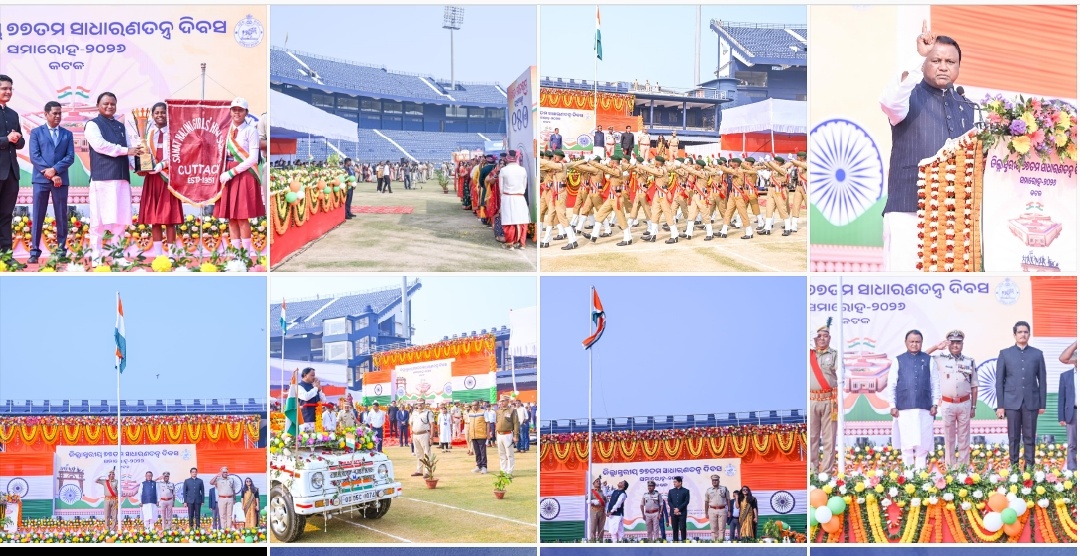
CUTTACK/BHUBANESWAR: On January 26, 2026, Odisha Chief Minister Mohan Charan Majhi delivered his Republic Day address at the historic Barabati Stadium in Cuttack, amid vibrant parades and enthusiastic crowds, marking the 77th Republic Day celebrations. The event was held in Cuttack, a city symbolizing Utkaliya culture, where Majhi unfurled the national flag and outlined a comprehensive vision for Odisha’s development.
The speech blended tributes to India’s constitutional heritage, praise for national progress under Prime Minister Narendra Modi, reflections on his government’s 19-month tenure, and an ambitious roadmap for “Viksit Odisha” by 2036—the centenary of Odisha’s formation as a separate state. This address served as both a celebratory reflection and a forward-looking policy statement, emphasizing inclusive growth, welfare, and anti-corruption measures.
Key Themes and Content
Tribute to the Constitution and National/Odisha Leaders: Majhi began by underscoring the Constitution’s enduring strength, describing it as not just a legal document but the “heartbeat of every Indian,” guaranteeing justice, liberty, equality, and fraternity to all citizens regardless of caste, religion, colour, or gender. He highlighted its adoption in 1949 and enforcement on January 26, 1950, as the foundation of India’s sovereign republic, and noted PM Modi’s establishment of Constitution Day on November 26 in 2015.
The CM paid tributes to national icons like Mahatma Gandhi, Jawaharlal Nehru, Subhas Chandra Bose, and B.R. Ambedkar, alongside Odisha’s freedom fighters such as Surendra Sai, Gopabandhu Das, and Madhusudan Das. In Odia, he emphasized how the Constitution binds citizens in brotherhood, offering “bhakti-poot shraddhanjali” to great souls and “pranam” to brave warriors. This section set a patriotic tone, linking national values to state pride.
National Progress Under PM Modi: A significant portion praised India’s transformation under Modi, positioning Odisha’s growth within the national narrative. Majhi lauded economic milestones, such as India becoming the fourth-largest economy (soon third), initiatives like Make in India, self-reliance (Atmanirbhar Bharat), and the Blue Economy.
He highlighted welfare schemes including Swachh Bharat, Ujjwala Yojana, Ayushman Bharat, PM Awas Yojana, GST, Kisan Samman Nidhi, Digital India, and the New Education Policy (NEP) 2020, which have lifted 25 crore people out of poverty.On security, Majhi commended Modi’s “Ghar mein ghus ke marenge” (strike enemies in their homes) doctrine against Pakistan-backed terrorism, citing operations like Uri, Balakot, and “Operation Sindoor” as decisive actions that ended terror eras and showcased indigenous weapons. This alignment with central BJP policies reinforced the “double-engine sarkar” (BJP at both state and center) narrative.
Odisha’s Achievements and Vision for 2036: Majhi detailed his government’s progress since June 2024, framing Odisha as a “welfare state” aligned with Modi’s “Sabka Saath, Sabka Vikas, Sabka Vishwas, Sabka Prayas.” He expressed confidence in achieving “Viksit Odisha” by 2036, aiming for top-five state status through collective efforts across citizens, regions, and districts. Key priorities included adapting to technological changes, with special focus on the poor, farmers, youth, and women.
Women Empowerment and Safety: Quoting “Yatra Naryastu Pujyante, Ramante Tatra Devah” (where women are respected, gods reside), Majhi declared women’s development essential for prosperity.He highlighted the Subhadra Yojana, approved in the first cabinet meeting, benefiting over one crore women in eight months with Rs 89,862 crore (30% of the budget) allocated for women’s programs in education, health, transportation, and livelihoods. Odisha leads in the Lakhpati Didi scheme. On safety, he enforced “zero tolerance,” noting conviction rates for crimes against women rose from 6.9% in 2023 to 41% in early 2025, exceeding 62% by June, declaring jail as the only address for perpetrators without political protection.
Education: Majhi criticized the previous government for “cosmetically painted schools” and stressed building infrastructure-based institutions.He referenced the Godavarish Mishra Adarsh Primary School in Banpur as a national model with world-class facilities, enabling rural children to compete with urban ones. Odisha fully implements NEP-2020 (delayed elsewhere for politics) and allocates over 14% of its budget to education.
Healthcare: The Ayushman Bharat-Pradhan Mantri Jan Arogya Yojana, combined with Gopabandhu Jan Arogya Yojana, benefits 3.5 crore people; Ayushman Vaya Vandana supports seniors. Majhi noted the scheme was stalled previously due to politics but implemented post-BJP victory.
Farmers and Economy: Farmers, termed “annadatas,” receive paddy at Rs 3,100 per quintal, boosting incomes by Rs 61,000 annually via schemes like PM-KISAN and diversification into fisheries and animal husbandry. Industrialization saw 300 projects worth Rs 7.7 lakh crore approved, with 85 (Rs 2 lakh crore) inaugurated, creating 1.65 lakh jobs across districts. Policies like Odisha State Road Policy 2025 and AI Policy promote transparent governance.
Anti-Corruption and Governance: Odisha’s Vigilance Department is hailed as the country’s best, with over 50% conviction rates; no protection for corrupt officials regardless of affiliation.Over 400 services are online, Mondays dedicated to grievance redressal, and development councils address regional disparities in western, southern, and northern Odisha. Cultural initiatives include heritage villages, Odia in governance, and UNESCO push for Bali Yatra.
Youth and Future Opportunities: The coming years are “years of opportunity” for youth, with jobs in government and private sectors. Majhi ended optimistically: “We will succeed, definitely succeed’.
Analysis: Politically, the speech is a strategic BJP narrative, aligning Odisha’s progress with Modi’s national vision while subtly critiquing the previous BJD government under Naveen Patnaik for delays in schemes like NEP and Ayushman Bharat, superficial education reforms, and low conviction rates in women’s safety cases.
This “targeting” positions the BJP as a reformist force, emphasizing “double-engine” synergy to counter long-standing BJD dominance. The anti-Pakistan rhetoric on terrorism bolsters nationalist appeal, potentially resonating in Odisha’s electoral landscape ahead of future polls.
Socio-economically, the address prioritizes inclusivity, with heavy emphasis on women (30% budget allocation) and marginalized groups, reflecting Modi’s focus areas. The 2036 vision for top-five status is ambitious, backed by quantifiable achievements like job creation and conviction rates, but challenges remain in implementation, such as balancing industrialization with environmental concerns in a mineral-rich state. Anti-corruption vows, with Vigilance as a “top dept,” signal governance reforms, though sustained action will be key to credibility.
Culturally, promoting Odia pride and heritage (like Bali Yatra UNESCO bid) fosters regional identity, while technological adaptation (AI Policy) positions Odisha as forward-thinking. Overall, the speech is motivational, blending nostalgia with optimism, but its success hinges on translating promises into outcomes amid fiscal constraints and regional inequalities.
Conclusion: Majhi’s address was a holistic blueprint for Odisha’s future, rooted in constitutional values and national synergy, while addressing state-specific needs. It underscores a shift toward welfare-driven, transparent governance, with 2036 as a milestone for prosperity.This Republic Day message not only celebrated India’s unity but also rallied Odishans for collective development.