






By Our Correspondent
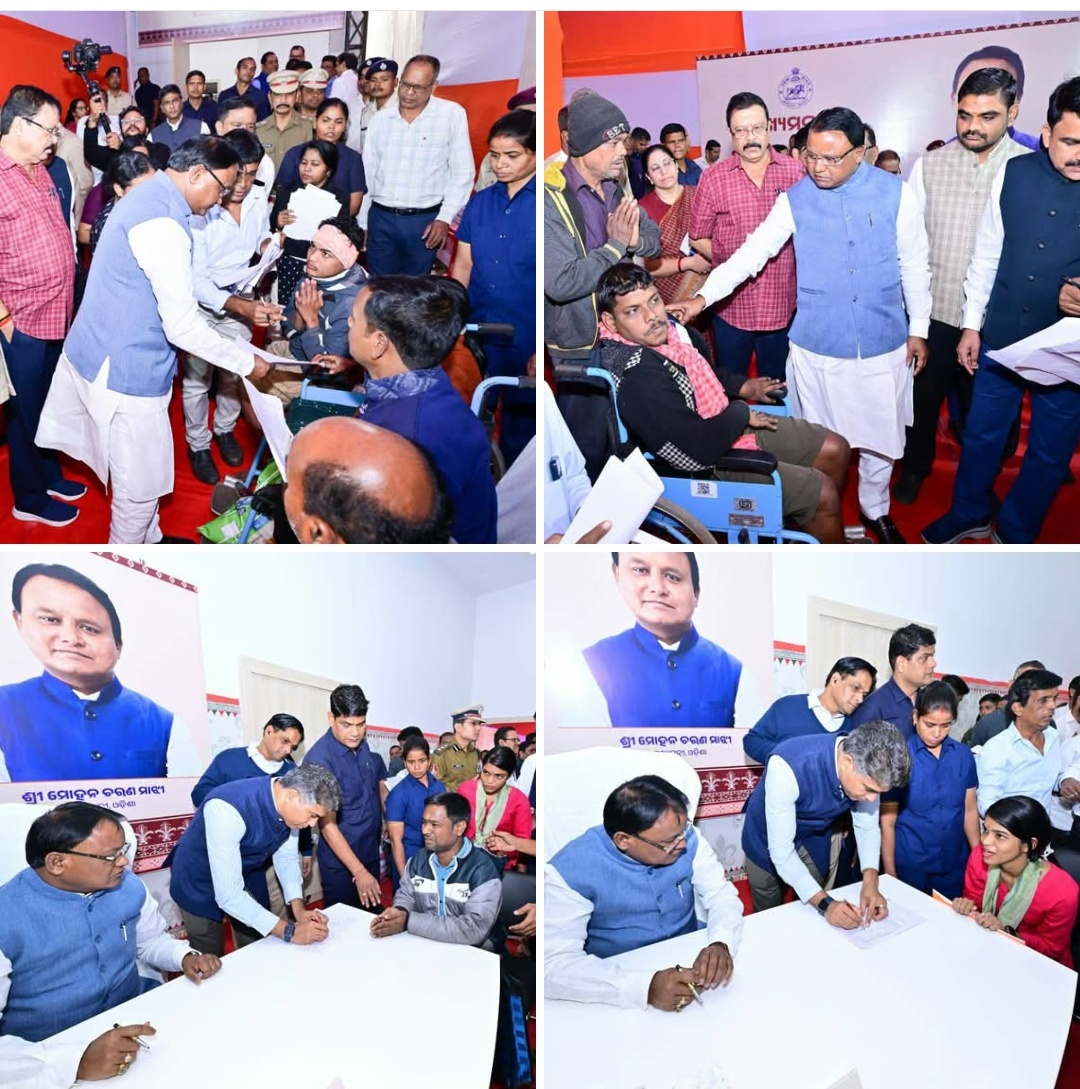
BHUBANESWAR: Odisha Chief Minister Mohan Charan Majhi, who assumed office on June 12, 2024, following the BJP’s victory in the state assembly elections, introduced a structured public grievance redressal system as a cornerstone of his administration. This initiative, often referred to as “public hearings” or the “CM’s Grievance Cell,” allows citizens to directly present their complaints to the CM and senior officials.
The system emphasizes people-centric governance under the “Lokanka Sarkar” (People’s Government) model, aiming to address long-standing issues like land disputes, pension delays, medical aid, infrastructure problems, and administrative inefficiencies. Hearings began on July 1, 2024, and have been held regularly, primarily on Mondays, with sessions extending beyond Bhubaneswar to districts like Sambalpur and Berhampur to improve accessibility. This covers the queried 19-month period from approximately June 2024 to January 2026.
Implementation and Process: The hearings are conducted at the CM’s Grievance Cell in Bhubaneswar, with Majhi personally presiding alongside key ministers and department secretaries. Citizens register complaints in person or via the online “Jana Sunani” portal, which integrates grievances from district-level officials like collectors, SPs, BDOs, and tehsildars. A single-window mechanism enables on-the-spot resolutions for urgent cases, such as financial aid from the Chief Minister’s Relief Fund (CMRF) for medical emergencies (like cancer or kidney treatments). Pending issues are escalated with strict timelines: simple cases resolved within a week, complex ones within 90 days, monitored through district and state-level reviews.
Frequency has varied, with 10 hearings by May 2025, 14 by November 2025, and 16 by January 2026. Sessions accommodate groups (2–15 people per grievance), amplifying reach.The system contrasts sharply with the previous Biju Janata Dal (BJD) government’s approach, which was criticized for being spectacle-oriented and ineffective, contributing to public disillusionment and the BJD’s 2024 defeat.
Key Statistics Over the 19 Months:
Data from various phases shows consistent high disposal rates, though figures differ slightly based on reporting periods and inclusion of portal submissions:
Total Grievances Received:
In-person hearings: Over 14,000 petitions by January 2026, representing grievances from more than 56,000 people. Earlier snapshots include 10,234 by May 2025, 12,950 by November 2025, and 13,358 by December 2025.
Via Jana Sunani Portal and other channels: 1,49,418 by January 2026, with 85,650 overall pleas by May 2025.
Pending Cases: Typically low, lke, 910 out of 12,950 (7%) as of November 2025, and 899 out of 10,306 (8.7%) over 16 months. Complex cases (like 1,34,579 portal grievances) are prioritized for joint district hearings. These numbers indicate a ramp-up in efficiency, with disposal rates improving from 80–83% in mid-2025 to 91–95% by early 2026.
Analysis of Effectiveness and Challenges: The system’s effectiveness stems from Majhi’s personal involvement, which fosters accountability and swift action. High resolution rates demonstrate operational success, with departments empowered for immediate interventions (e.g., CMRF disbursals of ₹30.5 lakh for 24 health cases in one session). The online portal enhances transparency, allowing real-time monitoring.
However, challenges persist: Opposition critiques highlight portal glitches (e.g., website failures), delays in rural areas, and over-centralization at the CM level, potentially overburdening the system and neglecting grassroots mechanisms like district collectors. Critics argue it’s more a political tool for image-building than systemic reform, diverting focus from institutional strengthening. Despite this, the initiative has evolved, with plans for state-wide expansion to decentralize access.
Broader Impact:
On Governance and Public Trust: The hearings have boosted citizen participation and trust, with high volumes reflecting restored faith in government responsiveness. They align with Majhi’s anti-corruption drive (for example vigilance probes yielding 125 cases in 2025) and welfare schemes like Subhadra Yojana, contributing to reduced crimes against women (13.5–29.4% drops in various categories).This has facilitated broader development, including ₹1.36 lakh crore investments creating 74,350 jobs.
Social and Economic Impact: Marginalized groups (tribals, disabled, seniors) benefit from direct access, addressing inequities. Economically, quick resolutions on land and infrastructure issues support growth in sectors like mining and tourism (like Shree Mandir Parikrama revival). Aid for health emergencies has provided tangible relief, enhancing quality of life
Political Impact: As a tribal leader, Majhi’s hands-on style has consolidated BJP’s hold in Odisha, especially in tribal belts, positioning the party for future elections (for example 2029). It counters BJD’s legacy of neglect, projecting the BJP as action-oriented. Public incidents, like Majhi’s accountability in the Puri tragedy (apology, probes, aid), reinforce this image.
Overall, the public hearings have transformed grievance redressal into a powerful governance tool, yielding high efficiency and public goodwill, though sustained decentralization is key for long-term success.