




By Our Correspondent
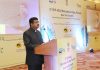
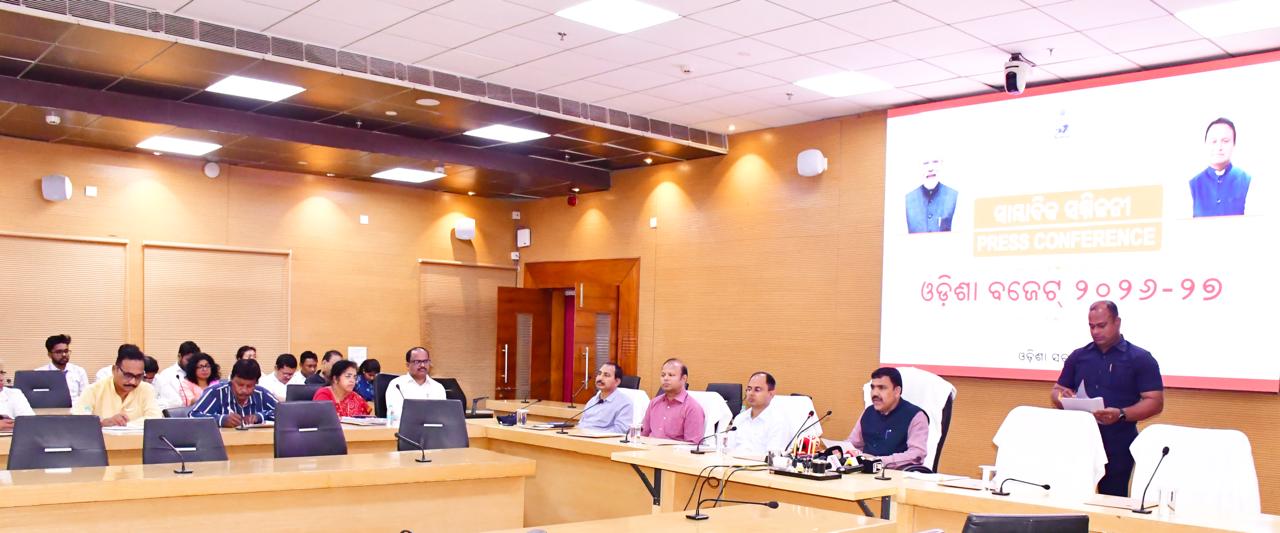
BHUBANESWAR:Minister Shri Nityanand Gand has presented the budget for the financial year 2026-27 for the Department of Scheduled Tribes and Scheduled Castes Development, Minority Communities and Backward Classes Welfare. Addressing a press conference organized on this occasion, Minister Shri Gand expressed the view that the budget has been prepared with the aim of education, livelihood and social upliftment of tribals, Scheduled Castes, Minorities and Backward Classes.
The total expenditure for the department this year is Rs 6649 crore 33 lakh 12 thousand. This includes Rs 5400 crore programme expenditure and over Rs 1249 crore administrative expenditure. This is an increase of about 3 percent over last year’s budget. Out of the programme expenditure in the budget, Rs 3610 crore has been allocated for state level schemes, Rs 190 crore for central level schemes and Rs 1600 crore for centrally initiated schemes.
The government has given special importance to students in the education sector. An expenditure of Rs 2094 crore has been proposed to provide scholarships to about 23 lakh students. Students belonging to Scheduled Castes, Scheduled Tribes and Backward Classes will benefit from this through the Chief Minister’s Merited Students Incentive Scheme and the Central Scholarship Scheme. In addition, the amount of pre-matric scholarship is being increased and more assistance is being provided to students for food and essential items. Currently, 1765 schools are functioning in the state for the improvement of education of tribal and Scheduled Caste students, out of which 1615 are residential and 150 are non-residential schools. About 4 lakh 38 thousand students are studying in these schools. In addition, a total of 5967 hostels are functioning in the state where about 5 lakh 52 thousand students are studying. Additional funds have been provided in the budget for food, textbooks and other facilities of the students.
To reduce the dropout rate, the government is providing an incentive of Rs 5,000 per annum to tribal students after enrolling in class IX and XI under the “Shahid Madho Singh Hatkhar Yojana”. The budget allocation for this scheme is Rs 154 crore. Under the “Anwesha Yojana” to provide quality education, about 20,473 students are studying in 163 private schools in 17 districts. The proposed outlay for this scheme is Rs 158 crore. In addition, free accommodation is being provided to students appearing for competitive examinations under the “Akanksha Yojana”.
For the overall development of the tribal areas, 234 blocks and 7667 villages in 27 districts of the state have been covered through the “Dharti Aba Janjati Gram Unnati Abhiyan”. More than 10 lakh tribal families will benefit from this. More than Rs 325 crore has been allocated for this scheme. Similarly, the “PM Janman” program aims to improve the health, education and livelihood of the underdeveloped tribal community in particular. It is being implemented in 1751 villages in 14 districts of the state. Through the Chief Minister’s Tribal Livelihood Mission, tribal families are being provided assistance for livelihood development through agriculture, livestock, fish farming and small scale industries. With the aim of promoting marriage with Scheduled Castes to strengthen social justice, the government is providing financial assistance of Rs 250,000 to each couple. For this, an online portal named “Sumangal” has been launched.