







By Our Correspondent
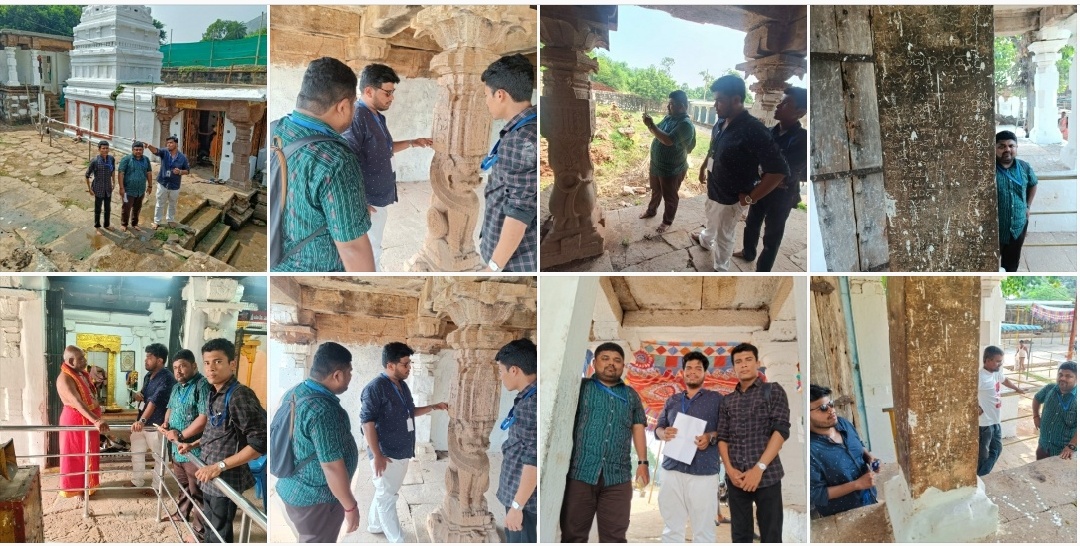
BHUBANESWAR: A stone inscription from the Dharmalingeswar Temple at panchadharla of Andhra Pradesh’s Anakapalli district reveals a glorious victory of combined army of Eastern Gangas & Haiheya Dynasty over the Delhi’s Tughlak dynasty occurred in the 14th Century. The information on this is published in the recently published book ‘Relics of Kalinga in South India, Part-I’ documented by the INTACH Odisha State Chapter. INTACH’s three member’s documentation team comprised of Project Co-ordinator & Author Deepak Kumar Nayak, Epigraphist Bishnu Mohan Adhikari & Surveyor Suman Prakash swain visited the site in November 2024 to list & document this important relics related to Kalinga.
Sharing more information on this inscription, Project Co-ordinator Deepak Kumar Nayak said that this inscription is engraved on three faces of a square black stone panel pillar at the eastern entrance of the temple. The inscription is from the time of Choda III who was a King from Haihaya dynasty. Inscribed in Telugu script and Sanskrit language, it is dated to the Saka Samvata 1325 that equals year 1403 CE. The inscription contains total 93 lines of writings.
As per Epigraphist Bishnu Mohan Adhikari, the verse number 16 from this long inscription tells about the real purpose of the inscription i.e. Choda III built a gopura and laid out a grove at the entrance of the Dharmalingeswara Temple. This confirms the defeat of the defeat of Delhi’s Tughlak dynasty ruler Firoz Shah Tughlak by the hands of Choda II (an ancestor of Choda III) the later being a sub-ordinate ruler under Eastern Ganga King Bhanudeva III of Utkala. He led an army up to Bengal to help the Sultan of Panduva Haji Iliyas at the moment when Firoz Shah Tughlak attacked that kingdom in the year 1353 CE. The great hero Choda II was a chief of Mahismati and belonged to the family of the Sahasrajuna Haihaya.
The Haihaya chieftains waged war against the Muslim forces on behalf of the Eastern Gangas with whom they had matrimonial relationship. After this victory Choda II gifted 22 elephants to the King of Utkala Bhanudeva III and some dancing girls to the Sultan of Panduva Haji Iliyas as Bijayashri (token of victory).
From the inscription it may be further gathered that the Sultan of Panduva (Bengal) gained victory over the emperor of Delhi aided by the King of Orissa. So it is likely that he was a vassal of the ruler of Orissa or a general of his army. The Haihayas of Panchadarla (Year 1200-1403 CE) ruled the regions of Simhachalam and Panchadarla in the south Kalinga during the 12th and 14th centuries CE. Choda I, Upendra, Choda II, Bhima and Choda III are the important kings that ruled for this dynasty.
The book ‘Relics of Kalinga in South India, Part-I’ was released on 27th April this year at Cuttack. It was authored by Deepak Kumar Nayak & jointly edited by Sanjib Chandra Hota (IAS Retd.) and Professor Asoka Kumar Rath. While the first part contains the details on Kalingan relics in five Andhra Pradesh districts Srikakulam, Vizianagaram, Parvatipuram Manyam, Visakhapatnam & Anakapalli, INTACH Odisha State Chapter is planning to complete the documentation in its upcoming volumes that will cover the Kalingan relics in remaining districts of Andhra Pradesh & in other states like Telangana, Karnataka, Tamil Nadu & Maharastra.