







By Our Correspondent
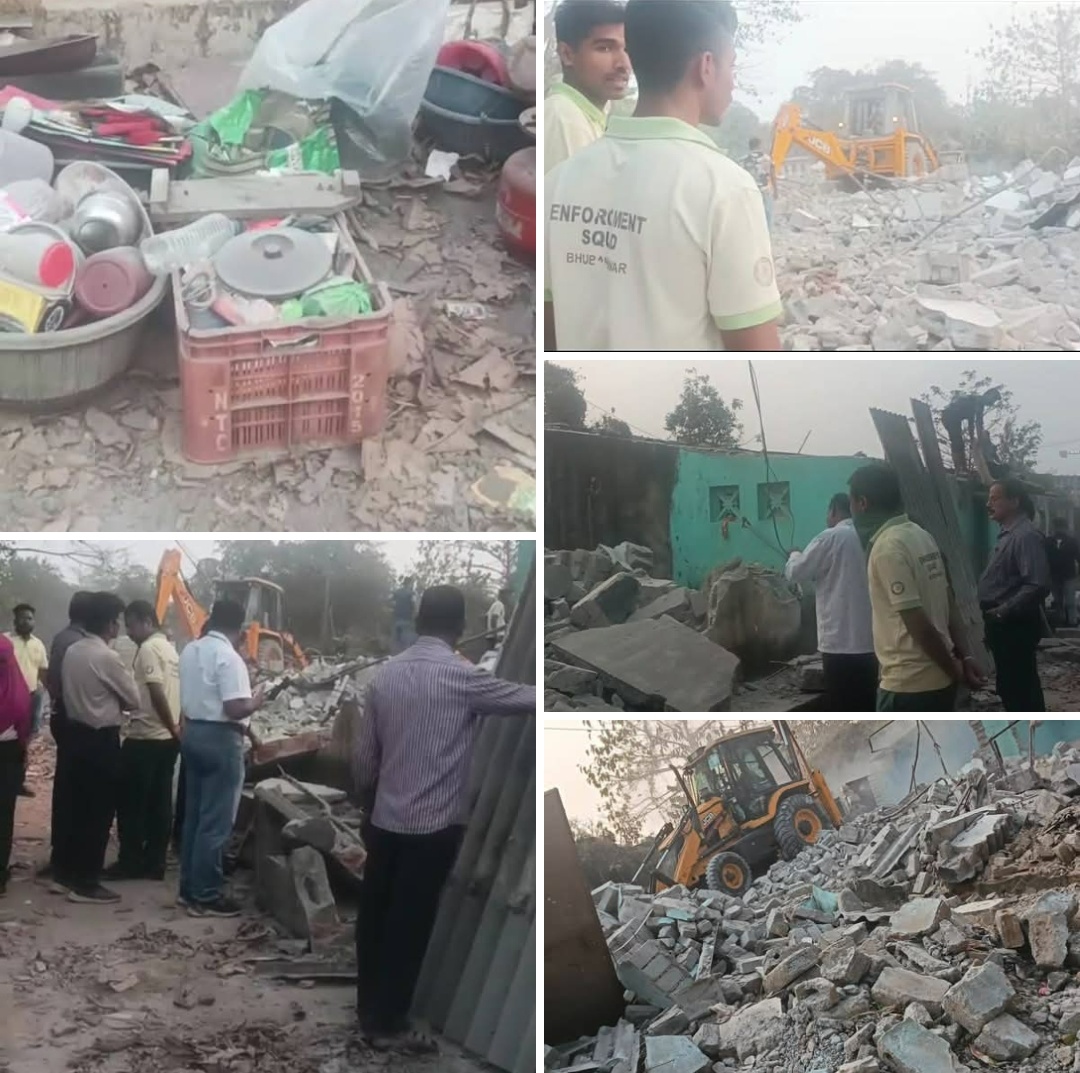
BHUBANESWAR: In a alarming instance of state-sponsored injustice, the Odisha government bulldozed transit houses meant for slum dwellers at Kanyashram, Bhubaneswar, allegedly to provide land for parking for a private luxury hotel.
Under the Rangamatia Improvement Project implemented through the Rajiv Awas Yojana (RAY), the Odisha government spent ₹6620.19 lakh of public funds, including Central Government assistance, to construct 600 dwelling units at Sai Vihar, Gadakana, and 902 transit houses at Kanyashram, Chandrasekharpur for slum dwellers, within the Bhubaneswar Municipal Corporation (BMC) limits; of this, Rs 661.89 lakh was allocated for the transit housing project, which included civic and social infrastructure.
Each transit unit, measuring approximately 10 ft × 10 ft, was built with brick walls and an asbestos roof, and equipped with basic amenities such as water and electricity, while the transit campus also features community toilets and an Anganwadi centre, intended to safeguard slum families from homelessness during eviction and rehabilitation.
However, on February 5, 2026, the BDA–BMC enforcement team demolished nearly 70 transit houses built specifically for the vulnerable slum dwellers. Although a section of Ambatota slum residents living these structures had been relocated to Budha Vihar, Chandrasekharpur, under the Affordable Housing Project, PMAY-U (PPP Vertical), about three families continued to live in the transit houses as government authorities had failed to complete their resettlement.
Shockingly, these families were evicted from transit housing without any prior notice or provision for permanent resettlement. As per policy, slum dwellers displaced from their settlements are to be temporarily accommodated in transit housing until permanent resettlement is ensured. This raises a critical question: where are they expected to seek shelter if they are evicted from transit houses without being permanently resettled?
The Supreme Court of India has consistently held that the right to shelter is an integral component of the right to life under Article 21. In Olga Tellis v. Bombay Municipal Corporation (1985) 3 SCC 545, the Apex Court ruled that eviction of pavement and slum dwellers without notice, hearing, and alternative accommodation deprives them of their livelihood and dignity, amounting to a constitutional violation.
Similarly, in Chameli Singh v. State of U.P. (1996) 2 SCC 549, the Court emphasized that the right to shelter includes adequate living space and protection from arbitrary deprivation. Therefore, forcible eviction from transit houses without ensuring permanent resettlement by the government constitutes a violation of constitutional fundamental rights as well as human rights.
Further, the family of Sri Damburudhar Swain from Ambatota slum had already paid its beneficiary contribution under the Affordable Housing Project (PMAY-U) and had been shown an allotted flat on paper through a lottery draw. Despite fulfilling all required formalities, the family was forcibly evicted without the issuance of a final allotment letter or delivery of the house keys for lawful possession.
Sources indicate that the allotment letters and keys are to be handed over to the heads of beneficiary families by the Hon’ble Chief Minister; however, the programme has yet to be scheduled. In the meantime, residents currently living in remaining transit housing (more than 800 transit units) remain anxious, fearing further evictions amid the looming threat of government bulldozers.
Public shelters built for the poorest citizens were destroyed, not because they were unsafe or unused, but because the land is reportedly being handed over to a private commercial interest. The demolition has sparked allegations that the land is being handed over to the Mayfair Hotel for parking, raising serious concerns that the government is prioritising private luxury interests over the fundamental right to housing for the poor.
Human rights defenders, social activists, and slum-dweller leaders argue that the demolition not only wastes public funds but also undermines the very purpose of welfare housing schemes meant to protect the most vulnerable, and they have warned that they will stage protests unless the destroyed transit houses are restored on the same land.
Official Record Source : Revised DPR ( Please refer Page no. 2 of the pdf file – Rs 661.89 lakh for 902 transit house at Sl no. 2 and Rs 6620.19 at G.Total )