








By Our Correspondent
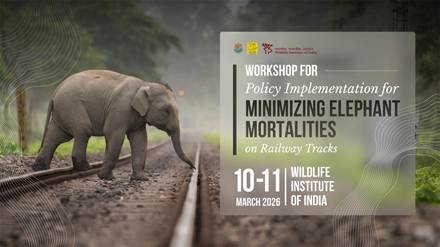
BHUBANESWAR:The Project Elephant Division of the Ministry of Environment, Forest and Climate Change (MoEFCC), in collaboration with the Wildlife Institute of India, organized a two-day national workshop on “Policy Implementation for Minimizing Elephant Mortalities on Railway Tracks” at the Wildlife Institute of India (WII), Dehradun, on 10-11 March 2026. The event brought together 40 participants, including senior representatives from MoEFCC’s Project Elephant Division, Ministry of Railways, Forest Departments of elephant-range states and leading conservation scientists. Key railway zones represented included East Central Railway, East Coast Railway, North Eastern Railway, North East Frontier Railway, Northern Railway, South Eastern Railway, Southern Railway and South Western Railway.
India harbours more than 60% of the global Asian Elephant population, with major habitats spanning eastern, northeastern, southern and central regions. However, increasing habitat fragmentation and expansion of railway infrastructure across elephant habitats have led to a rise in elephant mortalities on railway tracks, particularly in states such as Assam, West Bengal, Uttarakhand, Odisha, Tamil Nadu, Karnataka, Kerala, Chhattisgarh and Jharkhand. The workshop aimed to strengthen coordination between conservation and infrastructure sectors and to promote science-based mitigation strategies.
In an effort to address rising instances of wildlife mortality on railway tracks, MoEFCC, in partnership with WII and the Ministry of Railways, has identified 110 sensitive railway stretches across elephant ranges and 17 additional stretches in two tiger-range states.
Comprehensive joint field surveys – conducted by teams from Project Elephant, WII, State Forest Departments, and Indian Railways – evaluated site-specific ecological conditions and proposed targeted mitigation measures tailored to each location. Based on a detailed assessment of 127 railway stretches covering 3,452.4 km, 77 stretches spanning 1,965.2 km across 14 states were prioritised for mitigation, considering wildlife movement patterns and the risk of animal mortality.
The recommended mitigation package for these priority stretches includes 503 ramps and level crossings, 72 bridge extensions and modifications, 39 fencing or trenching structures, 4 exit ramps, 65 new underpasses and 22 overpasses, amounting to a total of 705 mitigation structures designed to facilitate safe wildlife passage and reduce collisions.
In addition to these proactive measures, several new railway lines and expansion projects – including track doubling and tripling – have incorporated wildlife-friendly infrastructure. Notable examples include the Gevra Road-Pendra Road railway line passing through the Achanakmar-Amarkantak elephant corridor in Chhattisgarh; the Darekasa-Salekasa railway track tripling project and the Nagbhid-Itwari gauge conversion project in Maharashtra, and the Wadsa-Gadchiroli railway line intersecting the Kanha-Navegaon-Tadoba-Indravati tiger corridor in Maharashtra.
A particularly significant intervention is planned along a 3.5-km sensitive stretch of the Azara-Kamakhya railway line in Assam, intersecting the Rani-Garbhanga-Deepor Beel elephant corridor where several elephant mortalities had occurred in the past. This section will be elevated to enable safe elephant movement across the corridor.
Several technology-based solutions are also being tested and implemented to prevent wildlife–train collisions. One notable innovation is the Distributed Acoustic System (DAS)-based Intrusion Detection System (IDS) being deployed along sensitive railway stretches across elephant landscapes. Pilot installations have been successfully commissioned in four sections under the North East Frontier Railway, covering a total of 64.03 km of elephant corridors and 141 km of railway block sections in Assam. The system is now being replicated in sensitive railway sections in North Bengal and in parts of Odisha under the East Coast Railway.
Another promising intervention is the AI-based early-warning system deployed at Madukkarai in Tamil Nadu, which uses a network of 12 tower-mounted cameras equipped with thermal and motion-sensing technology. The system detects elephant movement within 100 metres of railway tracks and automatically alerts forest and railway officials, enabling trains to slow down and allowing elephants to cross safely.
The workshop included technical sessions on elephant ecology, infrastructure planning and biodiversity conservation, stressing the need for joint planning where railways cross wildlife corridors. Participants examined state-level data, case studies and key collision drivers – habitat fragmentation, land-use changes, train speeds, night operations and seasonal elephant movements.
Regional working groups reviewed mitigation efforts across major landscapes (Shivalik-Gangetic Plains, Central India & Eastern Ghats, North-East India, Western Ghats), identified gaps and suggested landscape-specific strategies. Best practices shared included early-warning systems, sensor/AI detection technologies, GIS monitoring and community-based alert and patrolling networks.
The workshop emphasised stronger coordination among railway authorities, forest departments and scientific institutions, along with standardised protocols for risk assessment, monitoring and rapid response. Discussions reinforced national consensus on collision hotspots and priority stretches, calling for enhanced early-warning systems, dedicated crossings, better signage and improved data sharing.
Participants highlighted research priorities (AI detection, remote sensing) and contributed recommendations for a national roadmap under Project Elephant and the Ministry of Railways to minimise elephant-train collisions through science-based, collaborative action.