By Our Correspondent
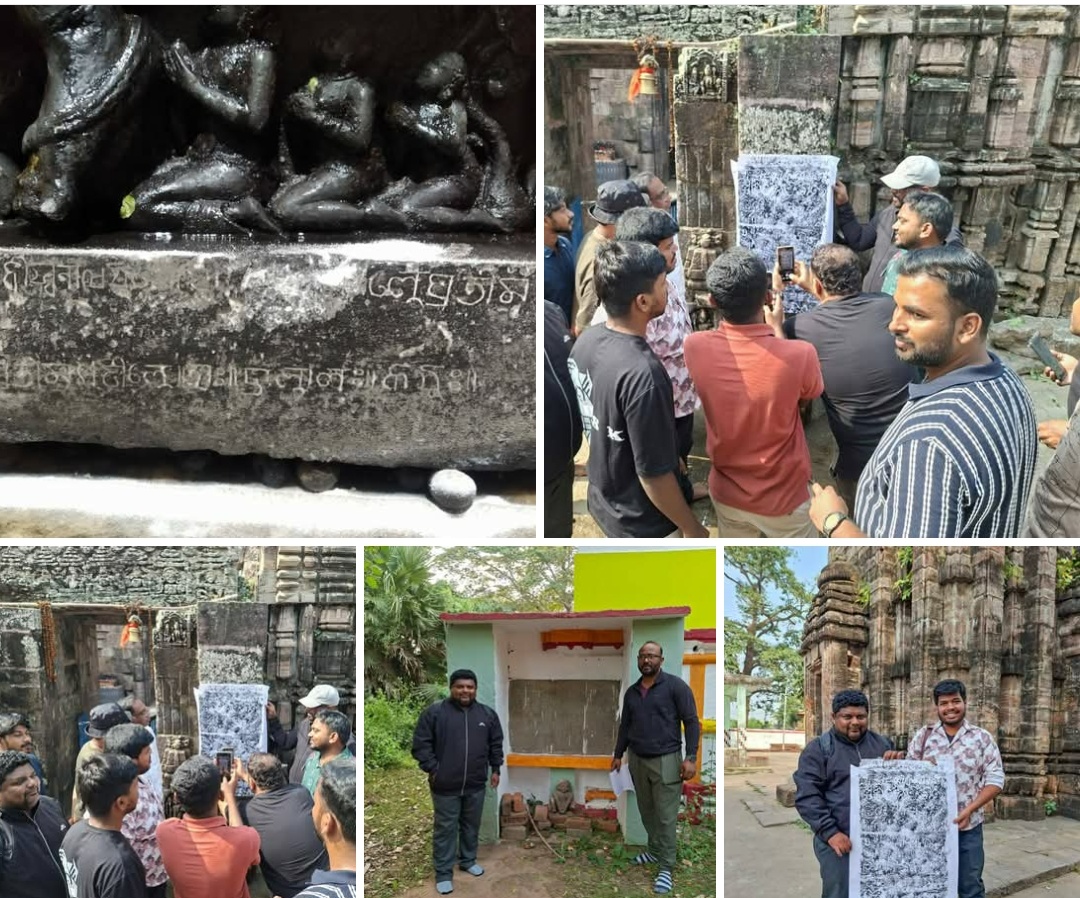
BHUBANESWAR:Ancient stone inscriptions belonging to the period of the Ganga and Suryavamsi Gajapati rulers have been found in the Birupa-Chitrotpala river basin of Odisha. On Sunday, 30 November, a joint archaeological survey was conducted in the Birupa river valley by the members of Rediscover Lost Heritage (RLH) Group, Silver City Cuttack (SCC) Public Charitable Trust, and Kalinga Epigraphical Research Society (KERS).
The parilticipants in this heritage exploration included history researcher Deepak Kumar Nayak, epigraphist Bishnumohan Adhikari, and heritage enthusiasts Bijaya Kumar Mahapatra, Bikram Kumar Nayak, Suman Prakash Swain, Nrupati Nihar Sial, Debiprasad Dhar, Omprakash Panda, Akash Pattanayak, Polki Apala Raju, among others. The team visited Gopinathpur, Kisinapur, Bhadreswar, Kendupatana, and other locations in the Birupa-Chitrotpala River basin and collected information on the ancient inscriptions of the Ganga and Suryavamsi Gajapati era found there.
As part of this survey, the group has announced that, for the first time, they have successfully deciphered an ancient inscription carved on the pedestal of the main idol at the Lakshminarayan Temple of Kendupatana.
Providing further details on the reading of the Kendupatana Lakshmi Narayan idol inscription, epigraphist Bishnu Mohan Adhikari stated that two lines of inscription were visible on the pedestal. They have been deciphered as follows:
Line 1: Śrībīsvanātha ___ le pratīma
Line 2: E pratīma gaḍhile || aḥ || Dulālaḥ || ka(rū)raḥ ||
Although portions of the inscription are damaged, it is engraved in a mixture of Odia and Sanskrit language. Based on paleographic study, Shri Adhikari suggests the inscription likely belongs to the 14th–15th century CE.
Heritage researcher Deepak Kumar Nayak opined that the Kendupatana inscription may date to the reign of the Ganga ruler Narasimhadeva IV. Narasimha Deva IV ruled from 1377 to 1414 CE. The individual named “Śrīviśvanātha” mentioned in the inscription may be identified with Śrīkaraṇa Biśvanātha Mahāsenāpati, who served as the ‘Chaturdiga Dandaparichha’ during that period.
The name of Biśvanātha Mahasenapati, a resident of Varanasi Kataka (present-day Cuttack), also appears in the 1381 CE inscription at Varaha Lakshmi Narasimha Temple of Simhachalam of Andhra Pradesh and in the 1394 CE Bahanasthamba inscription of Siddheswar Temple at Jajpur. Similarly, the ‘Dulāla Kara’ mentioned in this inscription was likely the sculptor or maker of the Lakshminarayan idol. A copper plate grant dating to the reign of Ganga ruler Narasimhadeva II was discovered a few decades ago near the same temple, further indicating the historical significance of this region during the Ganga period, said Shri Nayak.
Rediscover Lost Heritage (RLH) Group’s founder member Bikash Prasad Das stated that the research team has collected detailed information on the Kendupatana inscription along with others inscriptions of the time of Gajapati Kapilendra Deva at Gopinathpur and Anangabhimadeva III at Chateswar temple of Kisinapur. Additionally, an estampage (inked impression) of an inscription at Bhadreshwar Temple has been obtained by the researchers. Shri Das informed that a detailed compilation of all these findings will be published soon in a forthcoming book.